 ultimate-guide
Same-Day Full Arch Implants: Complete Process Guide
Table of Contents
- What Are Same-Day Full Arch Implants?
- The Step-by-Step Procedure
- Candidates for Full Mouth Dental Implants
- Full Arch Dental Implant Recovery Timeline
- Cost of Same Day Full Arch Implants
- Benefits and Advantages Over Traditional Options
- Potential Risks and What to Expect
- Post-operative Care and Long-term Maintenance
- Frequently Asked Questions
Last Updated: September 2, 2026
What Are Same-Day Full Arch Implants?
Same-day full arch implants replace all missing teeth in one arch (upper or lower jaw) with a complete set of fixed teeth in a single appointment. Unlike traditional implant procedures spanning months or years, patients leave the dental office with a functional prosthesis the same day extraction and implant placement occur.
The procedure combines three critical components: surgical extraction of remaining teeth, placement of multiple implants into the jawbone, and attachment of a custom-fabricated prosthesis. At Trinity Dental Arts, our board-certified implantologist leverages advanced digital planning and in-house laboratory capabilities to execute this complex procedure with precision.
The key innovation is "immediate loading", rather than waiting months for osseointegration (the biological process where bone fuses to the implant surface), patients receive a temporary or definitive prosthesis the same day. This dramatically reduces the psychological and functional burden of tooth loss while maintaining biological integrity.
The Step-by-Step Procedure
Pre-operative Assessment and Planning
Comprehensive clinical assessment determines candidacy and guides surgical planning. Your dental team evaluates bone height, width, and density in areas where implants will be placed, as many patients have experienced significant bone resorption after years of missing teeth.
The American Academy of Implant Dentistry guidelines recommend cone beam computed tomography (CBCT) scans for three-dimensional visualization that allows precise implant positioning. Digital treatment planning software maps implant positions virtually, determines optimal angles and depths, and fabricates the prosthesis before surgery begins, making same-day delivery possible.
Your surgeon will discuss anesthesia options during this phase. Local anesthesia with intravenous sedation is common for full arch procedures, allowing comfort throughout the 3-4 hour surgical appointment.
Tooth Extraction and Implant Placement
On surgery day, the procedure begins with careful extraction of remaining natural teeth using atraumatic techniques designed to preserve maximum bone structure. Implants are then placed into predetermined positions, typically ranging from four to six implants per arch.
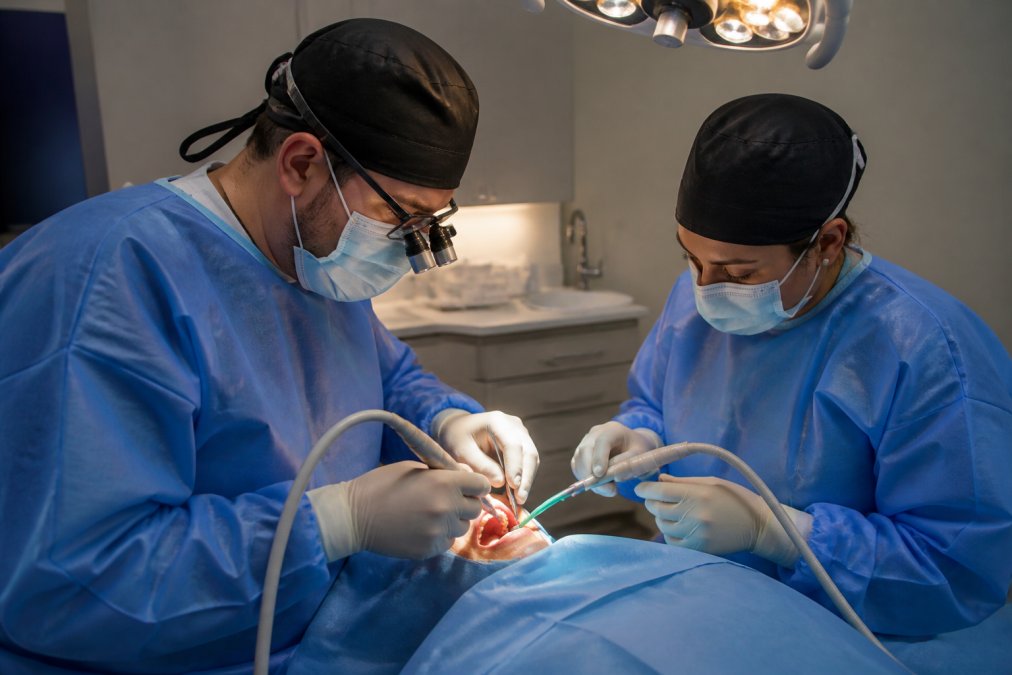
Implants are constructed from titanium, a biocompatible material that integrates reliably with bone tissue. Your surgeon assesses implant stability immediately after placement; insertion torque helps predict whether immediate loading is appropriate.
Bone grafting occurs if needed. When extraction sites show insufficient bone volume, grafting material fills gaps to ensure adequate implant support. This material may be autogenous (from your own bone), allogeneic (from a donor), or synthetic.
Prosthesis Fabrication and Attachment
The prosthesis has typically been fabricated before surgery based on pre-operative imaging and treatment planning, allowing immediate attachment after implant placement.
The prosthesis may be temporary or definitive depending on your situation. A temporary prosthesis made from acrylic resin allows immediate function while bone integrates around implants. Once osseointegration is complete (typically 3-6 months), a definitive prosthesis made from durable materials like porcelain-fused-to-zirconia replaces it.
Attachment involves securing the prosthesis to implants using abutments, connector pieces that link implants to the prosthesis. Your surgeon ensures proper fit, bite alignment, and esthetic appearance before completing the procedure.
Candidates for Full Mouth Dental Implants
Ideal candidates have sufficient jawbone height and width to support implants without extensive bone grafting. Patients with moderate to severe bone loss may still qualify, though bone grafting may extend the timeline beyond same-day delivery.
Overall health significantly influences candidacy. Uncontrolled diabetes, active smoking, and certain medications affecting bone healing can compromise implant success rates. Controlled medical conditions and commitment to post-operative care substantially improve outcomes.
Psychological readiness matters as well. Same-day full arch implants demand active participation in post-operative care, dietary modifications, and follow-up appointments. Age is not a barrier, healthy patients in their 60s, 70s, and beyond successfully receive same-day full arch implants.
Full Arch Dental Implant Recovery Timeline
Immediate Post-operative Period
The first 24 hours after surgery are critical. Swelling, discomfort, and bleeding are normal. Most patients experience peak swelling 48-72 hours after surgery, then gradual improvement over the following week.
Pain management typically involves prescription or over-the-counter analgesics as directed by your surgeon. Ice application during the first 24 hours reduces swelling. Keeping your head elevated minimizes fluid accumulation.
Dietary restrictions are strict immediately after surgery. Soft foods, smoothies, and cool beverages are appropriate for the first week. Avoid hot foods and beverages, which can increase bleeding.
Oral hygiene requires careful attention. While keeping the surgical area clean is important, aggressive rinsing or brushing near implant sites can disrupt healing. Your surgeon will provide specific instructions for gentle cleaning and antimicrobial rinses.
First Weeks and Months
By week two, most patients experience significant improvement in swelling and discomfort. Many patients return to light work or normal daily activities by the second or third week.
Dietary progression occurs gradually. By week three or four, most patients tolerate soft cooked foods, eggs, fish, and tender meats. Hard, crunchy, and sticky foods remain off-limits during early healing.
The temporary prosthesis requires adjustment and refinement during this period. Follow-up appointments at one week, two weeks, and monthly intervals allow your surgeon to assess healing, adjust bite relationships, and address concerns.
Long-term Healing and Osseointegration
Osseointegration continues for 3-6 months after surgery. During this period, implants gradually bear more biting forces as bone density increases. Your surgeon may recommend dietary restrictions during early osseointegration to avoid excessive force on healing implants.
By three months, most patients enjoy nearly normal function with their temporary prosthesis. At 3-6 months, once osseointegration is complete, the temporary prosthesis is replaced with the definitive prosthesis. This marks the completion of active treatment and the beginning of the long-term maintenance phase.
Cost of Same Day Full Arch Implants
The financial investment varies considerably based on individual anatomy, number of implants required, bone grafting needs, and prosthesis materials.
Insurance coverage for implant dentistry varies widely. Many insurance plans classify implants as restorative rather than cosmetic, which may result in partial coverage. Trinity Dental Arts recommends reviewing your insurance documentation or contacting your plan directly to understand your specific coverage.
Financing options often make same-day full arch implants more accessible. Many dental practices offer payment plans, and third-party financing companies can spread payments over time.
Benefits and Advantages Over Traditional Options
Same-day full arch implants offer compelling advantages compared to traditional dentures, removable partial dentures, or conventional multi-stage implant approaches.
Functional restoration is immediate. You leave the dental office with fixed teeth that function for eating, speaking, and smiling, reducing the psychological and social impact of tooth loss.
Fixed teeth eliminate the daily maintenance burden of removable dentures. Brushing and flossing your implant-supported prosthesis follows normal oral hygiene routines.
Bone preservation represents a significant long-term advantage. Removable dentures rest on bone that gradually resorbs over time. Implants stimulate bone through functional loading, preserving bone structure and maintaining facial height and contours.
Speech and eating comfort improve substantially. Fixed teeth don't shift during speech or eating. Biting force capacity increases dramatically, implant-supported prostheses can withstand forces comparable to natural teeth, whereas dentures typically tolerate only 25% of natural biting force.
Esthetic outcomes often exceed what removable dentures achieve. Your surgeon and laboratory team can design prostheses that match your facial features, lip support, and smile line precisely.
Potential Risks and What to Expect
Like all surgical procedures, same-day full arch implants carry risks that patients should understand before treatment.
Surgical complications, though uncommon, can occur. Excessive bleeding, infection, and nerve injury are rare but possible. Sinus perforation, breakthrough into the sinus cavity during upper jaw implant placement, occurs in a small percentage of cases and typically requires immediate repair.
Implant failure represents the most significant long-term risk. While implant success rates are high, some implants fail to integrate with bone or fail years after successful integration. Smoking, uncontrolled diabetes, and poor oral hygiene substantially increase failure risk.
Bone loss around implants can occur if oral hygiene is inadequate or if excessive biting forces are applied before osseointegration is complete. This progressive bone loss, called peri-implantitis, can compromise implant stability and longevity.
The temporary prosthesis may not feel or function identically to your eventual definitive restoration. Adjustments and refinements during the healing phase are normal and expected.
Allergic reactions to implant materials are extremely rare, as titanium is highly biocompatible.
Post-operative Care and Long-term Maintenance
Long-term success depends entirely on consistent post-operative care and maintenance habits established immediately after surgery.
Oral hygiene is non-negotiable. Brush your prosthesis and remaining natural teeth twice daily with a soft-bristled toothbrush. Floss or use specialized implant cleaning tools daily to remove plaque from areas your toothbrush cannot reach.

Dietary habits influence long-term implant health. While your definitive prosthesis can handle most foods, extremely hard items like whole nuts, hard candies, or ice should be avoided.
Regular professional monitoring is essential. Professional cleanings every three to six months allow your dental team to assess implant health, remove plaque and tartar that home care cannot eliminate, and identify early signs of complications.
Smoking and tobacco use substantially compromise implant longevity. Tobacco impairs bone healing, increases infection risk, and accelerates bone loss around implants.
Maintaining good control of chronic health conditions, particularly diabetes, protects your implant investment.
The prosthesis itself may require maintenance or replacement over time. Planned replacement every 10-15 years is common, though individual timelines vary based on material selection and wear patterns.
Same-day full arch implants represent a transformative solution for patients with severe tooth loss who seek immediate functional and esthetic restoration. For appropriate candidates, the outcomes justify the investment. At Trinity Dental Arts, our board-certified implantologist combines advanced surgical expertise with in-house laboratory precision to deliver same-day full arch implants that restore not just your teeth, but your confidence and quality of life. Schedule a comprehensive consultation to determine whether this approach aligns with your individual needs and goals.
Frequently Asked Questions
How does the same-day full arch implant process work?
Same-day full arch implants replace an entire row of missing teeth in one appointment. The procedure involves extracting remaining teeth, placing implants into the jawbone, and attaching a custom-made prosthesis (fixed bridge) the same day. This immediate loading approach allows you to leave with functional, permanent-looking teeth. The implants then integrate with your jawbone over several months through osseointegration, creating a stable foundation for long-term function.
Who is a candidate for full mouth dental implants?
Candidates for full mouth dental implants typically have adequate jawbone density, good overall health, and realistic expectations about the procedure. You should have healthy gums, be a non-smoker or willing to quit, and commit to excellent oral hygiene. Those with significant bone loss may require bone grafting or sinus lift procedures before implant placement. A clinical assessment and CBCT scan by an oral surgeon or implant dentist determines your eligibility and guides your comprehensive treatment plan.
What is the full arch dental implant recovery timeline?
Recovery occurs in phases. The immediate post-operative period involves swelling and discomfort for 3-5 days, managed with ice and prescribed pain medication. Most people resume normal eating within 1-2 weeks with soft foods. Full osseointegration, where implants fuse to the jawbone, typically takes 3-6 months. During this time, your temporary prosthesis may be adjusted. Once osseointegration is complete, your permanent fixed bridge provides stable, long-term function. Regular follow-up appointments monitor healing and implant stability.
How much do same-day full arch implants cost?
Pricing for same-day full arch implants depends on individual factors including jawbone condition, number of implants needed, whether bone grafting is required, and the materials used for the prosthesis. Costs vary based on your specific clinical needs and treatment plan. Contact Trinity Dental Arts for a personalized quote after your consultation, or visit the practice website for current pricing information and financing options.
Are same-day full arch implants permanent?
Same-day full arch implants are designed to be a permanent solution. The titanium implants integrate with your jawbone through osseointegration and can last a lifetime with proper care. The prosthesis (fixed bridge) typically lasts 10-15 years or longer depending on materials and maintenance. Unlike dentures, implants don't require removal for cleaning. However, they do require commitment to oral hygiene, regular dental visits, and avoiding habits like smoking to maintain long-term success.
What's the difference between same-day implants and traditional dentures?
Same-day full arch implants are fixed permanently in your mouth and function like natural teeth, preserving jawbone structure through the stimulus of chewing. Dentures rest on your gums and must be removed daily for cleaning, causing gradual bone loss over time. Implants offer superior stability, comfort, and eating ability. Dentures may shift while eating or speaking and require ongoing adjustments. While implants have higher upfront costs, they provide better long-term value, improved quality of life, and maintained facial structure.
What should I eat during full arch implant recovery?
Immediately after surgery, stick to cold soft foods like ice cream, yogurt, and smoothies for the first 3-5 days to reduce swelling. Progress to warm soft foods such as mashed potatoes, soup, scrambled eggs, and oatmeal during weeks 1-2. Avoid hot foods, hard foods, sticky foods, and anything requiring significant chewing for at least 2 weeks. By week 3-4, you can gradually introduce more substantial soft foods. Once your surgeon clears you, typically after several weeks, you can return to normal eating. Always follow your surgeon's specific dietary guidance.
What happens if an implant fails after same-day placement?
Implant failure is uncommon but can occur due to infection, poor osseointegration, or inadequate bone support. Early signs include persistent pain, swelling, or implant movement. Your implant dentist will monitor healing at follow-up appointments to catch issues early. If an implant fails, it can typically be removed and replaced after the bone heals, usually 3-6 months later. Choosing an experienced oral surgeon and following post-operative care instructions significantly reduces failure risk. Discuss your surgeon's experience and approach to complications during your consultation.
This article was written using GrandRanker