 ultimate-guide
8 Oral Health Benefits of Full Mouth Restoration
Last Updated: October 25, 2026
Quick Summary
Full mouth restoration rebuilds every tooth in the upper and lower arches, restoring bite, function, and appearance at the same time. It spreads chewing forces evenly, protects remaining teeth and jawbone, and corrects occlusion so restorations last longer. Implants replace missing roots and preserve the bone that supports them.
- Full mouth restoration is a coordinated sequence of treatments, not a single procedure.
- Gum disease is treated before implants because placing implants into untreated periodontal disease undermines results.
- Bone grafting must heal before implant placement, and implants need integration time before final restorations.
- Soft tissue from extractions or implant placement typically settles within a couple of weeks.
- Ask for an itemized plan, since quotes for full mouth restoration are rarely comparable without the procedure list.
Table of Contents
- What Full Mouth Restoration Actually Rebuilds
- The Oral Health Benefits That Go Beyond a Better Smile
- Full Mouth Restoration Procedures: What Treatment May Include
- Full Mouth Restoration Candidates: Who Benefits Most
- Full Mouth Restoration Pros and Cons
- Full Mouth Restoration Recovery Time and Maintenance
- Planning Your Full Mouth Restoration Consultation
- Frequently Asked Questions
What Full Mouth Restoration Actually Rebuilds
Full mouth restoration is a comprehensive dental treatment plan that rebuilds every tooth in the upper and lower arches, restoring bite, function, and appearance at the same time. You can see our full mouth restoration in Trinity, FL and what it includes.
It is not a single procedure. It is a coordinated sequence of treatments, from implants and crowns to periodontal care, sequenced so each stage supports the next. That planning is the part most guides skip.
Restoration Versus Reconstruction: A Distinction That Matters
The two terms get used interchangeably, but they describe different scopes of work. Full mouth restoration typically refers to rebuilding damaged, worn, or missing teeth to restore normal function and appearance, often using crowns, bridges, veneers, and implants. Full mouth reconstruction usually implies a broader correction of the bite itself, including jaw position, occlusion, and the relationship between the upper and lower arches.
In practice, most comprehensive cases blend both. A patient with worn enamel, a collapsed bite, and two missing molars needs the teeth rebuilt and the bite reorganized. That is why we assess the whole system, not just the individual teeth.
The Oral Health Benefits That Go Beyond a Better Smile
The cosmetic payoff gets the attention, but the functional gains are what hold up over decades. Rebuilding a full arch changes how force distributes through every remaining tooth, which is where the long-term value sits.
Chewing, Speech, and Bite Alignment
Restoring chewing function is usually the first thing patients notice. Missing or damaged teeth force people to shift food to one side, which overloads the remaining teeth and accelerates wear.
Speech improves in ways patients do not always expect.
Occlusion, the way the upper and lower teeth meet, drives much of this. When the bite is off, teeth wear unevenly, jaw joints take extra load, and restorations fail faster.
Protecting Remaining Teeth and Jawbone
Every missing tooth changes the bone around it.
Saving remaining natural teeth matters just as much. When a damaged tooth is restored early with a crown or filling, the decay stops spreading and the tooth stays in service.
Full Mouth Restoration Procedures: What Treatment May Include
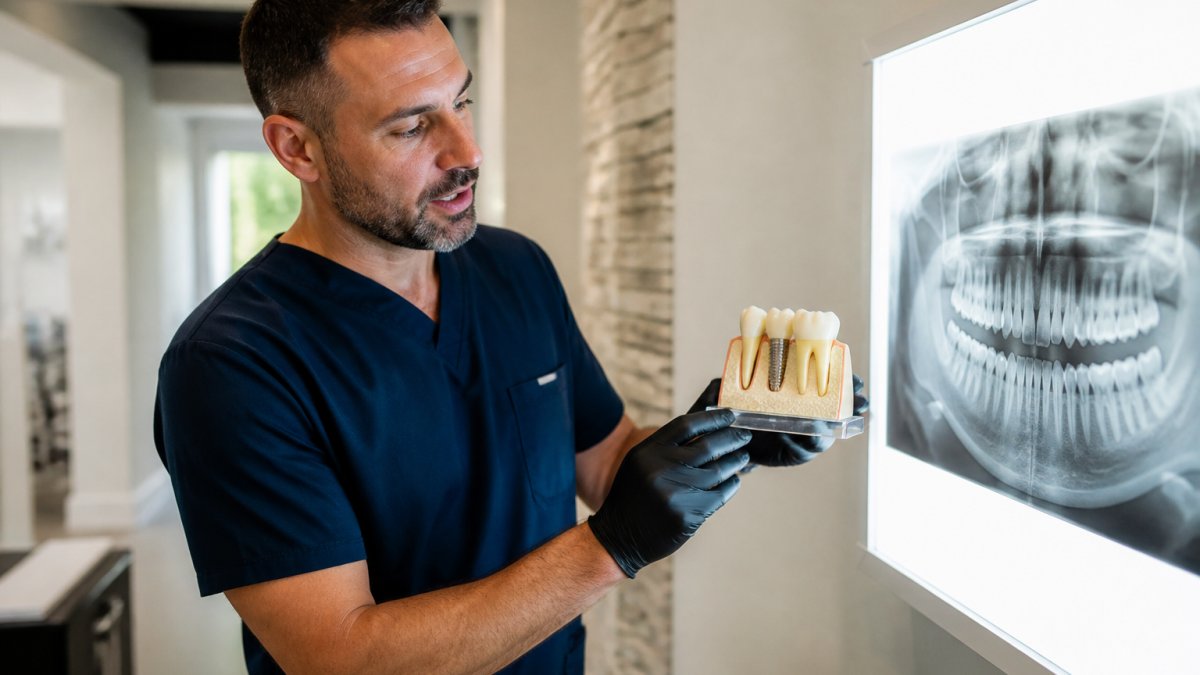
Treatment is built from a menu, and no two plans look the same. A typical comprehensive treatment plan may combine dental implants, implant-supported dentures or fixed full-arch teeth, crowns, bridges, fillings, periodontal therapy, and occasionally extractions or bone grafting. Each element is chosen for a specific problem, then sequenced so healing supports the next stage.
The sequence usually follows a logic: address active disease first, then rebuild structure, then restore function and appearance. Gum disease gets treated before implants go in, because placing implants into untreated periodontal disease undermines the result. Bone grafting, when needed, has to heal before implant placement.
How a Personalized Plan Is Actually Built
Most guides stop at the procedure list. The part that determines whether treatment succeeds is the planning sequence, and it follows a repeatable order:
- Full examination and records. A comprehensive exam, periodontal probing, bite analysis, and imaging, typically a panoramic radiograph and, when implants are being considered, a cone-beam CT scan to measure bone volume in three dimensions. Photographs and study models document the starting point.
- Diagnosis and problem list. Every issue gets written down and ranked: active decay, periodontal pockets, non-restorable teeth, missing teeth, occlusal wear, and esthetic concerns. This list, not the procedure menu, drives the plan.
- Prioritization of urgent issues. Active infection, uncontrolled gum disease, and teeth with a poor long-term prognosis are handled first. A tooth that cannot be saved is extracted early rather than restored and lost later.
- Sequencing by healing biology. Extractions and bone grafts need healing time before implants; implants need integration time before final restorations. Provisional restorations are used during healing so the patient can function and so the clinician can verify the bite before committing to final teeth.
- Staging for cost and tolerance. When a plan is large, it is often divided into phases so the patient can spread investment and recovery over time without abandoning the overall goal.
The Procedures in Context
- Dental implants and implant-supported restorations replace missing roots and support fixed or removable teeth; they are usually placed after periodontal disease is controlled and bone volume is confirmed.
- Crowns and bridges rebuild damaged teeth and replace missing ones by anchoring to adjacent teeth or implants.
- Fillings and endodontic treatment address decay and infection in teeth that can be saved.
For a detailed walkthrough of each procedure and how the stages fit together, see our guide to the full mouth restoration procedure.
Full Mouth Restoration Candidates: Who Benefits Most
The strongest candidates share a pattern: widespread damage that single-tooth fixes cannot solve.
Candidacy is not just about the mouth. Medical history matters, including conditions that affect healing and medications that influence bone metabolism. Smoking status, bone volume, and gum health all shape what is realistic.
Age is rarely the deciding factor. Adults in their 40s and adults in their 70s both pursue full mouth restoration successfully; what differs is the plan, the healing timeline, and how much preparatory work is needed.
Full Mouth Restoration Pros and Cons
The honest case for full mouth restoration is durability and function. Rebuilt arches let people eat what they want, speak clearly, and stop managing a mouth that is failing piece by piece.
The honest case against is commitment. Treatment takes multiple appointments over months, involves surgery in most cases, and requires real recovery time. It also demands maintenance: hygiene appointments, careful home care, and attention to habits like grinding.
What Actually Drives the Cost
There is no single price for full mouth restoration because the plan is assembled tooth by tooth and site by site. The main cost drivers are:
- Number of implants and whether they are single or full-arch. Implant-supported full-arch solutions concentrate cost in the implant sites and the prosthetic framework; single implants placed in several locations add up differently.
- Bone grafting and sinus augmentation. Sites that lack bone require additional procedures and healing time, which adds both cost and calendar time.
- Number of crowns, bridges, and fillings. Restoring many teeth multiplies laboratory and chair time.
Because of this, a quote for "full mouth restoration" from one practice is rarely comparable to another without the underlying procedure list. Ask for an itemized plan.
How Insurance and Financing Usually Work
Dental insurance typically covers a portion of restorative work, fillings, crowns, periodontal therapy, subject to annual maximums, waiting periods, and frequency limits. Implants are often excluded or covered only partially, and many plans classify them as a major or optional service. Medical insurance may contribute in specific situations, such as reconstruction after trauma or surgery, but coverage rules vary by plan.
Alternatives and Trade-Offs
Full mouth restoration is not the only path, and it is not right for every mouth. A useful comparison:
| Option | Best suited for | Main trade-off |
|---|---|---|
| Targeted treatment (fillings, single crowns, one implant) | Isolated problems with otherwise sound teeth and bite | Lower cost and disruption, but does not address widespread wear or a collapsing bite |
| Removable partial or complete dentures | Patients seeking a lower-cost, non-surgical replacement | Faster and less expensive, but continued bone loss, reduced chewing force, and daily removal |
| Fixed bridges | Replacing one or a few missing teeth adjacent to sound teeth | No surgery at the site, but requires preparing adjacent teeth and does not preserve bone at the gap |
| Implant-supported overdentures | Patients wanting more retention than conventional dentures | More stable than removable dentures, but still removable and requires implant surgery |
| Full-arch implant-supported restorations | Widespread tooth loss or failure with adequate bone or grafting | Closest to natural function and preserves bone, but highest commitment in cost, surgery, and maintenance |
The right choice depends on how much tooth structure remains, gum health, bone volume, medical history, and what the patient values most. A plan that fits one person's mouth and budget may be wrong for another with the same X-ray findings.
For a direct comparison of restoration against removable options, our breakdown of full mouth restoration versus traditional dentures covers the trade-offs side by side.
| Factor | Full Mouth Restoration | Traditional Dentures |
|---|---|---|
| Tooth replacement | Fixed implants or implant-supported | Removable appliance |
| Jawbone support | Preserved through implant roots | Continued bone loss likely |
| Chewing function | Close to natural | Reduced, especially hard foods |
| Maintenance | Hygiene visits, careful home care | Daily removal and cleaning |
| Treatment time | Months, staged | Weeks, often faster |
Full Mouth Restoration Recovery Time and Maintenance
Recovery is staged, not a single event.
Long-term success depends on maintenance. Routine hygiene visits, careful cleaning around implant sites, and addressing grinding with a nightguard all extend the life of the work.
Watch out: treating the restoration as finished once the final teeth are seated is the most common mistake we see. Our full mouth restoration recovery timeline walks through each healing stage in detail.
Planning Your Full Mouth Restoration Consultation
A good consultation answers three questions: what is actually wrong, what are the options, and what does each option require in time, visits, and investment. Imaging, a periodontal assessment, and a bite evaluation come first. Only then does a plan make sense.
At Trinity Dental Arts, our board-certified implantologist leads that assessment, and our in-house lab supports planning and same-day options where appropriate. We built the practice around comprehensive care under one roof, so the surgical, restorative, and cosmetic stages stay coordinated.
Come with your questions, including the uncomfortable ones about cost and anxiety. When you are ready, you can request a consultation in Trinity, FL and our team will confirm your time.
Frequently Asked Questions
What are the oral health benefits of full mouth restoration?
Full mouth restoration addresses damaged and missing teeth together rather than one at a time. It can restore chewing function, improve speech, correct bite alignment, and protect remaining teeth from uneven wear. Replacing missing teeth also helps limit jawbone loss and supports gum health. Many patients find that pain and oral comfort improve once decayed or broken teeth are repaired. The exact benefits depend on your starting condition, so a dentist should assess your teeth, gums, and jawbone before recommending a plan.
Who may benefit from full mouth restoration?
Full mouth restoration candidates typically have multiple damaged, worn, or missing teeth, or several problems that interact, such as gum disease alongside bite issues. People with severe tooth wear, failed previous dental work, or difficulty chewing may also qualify. Candidacy depends on gum health, bone volume, and general medical history. A dentist reviews these factors during an exam and imaging. If you have several teeth needing repair or replacement, a consultation can clarify whether a comprehensive treatment plan fits your situation.
How long does full mouth restoration take, and what is recovery like?
Full mouth restoration recovery time varies with the procedures involved. Cases with extractions, bone grafting, or implants usually span several months because healing and integration happen in stages, while simpler restorative work can finish in fewer visits. Expect some soreness and swelling after surgical steps, along with temporary diet adjustments. Your dentist sequences treatment so you are not recovering from everything at once. Follow aftercare instructions closely, and ask about the expected timeline for your specific plan before starting.
Is full mouth restoration the same as full mouth reconstruction?
The terms are often used interchangeably, but they can differ in emphasis. Full mouth restoration generally refers to rebuilding function and appearance across most or all teeth, often with crowns, bridges, or implant-supported teeth. Full mouth reconstruction more often describes a medically driven plan that also corrects bite, jaw joint, and muscle problems. In practice, many dentists use both terms for the same comprehensive treatment plan. Ask your dentist what your plan includes, which procedures are involved, and how it addresses both function and appearance.
Full mouth restoration is a serious commitment, and the right plan depends on a real assessment of your teeth, gums, and bone. Trinity Dental Arts combines a board-certified implantologist, an in-house lab, and same-day full-arch capabilities to plan and deliver comprehensive care in one place. Get started with Trinity Dental Arts and rebuild function, comfort, and confidence together.