 how-to
Fix Discolored Front Teeth: Treatment Options Explained
Table of Contents
- Why Front Teeth Become Discolored
- Teeth Whitening for Stained Teeth
- Veneers for Severe Tooth Discoloration
- Dental Bonding and Composite Treatments
- Internal Tooth Bleaching for Dark Front Tooth Treatment
- Dental Crowns for Severe Cases
- Choosing the Right Treatment for Your Discolored Front Teeth
- Conclusion
- Frequently Asked Questions
Last Updated: October 18, 2026
Why Front Teeth Become Discolored
Understanding why discolored front teeth happen is the first step toward fixing them. Discoloration falls into two categories, each requiring a different approach.
Extrinsic stains: surface-level discoloration
Extrinsic stains sit on the outside of your tooth, caused by what touches your teeth from the outside world:
- Coffee, tea, and red wine
- Tobacco use (smoking or chewing)
- Dark-colored foods like berries and beets
These stains respond well to professional cleaning and whitening because they don't penetrate deep into the tooth structure.
Intrinsic stains: discoloration inside the tooth
Intrinsic stains happen inside the tooth itself and are tougher to treat because they're embedded in the tooth structure. Causes include:
- Certain medications (like tetracycline antibiotics taken during childhood)
- Excessive fluoride exposure during tooth development
- Trauma or injury to the tooth
Intrinsic stains don't respond to regular whitening and require advanced cosmetic treatments like veneers, bonding, internal bleaching, or crowns.
A dark front tooth is often the result of intrinsic staining or trauma that killed or injured the tooth, and it sometimes requires a different approach than overall discoloration.
Teeth Whitening for Stained Teeth
Teeth whitening is the most popular cosmetic treatment for stained teeth, working best on extrinsic stains and mild intrinsic discoloration. Bleaching agents break down stain molecules safely, with results in days to weeks.
Professional in-office whitening
Professional in-office whitening delivers the fastest, most dramatic results. Your dentist applies a high-concentration bleaching gel, sometimes activated by a special light. The process takes one to two hours, and many people see their teeth lighten by several shades in a single appointment, with gums protected throughout.
Trinity Dental Arts offers professional whitening as part of our comprehensive cosmetic dentistry services, using advanced whitening systems that deliver consistent results.
Benefits of professional whitening:
- Faster results (one appointment)
- Stronger bleaching agents
- Gum protection from a professional
At-home whitening options
At-home whitening gives you flexibility and lower cost, using lower concentrations of bleaching agents so results develop gradually over one to two weeks. Options include:
- Custom trays from your dentist (stronger than store-bought)
- Over-the-counter whitening strips
- Whitening gels in trays
Custom trays fit your teeth perfectly for more even whitening, while store-bought strips are convenient but less effective and often produce uneven results.
Veneers for Severe Tooth Discoloration
When whitening isn't enough, veneers are an excellent option for severe discoloration. Veneers are thin shells that cover the front of your teeth.
Porcelain veneers are the most popular choice. They look natural and resist staining better than other materials.
How porcelain veneers work
Veneers work by covering the stained tooth completely: your dentist removes a thin layer of enamel, then bonds a custom-made veneer to the front of the tooth.
Veneers cover discoloration plus chips, gaps, and uneven tooth size, and they reflect light like natural teeth, so most people can't tell the difference.
Durability and maintenance
Porcelain veneers typically last 10 to 15 years, some even longer with proper care: brush twice daily with a soft toothbrush, floss daily, avoid biting hard objects (ice, hard candy, nuts), don't use your teeth as tools, and keep regular dental checkups.
Veneers can chip or crack on hard objects and stain if the bonding material deteriorates, but proper maintenance prevents most problems. Replacement involves removing the old veneer and placing a new one, which may require some tooth preparation again.
Dental Bonding and Composite Treatments
Dental bonding is a simpler, less expensive alternative to veneers. Your dentist applies a tooth-colored composite resin directly to the stained tooth, shaping and hardening it with a special light. Bonding works well for mild to moderate discoloration, chips, and small gaps.
Advantages of bonding:
- Less expensive than veneers
- Faster procedure (one appointment)
- Reversible (can be removed)
Disadvantages of bonding:
- Not as durable as veneers (lasts 5 to 7 years)
- Stains more easily than porcelain
- Can chip or break more easily
Internal Tooth Bleaching for Dark Front Tooth Treatment
A single dark front tooth differs from overall yellowing and should be diagnosed before any cosmetic treatment. Internal bleaching can be an excellent fix, but only after the cause is identified, whitening a dead or damaged tooth alone can mask a problem that needs dental care first.
Why one front tooth turns dark
A lone dark front tooth usually points to an intrinsic cause confined to that tooth:
- Trauma: A fall, sports injury, or blow to the mouth can damage the pulp (the nerve and blood supply inside the tooth) without visibly cracking it. The tooth may darken months or years later as the pulp breaks down.
- Pulp necrosis: When the pulp dies, blood breakdown products seep into the dentin and stain it from the inside, one of the most common reasons a single front tooth turns gray or brown.
- Prior root canal treatment: Leftover pulp tissue, sealing materials, or internal staining can darken the tooth over time. This is the classic candidate for internal bleaching.
Because these causes lead to different treatments, a dentist will examine the tooth, test its response, and may take a radiograph before recommending cosmetics. A painful, mobile, or trauma-affected tooth should be evaluated for structural or pulp problems first.
When internal bleaching is appropriate
Internal bleaching (also called walking bleach) is generally considered when a single tooth is noticeably darker than its neighbors, has had root canal treatment, is otherwise structurally sound, and has intrinsic discoloration that hasn't responded to external whitening. It is not right for a tooth with active decay, cracks, resorption, infection, a questionable root canal, or a structural defect needing a crown.
How the procedure works
Internal bleaching is performed from inside the tooth, which is why it is reserved for teeth that already have a root canal or an access opening.
- Access: The dentist creates or reopens a small access through the back of the front tooth.
- Cleaning: Old filling material and staining debris are cleaned from the pulp chamber.
- Barrier placement: A protective barrier is placed over the root canal filling so the bleaching agent does not travel down the root.
- Bleaching agent: A bleaching paste is placed in the pulp chamber, and the tooth is sealed.
- Follow-up visits: The agent is typically replaced every few days to a couple of weeks until the shade improves.
- Final restoration: Once the desired shade is reached, the access is sealed permanently.
Results usually appear within a few visits, though some teeth lighten dramatically and others improve only partially.
Risks and limitations
Internal bleaching is generally well tolerated, but it has real limitations:
- Cervical resorption: A rare but serious risk of root damage near the gum line; a proper barrier and limiting the agent to the crown portion reduces this risk.
- Uneven results: The tooth may not match its neighbors exactly.
- Recurrence: Some teeth darken again over time, particularly if the original cause was not fully addressed.
Internal bleaching versus other options for one dark tooth
| Situation | Often considered |
|---|---|
| Dark tooth after successful root canal, sound structure | Internal bleaching |
| Dark tooth with a large failing restoration or crack | Crown |
| Dark tooth with mild surface stain only | External whitening or polishing |
| Dark tooth with active decay or infection | Treat the cause first, then reassess cosmetics |
| Dark tooth plus chips or shape issues | Veneer or crown may address both |
A cosmetic dentist will compare the dark tooth to its neighbors and decide whether bleaching alone can blend it in or a restoration is needed to match shape and shade.
Dental Crowns for Severe Cases
Dental crowns are used when discoloration is severe or the tooth is damaged, covering the entire tooth from the gum line up.
When to consider a crown:
- Severe discoloration that won't respond to other treatments
- Tooth is cracked or broken
- Tooth structure is compromised
Crowns require more tooth preparation than veneers: your dentist removes damaged areas, shapes the tooth, and cements the crown in place.
At Trinity Dental Arts, we offer same-day crowns using advanced technology. Our in-house lab ensures precision and quality.
Choosing the Right Treatment for Your Discolored Front Teeth
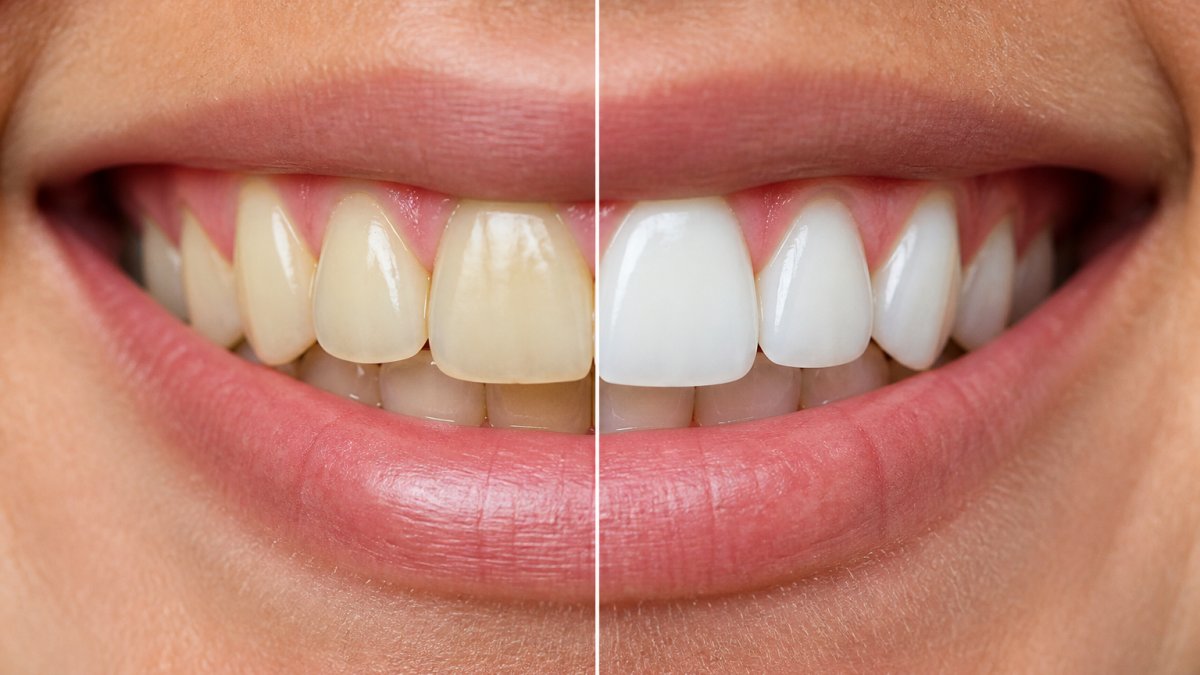
The best treatment for discolored front teeth depends on more than shade. The type of stain, how many teeth are involved, whether the tooth is structurally sound, how much enamel you are willing to give up, and how long you want results to last all shape the decision.
Start with the stain type, not the treatment name
Extrinsic stains (surface): These sit on the outside of the tooth and usually respond to cleaning and whitening.
Intrinsic stains (inside the tooth): These are embedded in the dentin and do not respond to surface cleaning.
Widespread discoloration across multiple front teeth: Whitening is usually tried first when the teeth are otherwise healthy.
A practical decision guide
| What you are seeing | Often considered first | Also worth discussing |
|---|---|---|
| Yellow surface stain from coffee, tea, or tobacco | Professional whitening | Custom at-home trays |
| Mild intrinsic yellowing | Professional whitening | Bonding or veneers if whitening plateaus |
| One dark tooth after trauma or root canal | Diagnosis, then internal bleaching | Crown or veneer if structure is compromised |
| Dark tooth with a large old filling or crack | Crown | Veneer if enough sound structure remains |
| Discoloration plus chips, gaps, or uneven shape | Veneers | Bonding for a smaller budget |
| Severe tetracycline-type banding | Veneers or crowns | Whitening may only partially help |
| Discoloration from decay or a leaking filling | Treat the cause first | Reassess cosmetics after restoration |
Risks, limitations, and tooth preservation
Every cosmetic option trades something:
- Whitening: Preserves tooth structure but can cause temporary sensitivity and uneven results, especially if one tooth is intrinsically darker. Results fade and need maintenance.
- Bonding: Minimal to no enamel removal and generally reversible, but composite can stain, chip, and needs replacement sooner than porcelain. Good for mild to moderate discoloration and small defects.
- Veneers: Require irreversible removal of a thin enamel layer. Excellent shade control and can address shape too, but a long-term commitment that can chip or debond.
A common pattern is to start with the least invasive option that can reasonably meet the goal, then escalate only if needed, which is why many dentists try whitening before recommending veneers for otherwise healthy front teeth.
Realistic timelines and treatment sequence
Most cosmetic treatment for front teeth follows a sequence rather than a single appointment:
- Consultation and diagnosis: Shade assessment, examination, and imaging if a single tooth is dark or damaged.
- Cause control: Treat decay, failing restorations, or active infection before cosmetics.
- Trial phase: Whitening or a trial smile to set expectations.
- Definitive treatment: Bonding, veneers, crowns, or internal bleaching.
- Review and maintenance: Shade check, polish, and a home-care plan.
Typical timelines vary by treatment:
| Treatment | Typical visits | Longevity (typical) |
|---|---|---|
| Professional in-office whitening | 1 visit | 6-12 months before touch-up |
| Custom at-home whitening | 1 fitting plus 2-4 weeks of use | 3-6 months before touch-up |
| Dental bonding | 1 visit | 5-7 years |
| Porcelain veneers | 2-3 visits | 10-15 years |
| Internal bleaching | 2-4 visits | 1-2 years, variable |
| Dental crowns | 1-2 visits | 10-20 years |
Cost and insurance considerations
Costs vary widely by region, dentist, and complexity, so treat any range as indicative rather than a quote. Whitening is generally least expensive, bonding next, and veneers and crowns most expensive because they involve laboratory work and more appointments; internal bleaching falls in the middle.
Matching the choice to your goals
- Fastest visible change: Professional whitening or bonding.
- Longest-lasting result: Veneers or crowns.
- Most conservative (least tooth removal): Whitening or bonding.
A cosmetic dentist can compare these options against your specific shade, tooth structure, and goals. The right answer addresses the cause, preserves as much natural tooth as possible, and meets your expectations for timeline and longevity.
Conclusion
Discolored front teeth don't have to be permanent. Whether your stains are surface-level or deep inside the tooth, modern cosmetic dentistry offers a treatment that can help, the key is choosing the right approach.
Trinity Dental Arts specializes in cosmetic dentistry treatments for discolored teeth. We offer professional whitening, veneers, bonding, crowns, and internal bleaching. Our board-certified implantologist and in-house lab ensure precision and quality.
Frequently Asked Questions
Can a dentist make yellow teeth white again?
Yes. Yellow teeth from surface stains respond well to professional whitening treatments, which use stronger bleaching agents than over-the-counter products. In-office whitening typically produces results in one appointment, while at-home trays work over 1-2 weeks. However, if discoloration is intrinsic (inside the tooth), whitening may be less effective, and veneers or bonding may be better options.
Why is one front tooth darker than the others?
A single dark front tooth often results from a root canal, internal bleeding after trauma, or natural aging of that specific tooth. This type of discoloration is typically intrinsic and does not respond well to whitening alone. Internal tooth bleaching or a veneer can address this issue effectively and restore a natural-looking smile.
Are veneers a good option for severe tooth discoloration?
Veneers are an excellent choice for severe discoloration, especially when whitening or bonding won't achieve the desired result. Porcelain veneers cover the front surface of the tooth, providing a natural-looking, long-lasting solution. They also correct other cosmetic concerns like chips and gaps. Veneers typically last 10-15 years with proper care.
How long do cosmetic treatments for discolored teeth last?
Longevity varies by treatment: professional whitening results last 6-12 months; at-home whitening lasts 3-6 months; dental bonding lasts 5-7 years; veneers last 10-15 years; and crowns last 10-25 years or longer. Maintenance, oral hygiene, and lifestyle habits (smoking, staining foods and drinks) affect how long results remain visible. Your dentist can recommend touch-up schedules based on your treatment.