 comparison
Oral Sedation vs IV Sedation for Dental Work
Table of Contents
- Oral Sedation vs IV Sedation: Quick Comparison
- What Oral Sedation Is and How It's Administered
- What IV Sedation Is and How It's Administered
- Levels of Sedation Dentistry: Depth and Adjustability
- IV Sedation for Dental Anxiety: When It's the Right Choice
- Dental Sedation Safety: What You Need to Know
- Dental Sedation Recovery Time and What to Expect
- Key Differences: Onset, Awareness, and Memory
- Frequently Asked Questions
Last Updated: October 10, 2026
Oral Sedation vs IV Sedation: Quick Comparison
Sedation dentistry helps manage dental anxiety. The two most common options, oral sedation and IV sedation, differ in administration, depth of relaxation, and recovery. The right choice depends on your anxiety level, procedure complexity, and personal preferences.
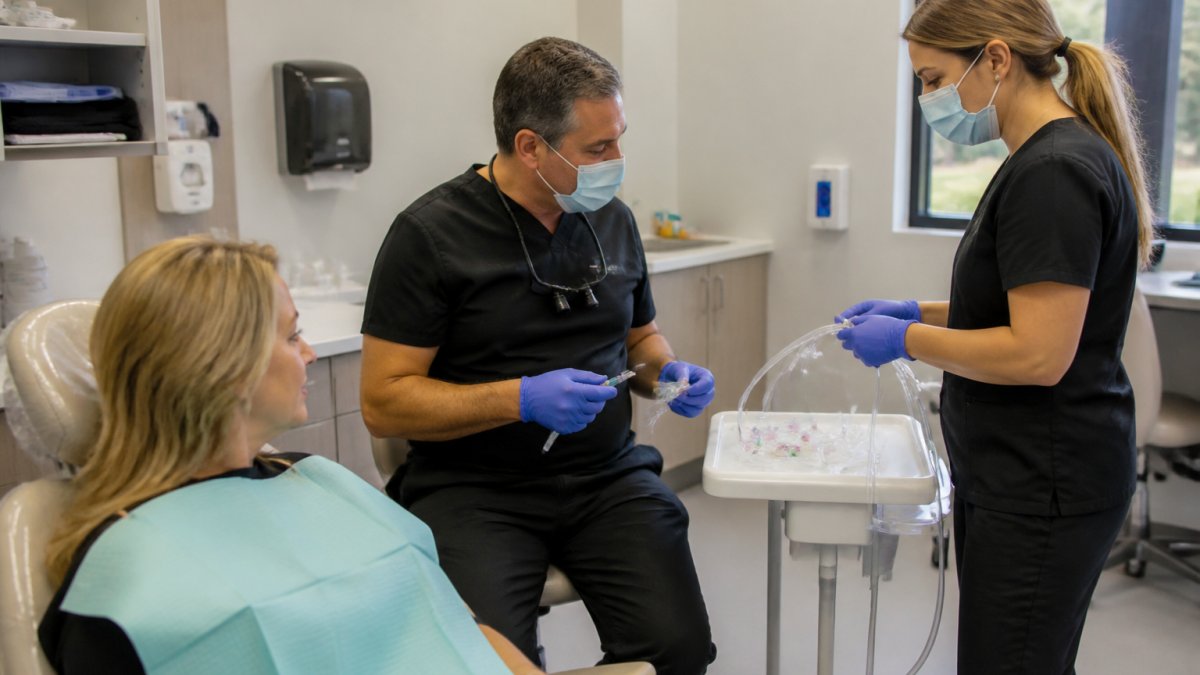
Oral sedation vs IV sedation differ in administration, onset, and depth. Oral sedation is a pill taken 30-45 minutes before your appointment; IV sedation is injected into a vein and takes effect in seconds. Oral sedation provides mild to moderate relaxation; IV sedation can provide deeper, adjustable sedation.
Here's what you need to know to decide which is right for you.
Comparison Table
| Factor | Oral Sedation | IV Sedation |
|---|---|---|
| How It's Given | Pill taken before appointment | Injection into a vein |
| Onset Time | 30-45 minutes | Seconds to minutes |
| Depth of Relaxation | Mild to moderate | Mild to deep (adjustable) |
| Awareness During Procedure | Conscious, drowsy | May have little memory |
| Best For | Mild to moderate anxiety, simpler procedures | Severe anxiety, complex procedures |
| Recovery Time | 2-4 hours | 2-4 hours (may feel groggier) |
| Adjustability | Limited (fixed dose) | Highly adjustable in real-time |
What Oral Sedation Is and How It's Administered
Oral sedation is a pill taken before your appointment that enters your bloodstream through digestion, gradually producing relaxation. You remain conscious and can respond to instructions, though you'll feel drowsy and may not remember much of the procedure.
Your dentist will review your medical history, medications, and anxiety level to prescribe the right dose. Certain medications interact with sedatives, and some medical conditions affect how your body processes them.
Take the pill 30-45 minutes before your appointment and arrange for a driver. As the medication takes effect, you'll feel increasingly relaxed and drowsy. Your dentist will monitor your comfort, though adjusting sedation depth mid-procedure is limited with oral medications.
Oral sedation works well for patients with mild to moderate dental anxiety who need simpler procedures like cleanings, fillings, or single extractions. It's also a good fit if you prefer to avoid needles or want a less intensive sedation experience.
What IV Sedation Is and How It's Administered
IV sedation is administered directly into a vein through a small catheter. Because the drug reaches your system immediately, the dentist can control the depth and duration of sedation with precision.
A trained anesthesiologist or dentist will insert the catheter quickly and painlessly. Sedative medication begins flowing immediately, producing relaxation and drowsiness. Many patients report feeling like only a few minutes have passed when the procedure is actually complete.
During IV sedation, you remain conscious enough to respond to instructions but in deeper relaxation than oral sedation. Your memory is often fragmented or absent (anterograde amnesia), which many patients find relieving.
Your dentist and staff monitor vital signs continuously and can adjust medication in real time. This adjustability is a key advantage of IV sedation, especially for longer or complex procedures.
IV sedation is ideal for severe dental anxiety, complex oral surgery, multiple extractions, implant placement, or full-mouth restorations. It's also the choice for patients who have had limited success with oral sedation or who need deeper relaxation than a pill can provide.
Levels of Sedation Dentistry: Depth and Adjustability
Sedation dentistry exists on a spectrum: minimal sedation (relaxation without drowsiness), moderate sedation (drowsy but conscious, typical of oral sedation), deep sedation (near-sleep, often with IV sedation), and general anesthesia (full unconsciousness, used only in hospitals).
With oral sedation, you take a fixed dose and can't adjust it mid-procedure. With IV sedation, your dentist adjusts medication in real time, making it safer for complex procedures and more predictable for anxious patients.
IV Sedation for Dental Anxiety: When It's the Right Choice
If you have severe dental anxiety that's kept you away from the dentist or causes panic, IV sedation often makes the biggest difference.
Severe anxiety triggers physical symptoms: racing heart, difficulty breathing, panic attacks. Some patients become so tense their jaw locks; others have traumatic dental memories that create lasting fear.
IV sedation produces genuine relaxation and memory gaps. You won't remember the worst moments, your body won't flood with stress hormones, and the procedure feels shorter. For many anxious patients, this is life-changing.
IV sedation is also the right choice when:
- Your procedure is complex or lengthy (full-mouth restoration, multiple implants, wisdom teeth extraction)
- You have a sensitive gag reflex that makes dental work difficult
- You need multiple procedures and want to handle them in fewer visits
- Oral sedation hasn't worked well for you in the past
- You have medical conditions that make anxiety management important
A practical consideration: IV sedation requires more preparation and a longer appointment, but it often allows your dentist to complete more work in one visit. Instead of spreading treatment across four appointments with anxiety building each time, you might finish everything in one or two sedated sessions. For many patients, that's worth the extra time.
Dental Sedation Safety: What You Need to Know
Both oral and IV sedation are safe when administered by trained professionals in a controlled dental setting. But safety depends on proper screening, monitoring, and preparation.
Before any sedation, your dentist will review your complete medical history. Certain conditions, heart disease, sleep apnea, uncontrolled diabetes, liver or kidney problems, affect how your body handles sedatives. Some medications interact with sedation drugs. Some allergies matter. This screening isn't bureaucracy; it's the foundation of safe sedation.
During sedation, your dentist monitors your vital signs: heart rate, blood pressure, oxygen level, and breathing. This continuous monitoring catches any problems early. Modern dental offices have oxygen, emergency medications, and training to handle complications. Serious complications from dental sedation are rare, but the monitoring and readiness make them manageable if they occur.
What sedation does NOT do: it doesn't provide pain control. Your dentist will still use local anesthesia (numbing medication) to keep you comfortable during the procedure. Sedation makes you relaxed and drowsy; local anesthesia stops the pain. You need both.
Recovery from sedation requires time and caution. Your judgment and coordination are impaired for hours afterward. You cannot drive, operate machinery, or make important decisions. You need someone to stay with you. This isn't optional, it's a safety requirement.
Dental Sedation Recovery Time and What to Expect
Recovery from oral sedation typically takes 2-4 hours. You'll feel drowsy and slow for the first hour or two. Your thinking may be fuzzy, your coordination off. By hour three or four, most people feel mostly normal, though some residual grogginess is common.
Recovery from IV sedation follows a similar timeline, though some patients feel groggier afterward because the sedation was deeper. You might feel tired for the rest of the day. Appetite may be off. Mild headache or nausea is possible but uncommon.
Here's what a typical recovery looks like:
- First 1-2 hours: Drowsy, slow thinking, impaired coordination. Rest at home.
- Hours 2-4: Gradually clearing, but still not safe to drive or make decisions. Light activity okay.
- Hour 4 onward: Most people feel normal, though some fatigue may linger into the evening.
For the rest of the day after sedation:
- Don't drive or operate machinery
- Don't make important decisions or sign documents
- Don't care for young children alone
- Eat light meals if you feel hungry
- Avoid alcohol
- Rest as much as you want
Some people experience minor side effects: dry mouth, mild dizziness, or slight nausea. These typically resolve within hours. If you have unusual symptoms, severe headache, chest pain, difficulty breathing, or confusion that doesn't improve, contact your dentist immediately.
The day after sedation, most people feel completely normal and can return to regular activities.
Key Differences: Onset, Awareness, and Memory
The practical differences between oral and IV sedation come down to how fast they work, how aware you are during the procedure, and what you remember afterward.
Onset time: Oral sedation takes 30-45 minutes to reach full effect. You'll feel gradually more relaxed. IV sedation works in seconds to a few minutes, as soon as the medication enters your vein, you feel the effects.
Awareness during the procedure: With oral sedation, you remain conscious and aware. You can hear the dentist talking, feel vibrations and pressure, and respond to instructions. You're just very relaxed and drowsy.
With IV sedation, your awareness is reduced. You may drift in and out of consciousness. You might respond to instructions, but you won't process much of what's happening. Many patients describe it as "I blinked and it was over."
Memory: This is where the biggest difference shows up. With oral sedation, you'll likely remember parts of the procedure, though the memory may be hazy. With IV sedation, many patients remember little to nothing, the medication creates amnesia for the procedure. Some remember the beginning or end but not the middle.
For patients with severe anxiety, this memory gap is a major advantage. The worst parts of dental anxiety, the sounds, the sensations, the feeling of helplessness, don't get encoded into memory. Future dental visits feel less threatening because you don't have those traumatic memories to dread.
For patients with mild anxiety or those who prefer to stay fully aware, oral sedation's lighter touch and preserved memory may be preferable.
Choosing between oral sedation and IV sedation for dental work comes down to your anxiety level, the complexity of your procedure, and how much control and memory you want during treatment. Oral sedation works well for mild to moderate anxiety and simpler procedures.
At Trinity Dental Arts, we specialize in comprehensive dental care including complex restorations and oral surgery. Our board-certified implantologist and experienced team are trained in both oral and IV sedation protocols, and we can help you decide which approach fits your needs.
Frequently Asked Questions
Which type of dental sedation is better for severe anxiety?
IV sedation typically provides deeper relaxation and is often recommended for severe dental anxiety because it works quickly and can be continuously adjusted. Oral sedation suits mild to moderate anxiety. Your dentist will assess your anxiety level and medical history to determine which option is appropriate for you during a consultation.
How long does it take to recover from oral or IV dental sedation?
Oral sedation recovery typically takes 2-4 hours, though residual drowsiness may linger into the afternoon. For both oral and IV sedation, you should arrange transportation and avoid driving for at least 24 hours. Plan to have someone drive you home and rest for the remainder of the day.
Can you feel pain during IV sedation for dental work?
No. IV sedation works alongside local anesthesia to prevent pain. The sedative relaxes you and reduces anxiety, while the local anesthetic numbs the specific area being treated. You may feel pressure or vibration but should not experience pain. Tell your dentist immediately if you do feel pain during the procedure.
What are the main safety considerations for dental sedation?
Both oral and IV sedation are safe when administered by trained professionals. Your dentist will review your medical history, current medications, and allergies beforehand. Vital signs are monitored throughout. Risks are rare but can include allergic reactions, breathing difficulties, or nausea. IV sedation carries slightly more monitoring requirements. Disclose all health conditions and medications to your dentist before treatment.
Do you need someone to drive you home after dental sedation?
Yes. After both oral and IV sedation, you must have a responsible adult drive you home. You cannot drive yourself for at least 24 hours because sedation impairs judgment, coordination, and reaction time. Arrange transportation before your appointment. Your dentist will not release you without a driver present.