 comparison
Full Mouth Restoration vs Traditional Dentures
Table of Contents
- Full Mouth Restoration vs Traditional Dentures: Key Differences
- Comfort, Fit, and Stability Comparison
- Chewing Ability and Food Limitations
- Appearance and Natural Feel
- Treatment Procedures and Appointment Stages
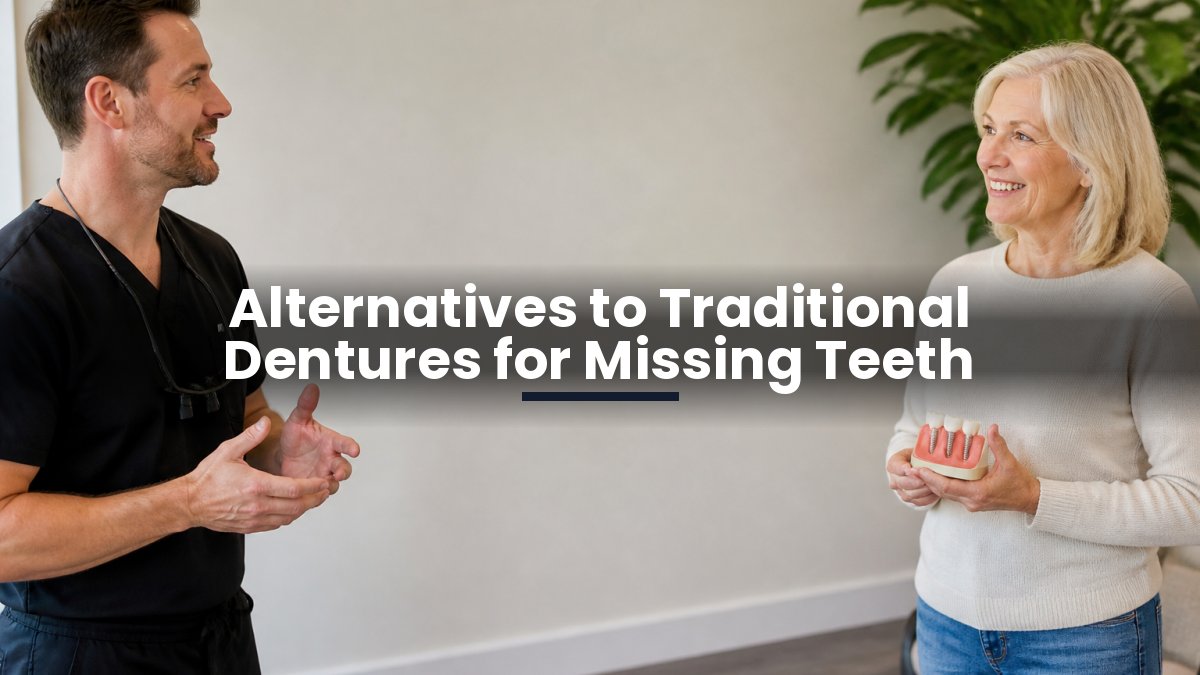
- Alternatives to Traditional Dentures for Missing Teeth
- Full Mouth Restoration Cost and Financing
- Full Mouth Dental Implant Recovery and Candidacy
- Frequently Asked Questions
Last Updated: October 20, 2026
Full Mouth Restoration vs Traditional Dentures: Key Differences
When you're missing most or all of your teeth, the choice between full mouth restoration and traditional dentures shapes how you eat, speak, and feel about yourself. Full mouth restoration vs traditional dentures is a fundamental decision about permanence, comfort, and long-term oral function.
The core difference is simple: traditional dentures rest on your gums and come out daily, while full mouth restoration uses dental implants anchored into your jawbone for a fixed solution that functions like natural teeth.
This guide breaks down what separates these two approaches so you can decide which fits your needs and lifestyle.
What Full Mouth Restoration Means
Full mouth restoration is a comprehensive treatment plan that replaces all or most of your natural teeth using dental implants as the foundation.
The result is a permanent or semi-permanent solution: your new teeth don't come out and function like natural teeth for chewing, speaking, and smiling. Full mouth restoration typically involves 4 to 8 implants per arch, depending on your bone structure and treatment plan.
This approach requires multiple appointments over several months: extractions if natural teeth remain, bone grafting if your jawbone has deteriorated, implant surgery, then fabrication and placement of your new teeth.
What Traditional Dentures Are
Traditional dentures are removable prosthetics that rest on your gums and underlying bone structure. They're custom-made, but held in place primarily by suction and the shape of your remaining ridge.
Full dentures replace all teeth on one or both arches; partial dentures replace some while natural teeth stay. Traditional dentures require daily removal, cleaning, and storage, and need periodic relining as your jawbone shrinks after tooth loss.
The upfront process is faster than full mouth restoration: impressions, a model, and fabrication over a few appointments, with wear typically starting within weeks.
Comfort, Fit, and Stability Comparison
The comfort difference between these two options is immediate and persistent.
Traditional dentures rest on soft tissue, so they can shift when you eat, speak, or laugh, especially in the lower jaw, where the narrower ridge offers less retention.
Full mouth restoration anchors directly into bone. Once implants integrate, typically 3 to 6 months after placement, they don't move, no shifting, no clicking, no adhesives.
The trade-off is initial discomfort: implant surgery involves bone work, meaning soreness, swelling, and recovery. Traditional dentures have no surgical component, so no post-operative pain or healing timeline.
For long-term comfort, full mouth restoration typically wins; for immediate comfort without surgery, traditional dentures win initially.
Chewing Ability and Food Limitations
This is where the functional difference becomes impossible to ignore.
Traditional dentures reduce chewing force to roughly 25% of natural teeth.
Full mouth restoration restores chewing force to 70-80% of natural function. You can bite into an apple, chew steak, and eat most foods without modification, dramatically expanding your diet compared to denture life.
This affects nutrition: patients who can't chew effectively often avoid nutrient-dense foods like raw vegetables and lean proteins. Full mouth restoration removes that barrier.
The catch: very hard foods like ice or hard candy can damage implant-supported teeth, just as they can natural teeth. But for practical daily eating, full mouth restoration feels like having your natural teeth back.
Appearance and Natural Feel
Both options can look natural if they're well-made, but the way they feel in your mouth differs significantly.
Upper dentures cover the roof of your mouth, which can mute taste and temperature sensation.

Full mouth restoration feels like your own teeth: no foreign object, no palate coverage, no taste interference, and unaffected speech. The psychological impact is substantial, patients often report feeling like themselves again rather than wearing something.
Aesthetically, both can look excellent, modern dentures are highly realistic, and implant-supported teeth are custom-designed to match your face.
Treatment Procedures and Appointment Stages
Understanding the timeline helps you plan around treatment.
Traditional dentures typically require 4-6 appointments over 3-4 weeks:
- Initial consultation and impressions
- Bite registration and shade selection
- Try-in appointment (checked for fit and appearance before final processing)
- Delivery and adjustment
- Follow-up adjustments as needed
You're wearing dentures within weeks, no surgery, no healing time, no bone integration period.
Full mouth restoration involves a longer process:
- Consultation and treatment planning (including imaging to assess bone)
- Tooth extraction (if needed) and initial healing (1-2 weeks)
- Implant placement surgery and osseointegration (3-6 months for implants to fuse with bone)
- Abutment placement and tooth fabrication
- Final placement and adjustments
The entire process typically takes 4-9 months. At Trinity Dental Arts, our same-day full-arch teeth option can compress this in select cases, letting you leave with functional teeth the day of implant placement, though final integration still takes months.
The longer timeline matters if you need teeth quickly, but the permanence often justifies the wait.
Alternatives to Traditional Dentures for Missing Teeth
Beyond these two main options, several middle-ground solutions exist.
Implant-supported partial dentures (overdentures) use 2-4 implants to anchor a removable denture, improving stability and retention over traditional dentures at less cost than a full implant restoration.
Fixed bridges anchor artificial teeth to remaining natural teeth, but require grinding down healthy teeth and work only if enough remain in the right positions.
Removable partial dentures replace some teeth while keeping natural teeth, but they're less stable than full dentures and can accelerate bone loss around remaining teeth.
Each alternative has specific use cases. Your dentist can evaluate whether your bone structure, remaining teeth, and budget make any of these appropriate for you.
Full Mouth Restoration Cost and Financing
Cost is the primary barrier for most patients considering full mouth restoration, and it's also where most comparisons stop short. Upfront price is only half the story. The number that should drive your decision is the total cost of ownership over the life of each option, and that requires looking at what you'll pay after the initial treatment.
Upfront cost ranges
Traditional dentures and implant-supported full mouth restoration have varying costs depending on materials, complexity, the number of implants, whether bone grafting is needed, and whether same-day teeth are included. A hybrid plan, implants in one arch, a conventional denture in the other, often lands in between.
Those ranges are wide because the variables are real: the number of implants (4 to 8 per arch is typical), whether extractions and grafting are required, the type of final prosthesis (a fixed acrylic-and-metal hybrid versus a zirconia or ceramic full-arch restoration), and the lab fees involved. Ask for a written treatment plan that itemizes each of these line items rather than a single bundled quote.
The lifetime cost picture
This is the part most articles skip. Traditional dentures are not a one-time purchase:
- Relines are typically needed every few years as the jawbone resorbs, and a hard reline or a new denture base carries its own fee each time.
- Adjustments for sore spots are common in the first weeks and periodically thereafter.
- Replacement is generally expected every 5 to 10 years as the denture wears and the ridge changes shape.
- Ongoing supplies, adhesives, cleansers, and soaking containers, are a small but recurring cost.
Full mouth restoration front-loads the cost but has a different tail: routine hygiene visits, occasional prosthetic repairs or replacement of worn components, and monitoring of the implants. Implants themselves can last decades with good care, but the prosthetic teeth attached to them are a wear item and may need replacement over a long horizon. The honest framing is that restoration trades a high upfront cost for lower ongoing maintenance, while dentures trade a low upfront cost for recurring relines, replacements, and the indirect costs of a diet and confidence that shrink over time.
Insurance, HSA/FSA, and financing
Coverage varies widely, and it's worth checking before you assume anything:
- Dental insurance often covers a portion of dentures and extractions but frequently caps implant coverage or excludes it as a cosmetic or major service. Read the plan's major-services and annual-maximum provisions.
- Health Savings Accounts (HSAs) and Flexible Spending Accounts (FSAs) can often be used for qualifying dental treatment, which effectively lets you pay with pre-tax dollars. Confirm eligibility with your plan administrator.
- Financing, practice payment plans, third-party dental loans, and extended payment arrangements, can spread the upfront cost. Compare the interest rate and term, not just the monthly payment.
- Medicare generally does not cover routine dental care or dentures under original Medicare; some Medicare Advantage plans include limited dental benefits, so check your specific plan.
Before deciding on cost alone, ask for both numbers in writing: the upfront treatment plan and a realistic 10-year maintenance estimate for each option.
Full Mouth Dental Implant Recovery and Candidacy
Not everyone is a candidate for full mouth restoration, and recovery requires commitment.
Candidacy factors include:
- Adequate jawbone volume (bone grafting can address deficiencies, but adds time and cost)
- Good overall health (certain conditions and medications can affect implant integration)
- Ability to maintain excellent oral hygiene (implants require diligent home care)
- Realistic expectations about the process and timeline
- Commitment to follow post-operative instructions during healing
Recovery timeline:
- Week 1: Maximum swelling and discomfort; soft diet only
- Weeks 2-4: Gradual improvement; most people return to normal activities
- Months 1-3: Continued healing; implants are integrating with bone
- Months 3-6: Full integration; teeth can handle normal chewing forces
During integration, you need to avoid disturbing the implant sites. This means no smoking (which significantly impairs healing), careful eating, and following your dentist's specific post-operative instructions.
Traditional dentures have no recovery period. You wear them immediately, though adjustment and adaptation take a few weeks.
For patients with significant dental anxiety, the surgical aspect of full mouth restoration can feel overwhelming. At Trinity Dental Arts, our approach prioritizes patient comfort and communication throughout the process.
When you're ready to explore either option in detail, schedule a consultation with a qualified implant dentist who can evaluate your specific situation.
Frequently Asked Questions
What is the difference between full mouth restoration and traditional dentures?
Full mouth restoration typically involves fixed implant-supported solutions that replace missing teeth with anchored prosthetics, while traditional dentures are removable appliances that rest on gum tissue. Restoration often includes dental implants placed in the jawbone, offering greater stability and chewing function. Traditional dentures may shift during eating or speaking and require daily removal for cleaning. The choice depends on bone structure, budget, and personal preference for fixed versus removable solutions.
Are full mouth dental implants better than traditional dentures?
Neither is universally better; each has distinct advantages. Full mouth dental implants offer superior chewing ability, stability, and a more natural feel, but require sufficient jawbone and a longer treatment timeline. Traditional dentures are more affordable upfront and don't require bone grafting in cases of significant bone loss. Implants prevent ongoing bone loss, while dentures may require frequent adjustments. Your best choice depends on your oral health, budget, timeline, and personal comfort with removable versus fixed solutions.
How long does full mouth dental implant recovery take?
Full mouth dental implant recovery varies based on individual healing and the specific treatment plan. Initial osseointegration, where bone fuses to implants, typically takes 3 to 6 months. Some practices offer same-day full-arch teeth, providing immediate function while underlying implants heal. Complete stability and final adjustments may take several months. Your dentist will provide a personalized timeline during consultation, as factors like bone quality, overall health, and smoking status affect healing speed.
What are alternatives to traditional dentures for missing teeth?
Alternatives include full mouth dental implants, implant-supported dentures (overdentures), fixed bridges, and partial dentures. Full mouth implants offer the most permanent solution with excellent chewing function. Implant-supported dentures combine removable and fixed benefits, snapping onto implant anchors for greater stability than traditional dentures. Fixed bridges span missing teeth by anchoring to adjacent teeth. Each option varies in cost, durability, and maintenance. A consultation with a board-certified implantologist can help determine which alternative best fits your needs and bone structure.
How much does full mouth restoration cost compared with dentures?
Traditional full dentures are generally the most affordable initial option. Full mouth restoration with implants typically costs significantly more upfront, though exact pricing depends on the number of implants, materials, and individual treatment needs. However, implants often provide better long-term value by avoiding frequent replacements and adjustments that dentures require. Financing options and insurance coverage vary widely. Contact Trinity Dental Arts for a personalized estimate and to discuss payment plans suited to your budget.