 blog
Should You Choose Jolie Smiles or Tampa Surgical Arts for Implants?
Last Updated: October 26, 2026
Quick Summary
An implant provider comparison should evaluate board certification, imaging technology, in-house lab capabilities, implant success rates of 95%+ over 5 years, and patient reviews to determine which practice best combines clinical expertise, efficiency, and cosmetic outcomes for your specific situation.
- Board-certified implantologists have completed advanced training beyond dental school and passed rigorous exams in implant dentistry.
- Cone-beam CT scans and computer-guided implant placement improve surgical precision and reduce complications.
- All-on-4 treatment uses four strategically positioned implants to support a full arch of fixed teeth, reducing the need for bone grafting.
- Osseointegration, where implants fuse with bone, takes 3-6 months before permanent teeth can be placed.
- Ask about implant brand, crown material, bone grafting approach, and whether the entire process is managed in-house or referred out.
Table of Contents
- Understanding Your Implant Provider Options
- Dental Implants vs. Dentures: Which Fits Your Situation
- What to Ask at Your Dental Implant Consultation
- Full-Arch Dental Implants Cost and Financing
- Dental Implant Recovery Time and What to Expect
- Provider Credentials, Technology, and Patient Outcomes
- Scheduling Your Implant Consultation Today
- Frequently Asked Questions
Understanding Your Implant Provider Options
When you're missing teeth and considering permanent restoration, choosing the right implant provider shapes everything that follows. The decision involves clinical expertise, technology, and whether the practice can address your expectations.
Some practices emphasize speed. Others focus on affordability. Still others market themselves on cosmetic outcomes. The real question is: which provider actually combines all three?
This comparison examines what separates one implant practice from another, and how to evaluate whether an implant provider comparison should even be your first step. Sometimes the choice is obvious once you understand what to look for.
Dental Implants vs. Dentures: Which Fits Your Situation
Dental implants and dentures both replace missing teeth, but they work in different ways.
Dental implants are surgically anchored replacements. A titanium post is placed into your jawbone, and a crown or bridge is attached to it. They function like natural teeth.
Dentures are removable prosthetics. They rest on top of your gums and are held in place by suction or adhesive. They require daily removal, cleaning, and storage. They can shift during eating or speaking. Many patients report difficulty adapting to the sensation of dentures in their mouth.
All-on-4 Treatment and Full-Arch Solutions
All-on-4 is a specific implant approach designed for patients missing all or most teeth in one arch. Instead of placing an implant for each missing tooth, four strategically positioned implants support a full arch of fixed teeth. The technique uses angled implants in the front and back of the jaw to maximize bone contact and reduce the need for bone grafting.
What to Ask at Your Dental Implant Consultation
Come prepared with specific questions.
Ask about experience with your specific situation. How many full-arch cases has the dentist completed? What percentage were successful? Ask to see before-and-after photos of patients similar to you, similar bone loss, similar age, similar aesthetic goals. A practice that hesitates or redirects this question may lack depth in your specific treatment type.
Ask about the implant brand and components. Not all implants are created equal. Some brands have decades of research backing long-term success. Others are newer or less established. Ask whether the practice uses the same implant system consistently or varies by case. Ask about the crown material, is it all-ceramic (most aesthetic, more fragile) or zirconia (stronger, slightly less aesthetic)? Is the crown milled in-house or sent to a lab?
Ask about bone grafting if needed. If your jawbone is thin or has resorbed significantly, grafting may be necessary. Ask what grafting material the practice uses (autograft from your own jaw, allograft from a donor, or synthetic). Ask how long grafting adds to your timeline. Ask whether grafting is done in-house or referred out.
Ask about the surgical process. Will the dentist place the implants, or will you be referred to an oral surgeon? If referred out, who handles the restoration? Fragmented care can lead to miscommunication. A practice that manages the entire process from implant placement to crown delivery typically delivers better coordination.
Ask about temporary teeth. If you need teeth immediately, ask whether the practice offers same-day provisional teeth. Ask how they're fabricated and how long you'll wear them. Ask about eating and speaking restrictions during the provisional phase.
Ask about complications and warranties. What happens if an implant fails? Does the practice replace it at no charge? What's the timeline? Does the practice offer any written guarantee on implant success rates? Transparency here matters.
Ask about follow-up care. How often should you return for checkups? What does maintenance cost? Are cleanings included, or charged separately? A practice that emphasizes long-term care over one-time transactions invests in your success.
Full-Arch Dental Implants Cost and Financing
For detailed pricing information and to understand the financial commitment for your specific situation, review the full-arch dental implants cost guide to see how practices structure pricing and what factors affect your final bill.
Dental Implant Recovery Time and What to Expect
Immediate recovery (first 24-48 hours): After surgery, expect swelling, bruising, and discomfort. Pain is typically manageable with prescribed medication. You'll be advised to rest, ice the area, and avoid strenuous activity. Most people take 1-2 days off work. If your work is desk-based and you feel up to it, you may return sooner. If your work is physical or client-facing, take the full 2 days.
Early healing (week 1-2): Swelling peaks around day 3-4, then gradually improves. Bruising may spread down your neck and chest, this is normal. You'll eat soft foods: soup, yogurt, mashed potatoes, smoothies. Avoid hot foods and drinks; stick to lukewarm or cool options. Avoid smoking and alcohol, both of which impair healing. Most people feel well enough to resume normal activities by the end of week 2, though some residual swelling remains.
Intermediate healing (week 3-8): Swelling continues to resolve. See a detailed recovery timeline of what to expect after full-mouth implant restoration. You gradually return to a normal diet. Implants are integrating with bone, but this happens invisibly, you won't feel it. If you received temporary teeth, you may experience some adjustment discomfort as you learn to eat and speak with them. Most people feel fully functional by week 6-8.
Long-term integration (3-6 months): Osseointegration, the process of implants fusing with bone, takes 3-6 months. During this time, implants are stable but still integrating. You should avoid trauma to the area. Once integration is complete, your dentist removes the temporary teeth and places permanent ones.
Provider Credentials, Technology, and Patient Outcomes
Evaluating an implant provider means looking beyond marketing claims to qualifications and equipment.
Board certification matters. A dentist who is board-certified in implant dentistry has completed advanced training beyond dental school, passed rigorous exams, and committed to continuing education. Board certification doesn't guarantee good outcomes, but it's a marker of expertise. Learn what credentials and qualifications to evaluate when choosing an implant dentist. Ask whether your provider is board-certified and in which specialty. Trinity Dental Arts is led by a board-certified implantologist, Dr. Xhoana Gjelaj holds credentials including MAGD (Master of the Academy of General Dentistry), DICOI (Diplomate of the International Congress of Oral Implantologists), FAAID (Fellow of the American Academy of Implant Dentistry), and DABOI/ID (Diplomate of the American Board of Oral Implants/Implantology). These credentials indicate specialized training and ongoing commitment to implant dentistry.
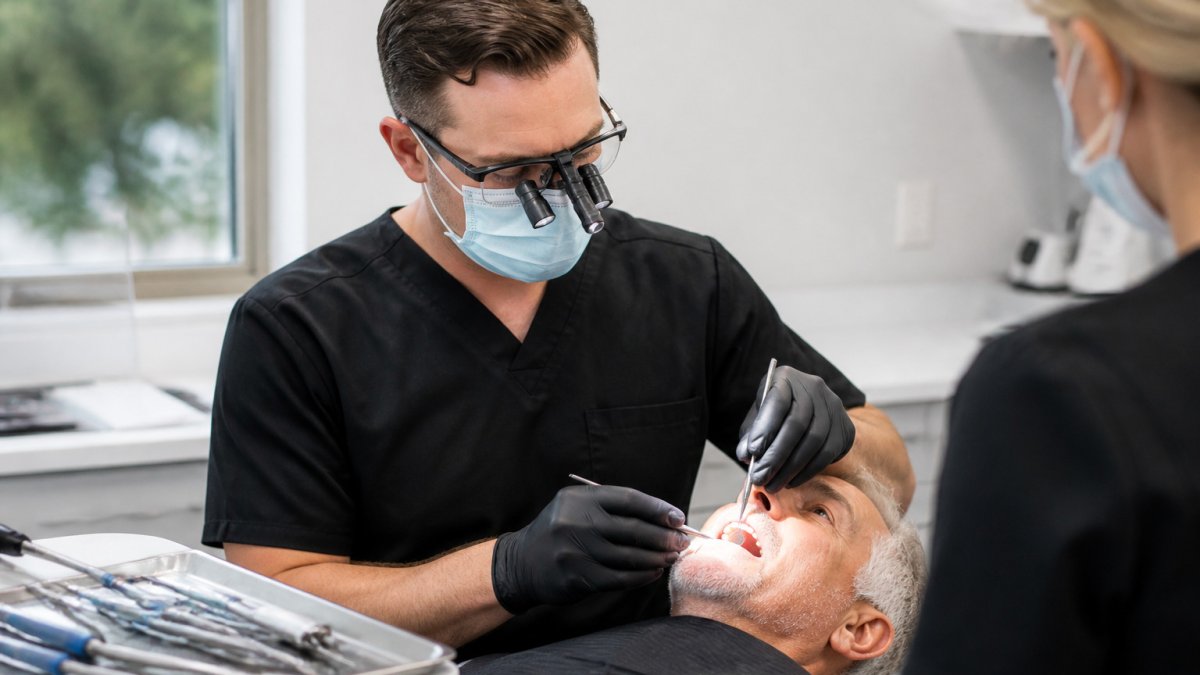
Technology affects outcomes and efficiency. Ask what imaging the practice uses. Cone-beam CT (CBCT) scans provide 3D images of your jaw, allowing precise implant placement. Ask whether the practice uses computer-guided implant placement, which uses 3D imaging to pre-plan implant positions and guide surgery with high precision. Ask whether the practice has an in-house lab to mill crowns. In-house labs allow same-day or next-day crown delivery and give the dentist direct control over fit and aesthetics.
Patient outcomes are the ultimate measure. Ask to see before-and-after photos. Ask about the practice's implant success rate. Industry standard is 95%+ success over 5 years. If a practice quotes lower success rates, ask why. Ask whether the practice tracks long-term outcomes and can show you data on how patients are doing 5, 10, or 15 years after treatment.
Patient reviews reveal how practices actually treat people. Look for patterns in reviews. Do patients mention feeling rushed? Do they praise the staff's gentleness? Do they report good communication? Do they feel their concerns were heard? Negative reviews aren't disqualifying, all practices have some, but the tone and frequency matter. A practice with mostly positive reviews and thoughtful responses to negative ones typically invests in patient experience.
| Evaluation Criteria | What to Look For | Why It Matters |
|---|---|---|
| Board Certification | Diplomate status in implant dentistry | Indicates advanced training and expertise |
| Imaging Technology | CBCT scans and computer-guided placement | Improves precision and reduces complications |
| In-House Lab | Crowns milled on-site | Faster delivery, better quality control |
| Success Rates | 95%+ implant success over 5 years | Reflects clinical skill and long-term outcomes |
| Patient Reviews | Positive feedback on communication and care | Indicates patient-centered practice |
Scheduling Your Implant Consultation Today
The next step is a consultation with an implant provider. A consultation is an opportunity to ask questions and determine whether they're the right fit for your needs.
If you're in the Tampa Bay area and considering implant restoration, schedule a same-day implant consultation with Trinity Dental Arts. We combine board-certified expertise with in-house lab capabilities.
Frequently Asked Questions
What should I ask at a dental implant consultation?
Ask about the provider's credentials, implant success rates, and experience with your specific case. Request details on the treatment timeline, recovery expectations, and what happens if complications arise. Inquire about the technology used. Ask for before-and-after photos of similar cases.
How much do full-arch dental implants typically cost?
Contact Trinity Dental Arts or your chosen provider directly for current pricing or a quote.
What is the difference between dentures and All-on-4 dental implants?
Dentures are removable replacement teeth. All-on-4 implants are a full-arch solution using four implants to support a fixed bridge of new teeth.
How long does dental implant recovery take?
Recovery timelines vary. Ask your dentist what to expect for your treatment.
Choosing an implant provider is one of the most important decisions you'll make about your oral health. The right provider combines clinical expertise, modern technology, and genuine commitment to your long-term success. Take time to evaluate credentials, ask detailed questions, and trust your instinct about whether a practice listens to you and respects your concerns.