 blog
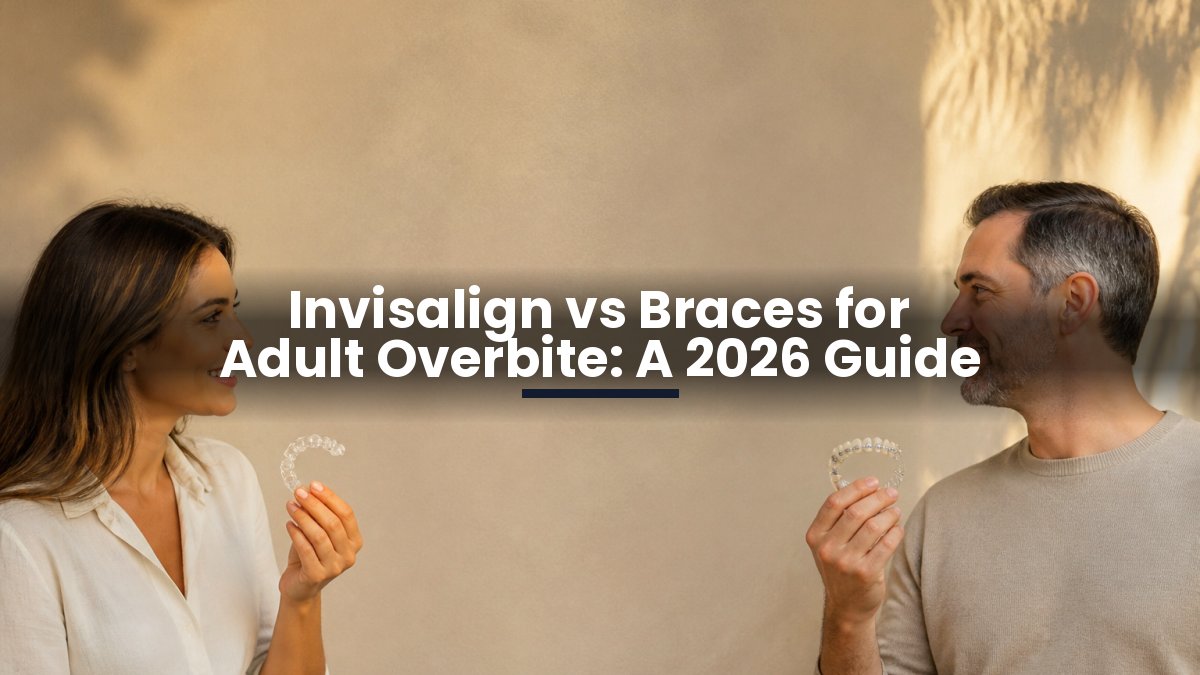
Invisalign vs Braces for Adult Overbite: A 2026 Guide
Table of Contents
- Understanding Overbite: Dental vs. Skeletal
- Can Invisalign Fix an Overbite in Adults?
- Traditional Braces for Adult Overbite Correction
- Invisalign for Severe Overbite: What You Should Know
- How Long Does Invisalign Take to Fix an Overbite?
- Invisalign Cost vs. Braces: What Adults Should Budget
- Making Your Choice: Overbite Treatment Decision Framework
- Conclusion
- Frequently Asked Questions
Last Updated: October 13, 2026
Understanding Overbite: Dental vs. Skeletal
An overbite is when your upper front teeth overlap your lower front teeth more than normal, affecting how your teeth meet, your appearance, and function.
A dental overbite happens when the teeth themselves are misaligned but the jaw structure is normal, the upper teeth tip forward or the lower teeth tip backward.
A skeletal overbite is caused by jaw bone structure, your upper jaw too far forward, your lower jaw too far back, or both.
At Trinity Dental Arts, we assess every patient's bite to determine whether it's dental or skeletal.
Understanding Invisalign vs braces overbite treatment starts with severity: mild overbites (1-3mm) are usually dental, moderate overbites (3-5mm) can be either, and severe overbites (5mm or more) often involve skeletal components.
Can Invisalign Fix an Overbite in Adults?
Yes, Invisalign can fix many overbites in adults, but not all.
Invisalign moves teeth gradually using custom trays, each applying gentle pressure to shift teeth into the next position.
The catch: Invisalign has limits with complex cases. Severe overbites, particularly skeletal ones, often need the more powerful control of traditional braces.
Compliance matters: aligners must be worn 20-22 hours daily, and removing them frequently for eating, drinking, or social situations stretches your timeline.
Invisalign also handles straightforward tooth movements better than complex three-dimensional corrections. Some overbites require precise control of tooth rotation or vertical positioning, tasks where fixed braces excel.
Traditional Braces for Adult Overbite Correction
Traditional braces remain the gold standard for correcting overbites, especially complex or severe cases.
Metal braces use brackets bonded to each tooth and a wire that guides movement.
The trade-off is visibility. Many adults hesitate about braces due to appearance; ceramic or tooth-colored brackets reduce visibility somewhat but are still noticeable.
Braces also require more careful oral hygiene, since food traps around brackets and wires. Adults need thorough cleaning routines to avoid cavities during treatment.
Adjustment appointments happen every 4-6 weeks, when the orthodontist tightens the wire and may adjust elastics.
Invisalign for Severe Overbite: What You Should Know
Severe overbites are where the Invisalign-versus-braces conversation gets real. Marketing says clear aligners handle "complex cases," but the mechanics of a deep or skeletal overbite often require tools aligners don't have.
Why severe overbites are mechanically harder. Correcting an overbite isn't just tipping teeth backward. It usually involves some combination of:
- Intrusion of the upper incisors, pushing the upper front teeth up into the bone.
- Extrusion of the lower incisors, bringing the lower front teeth down.
- Torque control, controlling the root position, not just the crown, so teeth don't tip when they should translate.
- Molar and jaw relationship changes, in growing patients, growth modification; in adults, often compensation or, in true skeletal cases, surgery.
Aligners apply force through a plastic shell that grips the crown, making crown tipping easy and root torque harder.
What aligners can and can't do for a severe overbite.
- Can do: mild-to-moderate dental overbites, some deep bites with good compliance, cases where the overbite is mostly from incisor position and the roots can be controlled with attachments and auxiliaries.
- Struggles with: skeletal overbites, overbites requiring significant intrusion, cases needing jaw repositioning, and cases where the roots must be moved precisely without tipping.
- Cannot do: change the position of the jaw itself. If your overbite is skeletal, no aligner or brace moves the bone, that requires growth modification (not available in adults) or orthognathic surgery.
The hybrid protocol. A common adult approach is staged: aligners first to level and align the arches, then a short phase of braces (often just one arch) to finish the bite.
Attachments and auxiliaries change the calculus. For severe corrections, aligners often need:
- Composite attachments on multiple teeth to give the aligner something to grip. More attachments mean the aligners are more visible and slightly harder to remove.
- Elastics worn between upper and lower attachments to help correct the bite relationship. These are visible and require the same compliance discipline as the aligners themselves.
- Buttons and temporary anchorage devices (TADs) in some cases, to provide anchorage for movements the aligners can't generate on their own.
What to ask before committing. If a provider proposes Invisalign for a severe overbite, ask:
- Is my overbite dental, skeletal, or mixed? What's the evidence?
- What specific movements does my case require, and can aligners produce them?
- What's the plan if tracking falls short, refinements, auxiliaries, or a switch to braces?
- Is a hybrid or two-phase plan more predictable than aligners alone?
- What's the realistic outcome if I choose aligners, full correction, partial correction, or camouflage?
The honest bottom line. For a severe overbite, braces (or a hybrid plan) are usually the more predictable path. Aligners can play a role, especially in the alignment phase, but treating them as one-size-fits-all sets up disappointment. The right answer depends on your diagnosis, which should come from a clinician who shows you the imaging and explains the mechanics.
American Association of Orthodontists, finding an orthodontist and understanding treatment options
How Long Does Invisalign Take to Fix an Overbite?
Timeline depends on overbite severity and case complexity. Mild overbites typically take 12-18 months, moderate overbites 18-24 months, and severe cases 24-36 months or hybrid treatment.
Age plays a subtle role: younger patients' bones respond slightly faster, while adults' fully developed bone moves marginally slower. The difference is usually weeks, not months.
Refinements extend the timeline: after your primary series finishes, your orthodontist may prescribe additional trays to fine-tune the result, typically adding 2-6 months.
Retainer wear after active treatment is critical. Once aligners finish, you'll wear retainers nightly (or full-time initially) to prevent relapse.
Invisalign Cost vs. Braces: What Adults Should Budget
Most comparison pages stop at "braces and aligners cost about the same." That's true at the headline level but hides the line items that determine what you actually pay.
The headline range. For adult comprehensive orthodontic treatment in the United States, expect a total fee roughly between $3,000 and $8,000 for either Invisalign or fixed braces, with limited cases landing lower and complex full-treatment cases higher.
What actually moves the number.
- Case complexity. A mild dental overbite that finishes in 12 months costs less than a skeletal case that runs 30 months with multiple phases. Longer active treatment means more aligner sets, more wire changes, and more chair time.
- Number of aligner sets and refinements. Invisalign fees usually include a set number of refinement aligners, but some plans cap them. If you need extra refinement trays beyond the plan, that can add cost.
- Retainers. Retainers are frequently billed separately from active treatment. A fixed lingual retainer and a removable retainer (or a set of each) can add several hundred dollars. Ask whether retainers are included before you sign.
- Hybrid treatment. If your plan starts with aligners and finishes with braces (or vice versa), you're paying for two appliance systems, two sets of records, and a longer overall timeline. That's typically more expensive than either method alone.
- Records and imaging. X-rays, intraoral scans, and photographs are sometimes bundled into the treatment fee and sometimes billed separately. Confirm which.
- Extractions or adjunct procedures. If overbite correction requires extractions, enamel reduction (interproximal reduction), or coordination with a periodontist or oral surgeon, those are separate costs.
How insurance actually works. Many dental plans include an orthodontic benefit, but the structure matters more than the headline:
- Lifetime maximum. Most plans cap orthodontic benefits at a fixed dollar amount for your lifetime, commonly in the low-to-mid four figures. Once you've used it, it doesn't reset.
- Percentage coverage. Some plans cover a percentage of the fee (often 50%) up to that lifetime maximum, and some apply age restrictions or exclude adults entirely.
- Age limits. A subset of plans only cover orthodontics for members under a certain age. Adults should verify their specific plan document, not a summary.
- Medical vs. dental. Severe skeletal overbites that require jaw surgery may be partially covered under medical insurance rather than dental, but that's a separate pathway and usually requires documented functional impairment.
Payment structures. Most practices offer in-house or third-party financing that spreads the fee across treatment, often a down payment plus monthly installments. Read third-party interest terms carefully. FSAs and HSAs can often be used for orthodontic treatment, effectively discounting the cost with pre-tax dollars.
The line-item checklist. When you compare quotes, compare these, not just the total:
| Line item | Ask your provider |
|---|---|
| Active treatment fee | Does it cover the full estimated treatment, or is it capped? |
| Aligner sets / refinements | How many are included? What happens if I need more? |
| Retainers | Included or separate? Fixed, removable, or both? |
| Records and imaging | Bundled or billed separately? |
| Emergency visits | Covered? Any per-visit fee? |
| Retention phase visits | How long are they included? |
| Extractions / adjuncts | In scope or referred out? |
The takeaway. Invisalign and braces land in similar total ranges for comparable cases, but what you pay is driven by complexity, refinements, retainers, and your plan's coverage.
American Dental Association, orthodontic treatment and insurance basics
Making Your Choice: Overbite Treatment Decision Framework
Choosing between Invisalign and braces depends on your situation. Use this framework to evaluate your options.
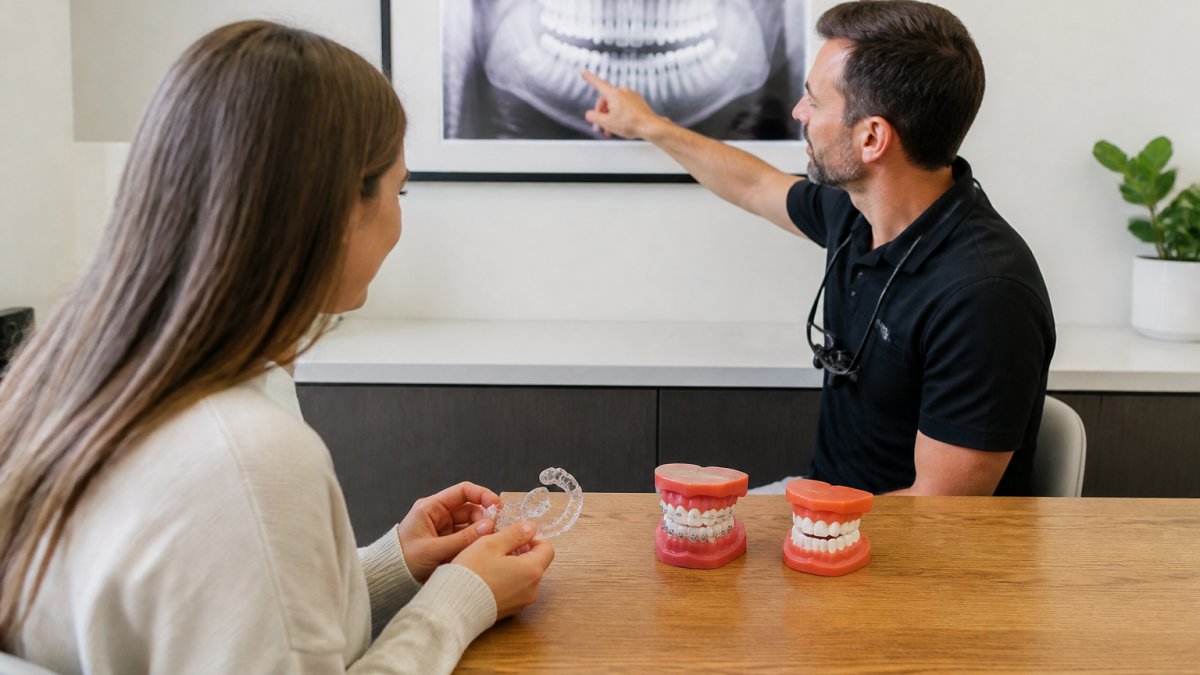
Start with severity. A mild dental overbite with no skeletal component responds to both options.
Consider your lifestyle. Invisalign requires discipline, 20-22 hours of daily wear.
Evaluate visibility concerns. If appearance during treatment matters significantly, Invisalign wins for most cases.
Factor in treatment duration. Braces often correct severe overbites faster than Invisalign.
Account for oral hygiene habits. Braces require meticulous brushing and flossing around brackets and wires, which challenges some patients.
Consider professional obligations. Adults in client-facing roles may prefer Invisalign's discretion.
| Factor | Invisalign | Traditional Braces |
|---|---|---|
| Best for mild overbites | Excellent | Excellent |
| Best for severe overbites | Limited | Superior |
| Visibility during treatment | Nearly invisible | Visible |
| Treatment speed | 12-36 months | Often faster for complex cases |
| Compliance requirement | High (20-22 hrs/day) | None (fixed appliance) |
| Oral hygiene | Easier (removable) | More challenging |
| Cost range | Similar to braces | Similar to Invisalign |
| Adjustment appointments | Every 6-8 weeks | Every 4-6 weeks |
Conclusion
When considering Invisalign vs braces overbite correction for adults, the choice comes down to your bite problem, lifestyle, and priorities. Mild dental overbites respond well to either method; severe or skeletal overbites typically favor braces for faster, more predictable results. At Trinity Dental Arts, our board-certified implantologist assesses each patient's situation and recommends the approach most likely to achieve your goals. Contact Trinity Dental Arts for a comprehensive overbite evaluation and personalized treatment recommendation tailored to your needs and timeline.
Frequently Asked Questions
Can Invisalign fix an overbite in adults?
Yes, Invisalign can correct many adult overbites, especially mild to moderate cases. Clear aligners apply gradual pressure to move teeth into proper alignment. However, the success depends on overbite severity, whether it's dental or skeletal, and patient compliance with wearing aligners 20-22 hours daily. Severe or complex overbites may require traditional braces or a combination of treatments. A qualified orthodontist can assess your specific case during a consultation.
How long does Invisalign take to fix an overbite?
Invisalign treatment for overbite correction typically ranges from 12 to 24 months, though some cases resolve faster. Mild overbites may take 12-18 months, while moderate cases often require 18-24 months. Severe overbites may take longer or may not be suitable for clear aligners alone. Treatment duration depends on overbite depth, your bite classification, and how consistently you wear your aligners. Your orthodontist will provide a more precise timeline after evaluating your bite.
Is Invisalign more comfortable than traditional braces for overbite correction?
Many adults find Invisalign more comfortable than fixed braces because the aligners are removable, smoother, and cause less mouth irritation. Traditional braces can cause soreness, especially after adjustment appointments, and may restrict eating. However, Invisalign requires discipline: removing aligners during meals and brushing before reinsertion adds daily steps. Both require an adjustment period. Comfort is subjective, but Invisalign's discreet nature appeals to adults concerned about appearance during treatment.
What is the cost difference between Invisalign and traditional braces for adults?
Invisalign and traditional braces typically fall in similar price ranges, though costs vary based on case complexity, treatment duration, and your insurance coverage. Both require an initial consultation and treatment plan. Insurance coverage and monthly payment plans often apply to both. For accurate pricing tailored to your specific overbite, contact your orthodontist or dental practice directly.