 how-to
How to Choose an Implant Dentist for Full Arch Teeth
Table of Contents
- Understanding Full-Arch Implant Dentistry and Provider Types
- Essential Dental Implant Dentist Qualifications to Verify
- Critical Questions to Ask a Dental Implant Dentist
- Evaluating Full-Arch Dental Implant Treatment Options
- Full-Arch Dental Implant Treatment Timeline and Recovery
- Understanding Full-Arch Dental Implant Cost and Financing
- Your Vetting Checklist for Full-Arch Implant Providers
- Frequently Asked Questions
Last Updated: October 6, 2026
Understanding Full-Arch Implant Dentistry and Provider Types
Learning how to choose an implant dentist for full arch teeth is one of the most important decisions you'll make for your oral health. Full-arch restoration replaces all teeth in one or both jaws with implant-supported teeth, requiring specialized training, experience, and a team approach.
Oral surgeons, periodontists, and prosthodontists
Oral surgeons handle surgical placement: extractions, bone grafting, and implant insertion.
Periodontists specialize in gum health and bone support, often managing the surgical phase and bone grafting.
Prosthodontists are restoration specialists who design the final teeth, manage bite alignment, and ensure long-term function, typically completing 2-3 years of additional training beyond dental school.
For full-arch cases, the best outcomes happen when these specialists collaborate, either within one practice or through referrals.
General dentists with implant training
Some general dentists complete implant training and handle full-arch cases. The key question is experience: a dentist placing 5-10 full-arch cases per year has very different expertise than one placing 50+.
Look for advanced implant training through recognized organizations, and ask specifically about full-arch case volume and outcomes, this matters more than the credential alone.
Essential Dental Implant Dentist Qualifications to Verify
Don't assume credentials are current or comprehensive. Verify them directly.
Advanced training and board certification
When determining how to choose an implant dentist for full arch teeth, verify they have:
- Completion of an accredited implant training program (typically 100+ hours minimum)
- Hands-on surgical experience under supervision
- Board certification or diplomate status (optional but valuable)
Board certification through organizations like the American Board of Oral Implantology/Implantologists (ABOI/ID) requires rigorous exams and ongoing case documentation. It's not required to place implants, but it signals commitment to staying current.
Ask: "Are you board-certified in implant dentistry? If not, what advanced training have you completed?" A hesitant answer is a red flag.
Full-arch experience and case volume
This is the single most important qualification for full-arch work. Ask directly: "How many full-arch cases have you completed?" Push for specific numbers.
Also ask: "What was your complication rate? How many cases required bone grafting? What percentage needed revisions?"
Critical Questions to Ask a Dental Implant Dentist
The consultation is your chance to assess whether a practice can deliver. Use the structure below to turn the conversation into a verifiable evaluation.
Surgery, prosthetics, and follow-up responsibilities
Full-arch treatment involves three phases: surgery, prosthetics, and long-term follow-up. You need clarity on who handles each, and what happens when handoffs fail.
Ask these questions and write down the answers:
- Who performs the implant surgery, an oral surgeon, periodontist, or general dentist? What is their specific full-arch case volume?
- Who designs and places the final restoration, a prosthodontist, general dentist, or in-house lab technician?
- If multiple providers are involved, who is the primary contact for you? Who coordinates the surgical and prosthetic phases?
A practice with in-house surgical and prosthetic capabilities can provide continuity.
Verifying credentials independently
Marketing language is not verification. Confirm the provider's standing through independent sources:
- State dental board: Confirm active licensure and check for disciplinary actions. Most state boards publish this online.
- Specialty board: If the provider claims to be a prosthodontist, oral surgeon, or periodontist, verify board certification through the corresponding American Board (e.g., the American Board of Prosthodontics, the American Board of Oral and Maxillofacial Surgery, or the American Board of Periodontology).
- Implant-specific credentials: The American Board of Oral Implantology/Implantologists (ABOI/ID) maintains a diplomate directory. Confirm any diplomate claim there.
Verify a dentist's license and disciplinary history through your state dental board
Outcomes, complications, and guarantees
Every implant case carries risk: infection, bone loss, implant failure, bite problems. Ask how your provider handles them, specifics, not reassurances.
Questions to ask:
- What is your implant success rate, and over what follow-up period? ()
- How many of your full-arch cases have required implant replacement, and what caused those failures?
- What is your complication rate for full-arch cases specifically, and how do you track it?
Documentation to request before you decide
Ask for these items in writing.
- A written treatment plan with itemized fees and a clear statement of what is and isn't included
- The name and credentials of every clinician involved in your care
- The practice's complication management and warranty policy
If a provider checks most of these boxes, you're on solid ground. If several are missing, keep looking.
Evaluating Full-Arch Dental Implant Treatment Options
Not all full-arch solutions are the same. Your bone structure, timeline, and goals determine which approach works best.
All-on-4, All-on-6, and immediate-load implants
All-on-4 uses four strategically placed implants to support a full arch.
All-on-6 uses six implants for added support and stability, often recommended when bone volume allows.
Immediate-load implants (same-day teeth) place a temporary restoration immediately after surgery, so you leave with teeth, not gaps.
Each option has trade-offs. Immediate-load offers convenience but requires precise planning; staged approaches take longer.
Diagnostic imaging and bone assessment
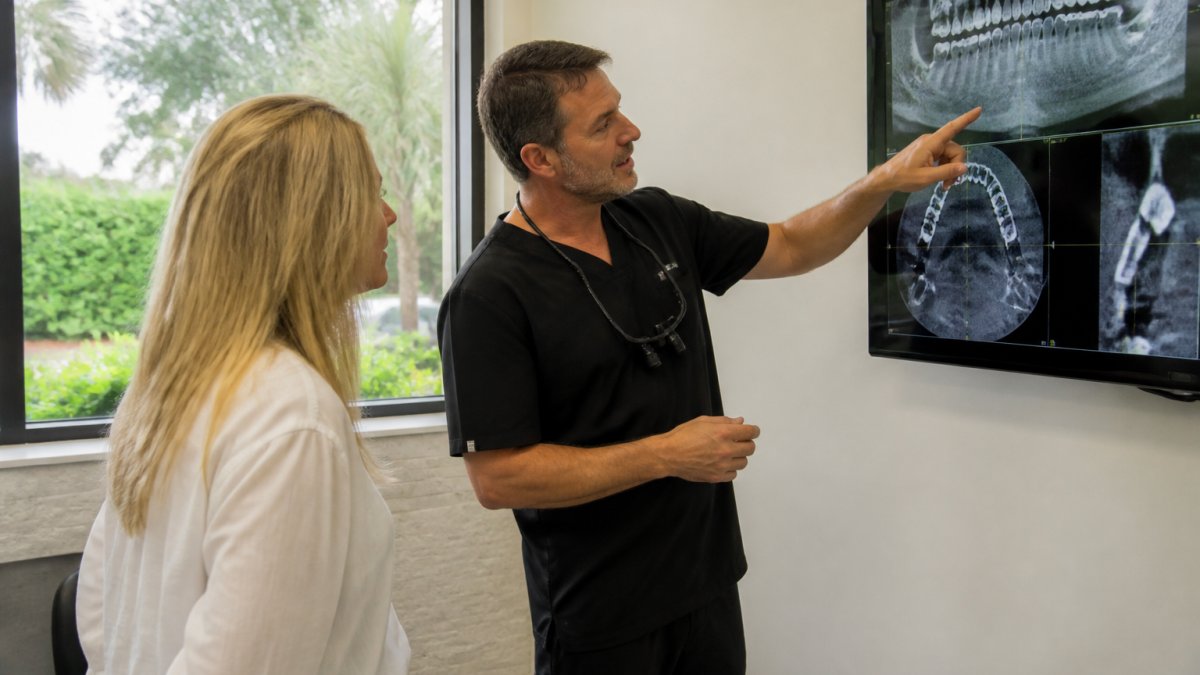
Before any implant work, your provider must assess bone density, volume, and quality using 3D cone beam CT (CBCT) imaging, not standard X-rays.
CBCT shows:
- Exact bone height and width
- Bone density (critical for implant success)
- Nerve and sinus locations (essential for safe placement)
If your provider doesn't order CBCT, they may not be able to plan a full-arch case safely without it.
During your consultation, ask to see your imaging. A provider can walk you through it, showing bone quality and explaining their recommended approach.
Full-Arch Dental Implant Treatment Timeline and Recovery
Full-arch restoration takes time. Understanding the timeline helps you plan.
Immediate-load vs. staged implant placement
Immediate-load timeline:
- Surgery and temporary restoration: Day 1
- Temporary teeth worn for 3-6 months while bone heals
- Final restoration placement: Month 3-6
Staged approach:
- Surgery: Month 1
- Healing without teeth: 3-6 months
- Temporary restoration: Month 4-7
Immediate-load can be faster if your case qualifies, not all patients have enough bone density for same-day teeth. Your provider should explain why you are or aren't a candidate.
Healing, temporary prosthesis, and final restoration
After implant placement, osseointegration (bone bonding to implants) takes 3-6 months. Your temporary restoration lets you eat and speak normally while bone heals.
Once osseointegration is complete, your provider removes the temporary teeth and places the final restoration, custom-made to your bite, appearance, and function, and typically fixed (cemented or screwed) to the implants.
Follow-up care matters: professional cleanings every 3-6 months and daily home care. Implants require maintenance like natural teeth.
Understanding Full-Arch Dental Implant Cost and Financing
Cost is a major concern for full-arch restoration. Transparency matters, but you also need a framework to compare plans apples-to-apples.
Factors affecting treatment cost
Full-arch implant cost varies based on:
- Number of implants (4, 6, 8, or more)
- Bone grafting needs (if bone is insufficient)
- Type of restoration (fixed bridge vs. removable denture on implants)
A full-arch case is a significant investment. Ask each provider to break their estimate into the categories below so you can compare like for like.
Comparing written treatment plans and total fees
Before committing, get a written treatment plan that itemizes every phase. Use this framework to compare plans from multiple providers side by side:
| Cost category | What to confirm in writing |
|---|---|
| Diagnostics | CBCT scan, panoramic X-ray, photos, models, included or billed separately? |
| Extractions | Number of teeth, surgical vs. simple, included or add-on? |
| Bone grafting | Type (socket preservation, sinus lift, block graft), site, and whether it's included or contingent |
| Implant hardware | Brand, number of implants, abutments, and whether premium vs. standard components are used |
| Temporary prosthesis | Is it included? Is it a fixed or removable temporary? How many adjustments are covered? |
| Final prosthesis | Material (acrylic, zirconia, hybrid), design, and whether it's included in the quoted price |
| Sedation or anesthesia | IV sedation, oral sedation, or local, included or separate? |
| Follow-up visits | Number and frequency included in the fee; what triggers an additional charge |
| Maintenance | Professional cleanings, screw tightening, and repair costs after the warranty period |
| Warranty and retreatment | What's covered, for how long, and what voids coverage |
Compare plans from multiple providers and look beyond the total price. A lower cost might mean fewer implants, lower-quality materials, or less experienced placement; a higher cost might reflect more comprehensive follow-up.
Ask: "Is this all-inclusive, or are there additional costs?" Hidden costs after treatment begins create frustration and mistrust.
Financing and payment considerations
Full-arch treatment is rarely paid in one lump sum. Common approaches:
- Third-party patient financing: Companies like CareCredit and LendingClub offer medical financing with varying terms. Compare APR, promotional periods, and whether interest accrues from day one.
- In-house payment plans: Some practices offer internal installment plans. Ask about interest, late fees, and what happens if you miss a payment.
- Dental savings plans: Membership programs can reduce fees for cleanings and some procedures, but usually don't cover major surgical work.
Questions to ask about cost before you commit
- Is the quoted price guaranteed, or can it change after surgery begins?
- What is the cost if an implant fails and needs replacement? Is that covered?
- Can I get a copy of the full fee schedule and warranty terms before I sign anything?
A provider who answers these questions clearly and in writing gives you what you need to decide.
Your Vetting Checklist for Full-Arch Implant Providers
Use this checklist when evaluating a full-arch implant dentist:
- Provider has completed advanced implant training (100+ hours minimum)
- Board certification or diplomate status in implant dentistry
- [ ]
If a provider checks most of these boxes, you're on solid ground. If several are missing, keep looking.
Choosing an implant dentist for full arch teeth requires more than credentials on a wall, it requires a provider who understands your situation, communicates clearly, and has the experience to handle complications.
Frequently Asked Questions
What qualifications should a full-arch implant dentist have?
A qualified full-arch implant dentist should have advanced training beyond dental school, such as a prosthodontics or oral surgery residency, or completion of accredited implant fellowship programs. Board certification through organizations like the American Board of Oral Implantologists/Implantologists (ABOI/ID) demonstrates expertise. Look for dentists with documented full-arch experience, successful case outcomes, and continuing education in advanced implant techniques. Verify credentials directly with licensing boards and professional organizations.
How long does full-arch dental implant treatment take?
Full-arch implant treatment timelines vary based on the approach. Immediate-load implants can provide fixed teeth on the same day or within 24 hours of surgery. Staged approaches typically take 4-6 months or longer, allowing bone to integrate with implants before the final restoration. The timeline depends on bone density, need for bone grafting, healing capacity, and the specific implant protocol your dentist recommends. Your dentist will provide a detailed timeline during the treatment planning consultation.
What questions should I ask at a dental implant consultation?
Ask about the dentist's experience with full-arch cases, the specific implant system they use, and who performs surgery versus prosthetic design. Inquire about diagnostic imaging (CBCT scans), whether bone grafting is needed, the timeline for your case, and what the total treatment cost includes. Ask about their complication rates, how they handle problems after treatment, and what long-term maintenance involves. Request references from previous full-arch patients and clarify their communication style and availability for follow-up care.
How much does full-arch dental implant treatment cost?
Full-arch implant costs depend on bone quality, the number of implants needed, whether bone grafting is required, implant materials, prosthetic design, and the dentist's experience level. Costs vary significantly based on location and treatment complexity. Rather than comparing generic price ranges, request a detailed written treatment plan from your dentist that itemizes each component. Ask about financing options and how your dental insurance applies. Trinity Dental Arts provides personalized quotes after a comprehensive evaluation of your specific needs.