 blog
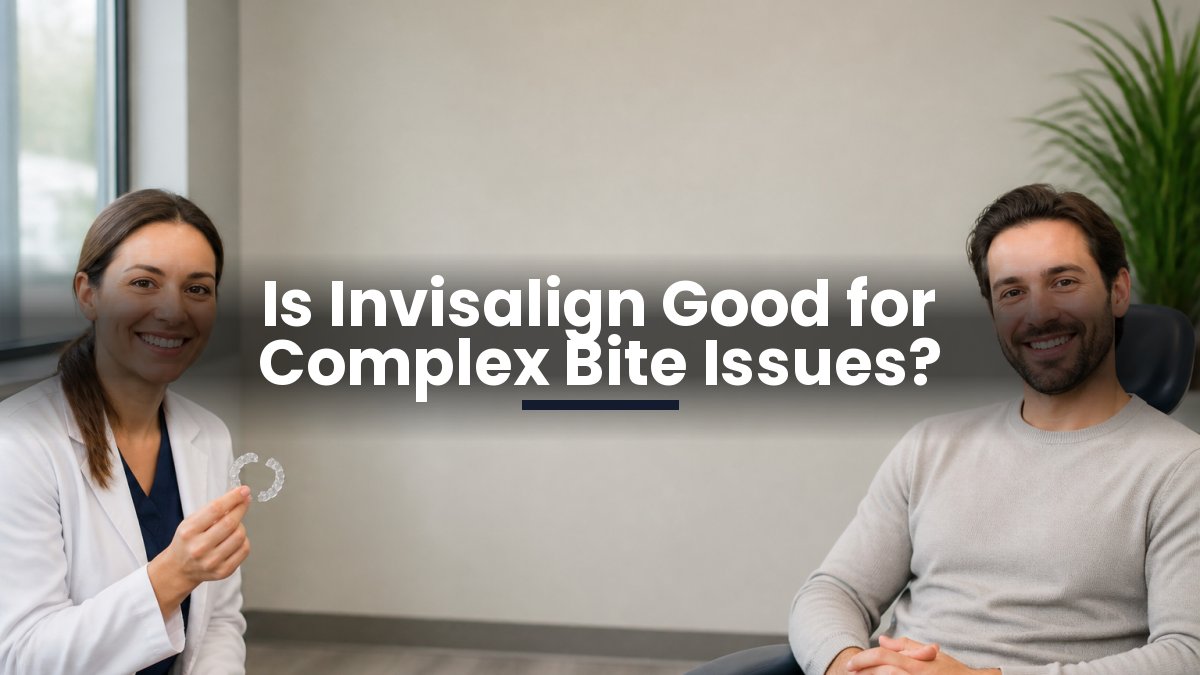
Is Invisalign Good for Complex Bite Issues?
Last Updated: October 27, 2026
Quick Summary
Invisalign can improve many bite problems, but it works best on mild to moderate cases, so is invisalign good for complex bite issues depends on how far the teeth or jaws must move. Complex bites involving jaw position may need additional appliances or a different plan. A clinician exam is needed to decide.
- Complex bites often involve a skeletal discrepancy, meaning the upper and lower jaws do not line up correctly.
- Aligners suit mild to moderate overbites, minor crossbites, spacing, crowding and modest tilting or rotation.
- Underbites and open bites are described as more demanding bite types for aligners.
- Missed trays or late check-in visits can add time to your overall treatment timeline.
- Ask your provider to compare both plans, including the fallback if teeth do not move as predicted.
Table of Contents
- What Counts as a Complex Bite Issue
- How Clear Aligners Move Teeth and Where That Works Well
- Invisalign Attachments for Bite Correction
- Invisalign vs Braces for Bite Correction
- How Long Does Invisalign Take to Fix a Bite?
- Invisalign Limitations for Complex Cases
- Booking a Bite Evaluation to Find Out Whether Invisalign Fits Your Case
- Frequently Asked Questions
If you have an overbite, underbite, crossbite or open bite, you have probably wondered whether clear aligners can fix it, and whether is invisalign good for complex bite issues or only for simpler cases. The short answer is that Invisalign can improve many bite problems, but it works best on mild to moderate cases. Complex bites may need additional appliances or a different plan.
What Counts as a Complex Bite Issue
A bite issue is complex when the problem involves the jaw position, not just the teeth. A simple misalignment usually comes down to crooked or crowded teeth. A complex one often involves a skeletal discrepancy, meaning the upper and lower jaws do not line up correctly.
Complexity also depends on how much movement is needed. Teeth that must travel far, rotate sharply or change height are harder to correct with aligners alone.
Overbite, Underbite, Crossbite and Open Bite
Each bite type behaves differently under treatment:
- Overbite: The upper front teeth sit well over the lower ones. Mild cases often respond well to aligners.
- Underbite: The lower teeth sit in front of the upper teeth. Because the jaw position is involved, these cases can be harder to treat.
- Crossbite: Some upper teeth sit inside the lower teeth when the mouth closes. Aligners can often address this, though severe cases may need more.
- Open bite: The front teeth do not touch when the back teeth close. This is one of the more demanding bite types for aligners.
How Clear Aligners Move Teeth and Where That Works Well
Aligners work best when the goal is tooth movement that is small and predictable. They are generally a good fit for:
- Mild to moderate overbites
- Minor crossbites
- Spacing and crowding
- Teeth that need to tilt or rotate a modest amount
Aligners tend to suit mild to moderate problems where the movement needed is small and predictable.
| Bite or issue | Aligner fit | Notes |
|---|---|---|
| Mild to moderate overbite | Often a good fit | Responds well to aligners |
| Minor crossbite | Often addressable | Severe cases may need more |
| Spacing and crowding | Good fit | Covered in the article's list |
| Modest tilting or rotation | Good fit | Small, predictable movement |
Invisalign Attachments for Bite Correction
Not every case needs attachments. Your provider will decide based on your specific bite. If you are also considering a smile goal, this comparison of Invisalign and veneers for a smile makeover lays out the differences.
Invisalign vs Braces for Bite Correction
A practical next step is to ask your provider to walk you through both plans for your bite: what each would involve, how long each would take, and what the fallback is if the teeth do not move as predicted. For a deeper side-by-side look at Invisalign vs braces for an adult overbite, the guide covers that exact choice.
How Long Does Invisalign Take to Fix a Bite?
Your overall timeline depends on how closely you follow the wear schedule and attend check-ins. Missed trays or late visits can add time.
Invisalign Limitations for Complex Cases
Aligners have real limits, and the most useful way to understand them is to connect each limit to a specific feature of the bite rather than the broad label of "severe." You can see Invisalign pricing and what treatment involves on the service page.
Signs the plan may need adjustment:
Booking a Bite Evaluation to Find Out Whether Invisalign Fits Your Case
If you are weighing Invisalign against other options, book an evaluation so a clinician can review your specific bite. Every case is different, and a clear answer comes from an exam, not a general guide. You can read about the doctor who would assess your bite and her credentials before booking.
Frequently Asked Questions
Can Invisalign fix complex bite problems?
Whether Invisalign is suitable for a particular bite depends on an individual clinical assessment.
Is Invisalign as effective as braces for correcting a bite?
A qualified dental professional can assess which treatment options may be appropriate for an individual bite.
How long does Invisalign take to correct a bite?
Treatment timing depends on the individual case and should be discussed with a qualified dental professional.
What bite problems are difficult to treat with Invisalign?
A qualified dental professional can assess whether aligners are appropriate for an individual bite.