 how-to
Can I Get All My Teeth Pulled and Replaced With Implants?
Table of Contents
- Is It Possible to Replace All Teeth With Implants?
- Dental Implant Candidacy Requirements
- Full-Arch vs. Single Dental Implants: Understanding Your Options
- The Surgical Procedure: What to Expect During Tooth Extraction and Implant Placement
- Full Mouth Restoration Recovery Timeline
- Full Arch Dental Implants Cost and Financing
- Alternatives to Full-Mouth Implants
- Life After Full-Arch Implants: Long-Term Maintenance and Quality of Life
- Frequently Asked Questions
Last Updated: September 26, 2026
Is It Possible to Replace All Teeth With Implants?
Yes, you can have all your teeth pulled implants, a procedure called full-arch dental implants or full-mouth restoration. This procedure, called full-arch dental implants or full-mouth restoration, is a permanent solution for missing teeth.
Full-arch implants anchor prosthetic teeth directly to your jawbone, fusing through osseointegration. Once stable, they support a fixed bridge or denture that looks and functions like natural teeth. The process takes months from extraction to final restoration.
Dental Implant Candidacy Requirements
Your jawbone must have sufficient density to support implants; years of missing teeth may require bone grafting. Overall health matters, uncontrolled diabetes, active gum disease, or heavy smoking can interfere with healing. You'll need strong oral hygiene habits, as gum disease around implants can cause failure.
Full-Arch vs. Single Dental Implants: Understanding Your Options
Single implants replace one or a few missing teeth with individual crowns, preserving remaining natural tooth structure. Full-arch implants replace an entire row of teeth in one procedure.
Common full-arch designs include all-on-four (four implants, less invasive and affordable), all-on-six (six implants for extra stability), and implant-supported bridges (multiple implants anchoring a fixed bridge). These solutions are ideal if you're missing most or all of your teeth.
The Surgical Procedure: What to Expect During Tooth Extraction and Implant Placement
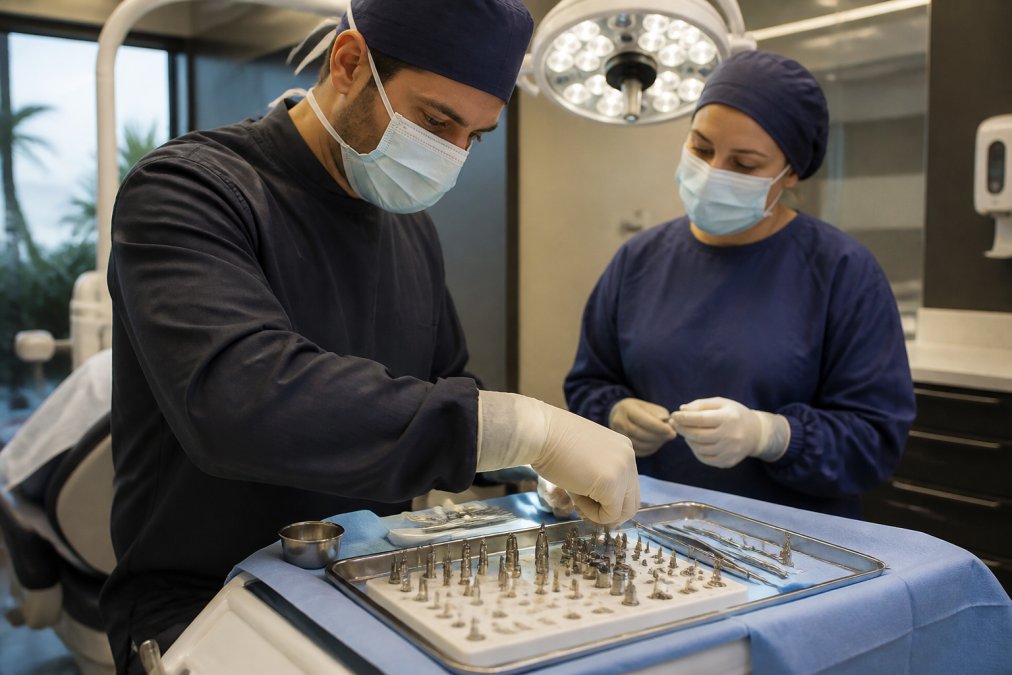
Your oral surgeon extracts remaining teeth pulled implants, preparing your jawbone and placing titanium posts under local anesthesia (with sedation available for anxious patients). The surgeon makes incisions to access the jawbone, creates holes for each implant, and threads the posts into place with precise angulation and depth. Gums are closed with stitches, and osseointegration, bone fusing with the implant surface, begins immediately.
Same-Day Extraction and Implant Procedures
Some patients qualify for same-day extraction and implant placement, reducing overall treatment time. Jawbone density and implant count determine eligibility. Healing still takes months before prosthetic teeth are attached.
Full Mouth Restoration Recovery Timeline
Recovery from full-mouth implant restoration unfolds over several months, with distinct phases. Understanding what to expect, including potential complications, helps you plan and recognize when something requires professional attention.
Immediate post-operative phase (Days 1-3): Swelling and discomfort peak in the first 48-72 hours. Ice for 20 minutes on/off during the first 24 hours. Bite gauze gently if bleeding occurs. Avoid rinsing, spitting forcefully, or using straws to prevent blood clot dislodgement. Sleep elevated on 2-3 pillows. Stick to cold, soft foods (yogurt, applesauce, smoothies, mashed potatoes, ice cream) and avoid hot foods for one week.
Early healing phase (Weeks 1-2): Swelling gradually decreases; bruising fades over 2-3 weeks. Most patients return to light work within 5-7 days. Continue soft foods and begin gentle warm salt water rinses (1/2 teaspoon salt in 8 oz water) after meals starting day 3-4. Avoid commercial mouthwash. Your surgeon will assess healing and remove stitches around day 7-10.
Intermediate healing phase (Weeks 2-6)
Discomfort subsides significantly. Most patients discontinue pain medication by week 2. You can resume normal oral hygiene around the surgical sites, though your surgeon will provide specific instructions on how to clean without disturbing healing tissue.
Gradually introduce more solid foods as comfort allows. Avoid chewing directly over implant sites. Most patients can return to normal work and light exercise (walking, gentle stretching) by week 3-4. Avoid heavy lifting, intense cardio, or contact sports for at least 4-6 weeks, as elevated blood pressure can increase bleeding and swelling.
Temporary dentures or a temporary prosthesis may be fitted during this phase, allowing you to maintain appearance and basic function while osseointegration occurs.
Osseointegration phase (Weeks 6-6 months)
This is the critical period when your jawbone fuses with the titanium implants. You won't feel this process, but it's essential for long-term stability. During this time, avoid habits that stress the implants: do not chew on ice, hard candy, or very tough foods. Smoking significantly impairs osseointegration and increases implant failure risk; if you smoke, this is the time to quit or reduce consumption dramatically.
Most patients feel fully recovered by week 6, with minimal swelling or discomfort. You can resume normal exercise, including weightlifting and high-impact activities, once your surgeon clears you (typically by week 6-8).
Your dentist will monitor osseointegration progress with periodic X-rays. At the 3-4 month mark, your surgeon may perform a simple test to assess implant stability.
Final restoration phase (Months 4-6)
Once osseointegration is confirmed (usually at the 4-6 month mark), your dentist removes the temporary restoration and attaches the final prosthetic teeth. This appointment involves minimal discomfort and typically takes 1-2 hours. You'll receive your new smile and detailed instructions on care and maintenance.
The entire process from extraction to final restoration typically takes 5-9 months, depending on bone quality, the number of implants, and whether bone grafting was needed.
Potential complications and warning signs
While most implant surgeries heal without incident, complications can occur. Contact your surgeon immediately if you experience:
- Excessive bleeding that doesn't stop after 30 minutes of gentle pressure
- Severe or worsening pain after day 3, especially if accompanied by fever (may indicate infection)
- Swelling that increases after day 4 or doesn't improve by week 2
- Numbness or tingling in your lip, chin, or tongue that persists beyond a few weeks (may indicate nerve irritation)
- Implant mobility or movement (implants should feel completely stable)
- Pus or foul odor from the surgical site (signs of infection)
- Fever above 101°F within the first week
Peri-implantitis, an inflammatory condition affecting the bone around implants, can develop months or years after placement if oral hygiene lapses or gum disease develops. Early signs include bleeding when flossing around implants, persistent bad breath, or gradual bone loss visible on X-rays. This condition requires professional treatment and, if severe, can lead to implant failure.
Psychological adjustment
Beyond physical healing, many patients experience an emotional transition. If you've worn dentures for years, implants feel remarkably different, more stable, more natural, and more permanent. Some patients report initial anxiety about the permanence or adjustment to the new sensation. This is normal. Most patients report that the psychological benefit (restored confidence, improved self-image, freedom from denture anxiety) exceeds their expectations within 2-3 months of receiving their final restoration.
Post-operative care essentials
Follow your surgeon's instructions precisely. Attend all follow-up appointments. Proper healing during these critical months directly determines how long your implants last.
Full Arch Dental Implants Cost and Financing
Full-mouth implant restoration is a significant financial commitment. Understanding the cost structure, insurance landscape, and financing options is essential for planning.
Cost breakdown and variables
Full-arch implant costs depend on several factors:
- Number of implants: All-on-four systems use fewer implants than all-on-six or traditional full-arch designs, affecting total cost.
- Bone grafting requirements: If your jawbone lacks sufficient density, bone augmentation adds $2,000 to $12,000 to your treatment plan.
- Extraction complexity: Surgical removal of remaining teeth, especially impacted or severely decayed teeth, increases procedural time and cost.
- Prosthetic design: The final restoration material (acrylic, porcelain, or hybrid) and whether it's fixed or removable impacts pricing.
- Geographic location and provider experience: Specialists and urban practices typically charge more than general dentists in rural areas.
Dental insurance vs. medical insurance
Financing and payment strategies
- Dental financing plans: Companies like CareCredit and Alphaeon Credit offer promotional periods (often 12-24 months) with zero interest if paid in full within that window. Interest rates after the promotional period typically range from 18-29%.
- Health Savings Accounts (HSAs): If you have a high-deductible health plan, you can use pre-tax HSA funds to pay for implants, reducing your taxable income.
- In-house payment plans: Many practices offer 3-6 month payment plans with little or no interest, though terms vary.
- Medical credit cards: Some patients use cards designed for healthcare expenses, which may offer better rates than general credit cards.
Long-term cost perspective
Insurance claim timing
Alternatives to Full-Mouth Implants
If full-arch implants don't fit your situation, other options exist.
Life After Full-Arch Implants: Long-Term Maintenance and Quality of Life
Once your implants are fully healed and your prosthetic teeth are in place, life changes significantly. Most patients report improved confidence and comfort.
Frequently Asked Questions
What disqualifies you from getting dental implants?
Several factors can affect implant candidacy. Insufficient jawbone density is the most common barrier, though bone grafting can address this. Active gum disease must be treated first. Uncontrolled diabetes, heavy smoking, and certain medications that affect bone healing may complicate treatment. Severe health conditions affecting immune function or bone metabolism require careful evaluation. A clinical evaluation with an oral surgeon or periodontist determines your specific eligibility and whether preparatory procedures are needed.
How long after tooth extraction can you get implants placed?
Timing varies based on your situation. Immediate loading places implants the same day as extraction. Traditional osseointegration typically requires 3-6 months of healing before the implant fuses with the jawbone. Your oral surgeon will assess bone density and quality to recommend the best timeline. Some patients benefit from bone grafting before implant placement, which adds 4-6 months to the overall process. A treatment plan developed during your consultation will outline your specific timeline.
What is the recovery period after full-mouth tooth extraction and implant placement?
Initial recovery takes 1-2 weeks, during which you manage swelling, discomfort, and dietary restrictions. Most patients return to normal activities within this timeframe. However, complete osseointegration, where the implant fuses with the jawbone, takes 3-6 months. During this healing period, you avoid heavy chewing on the surgical sites. Temporary prosthetic teeth may be worn during healing. Post-operative care instructions, including medication and follow-up appointments, ensure proper healing. Full restoration typically occurs 6-12 months after surgery.
Is same-day tooth extraction and implant placement really possible?
Yes, same-day or immediate loading procedures are possible for qualified candidates. Immediate loading places a temporary prosthetic tooth on the implant the same day as extraction, allowing you to leave with teeth. This requires excellent bone density and surgical precision. Not all patients are candidates, your jawbone must be strong enough to support immediate loading. Traditional osseointegration may be safer for some cases. Your oral surgeon will determine feasibility during a clinical evaluation and imaging assessment.
If you're missing teeth and considering permanent restoration, a consultation with an implant specialist is the first step. Trinity Dental Arts offers comprehensive evaluation and advanced implant solutions, including same-day full-arch teeth and in-house lab services for precision care. Schedule your consultation to discuss whether full-arch dental implants are right for your situation and learn about your specific treatment timeline and options.