 how-to
What to Expect During Implant Surgery
Table of Contents
- How to Prepare for Implant Surgery
- Anesthesia and Sedation Options for Implant Surgery
- The Step-by-Step Implant Surgery Procedure
- Dental Implant Recovery Timeline: What to Expect Week by Week
- Dental Implant Surgery Pain Management and Discomfort Relief
- Dental Implant Post-Operative Care Instructions for Healing
- Managing Anxiety and Planning Finances for Implant Surgery
- Frequently Asked Questions
Last Updated: September 16, 2026
How to Prepare for Implant Surgery
Knowing what to expect during implant surgery starts long before you sit in the chair. Preparation is where most of the outcome is decided, and it's the part patients underestimate. Preparation is where most of the outcome is decided, and it's the part patients underestimate.
Medical and Medication Review
Your surgeon needs a complete picture of your health before planning the procedure. Expect a review of your medical history, current medications, and any conditions that affect healing, such as diabetes or bleeding disorders. Blood thinners, certain supplements, and some prescriptions may need adjusting in the days before surgery. Never stop a medication on your own; your dental team coordinates that with your physician.
The American Dental Association's guidance on dental implant treatment notes that a thorough health assessment is essential before any implant placement.
Fasting, Arrival, and Day-of Logistics
If you're receiving sedation, you'll typically be asked to fast for a set number of hours beforehand. Your practice will give you the exact window. Arrange a ride home, wear comfortable clothing, and skip makeup or jewelry that interferes with monitoring equipment. Plan for a few hours at the office, not a quick visit.
A common mistake is scheduling surgery the day before a big work commitment. Give yourself a buffer.
Anesthesia and Sedation Options for Implant Surgery
Implant surgery is usually performed under local anesthesia, which numbs the treatment area while you stay awake. For patients who want more comfort, sedation dentistry offers options ranging from mild oral sedatives to deeper intravenous sedation. The right choice depends on the complexity of the procedure, your anxiety level, and your health history.
Most single implants are straightforward under local anesthesia alone. Full-arch or bone grafting cases often call for sedation. Discuss the options openly with your surgeon; there's no prize for white-knuckling it.
The Step-by-Step Implant Surgery Procedure
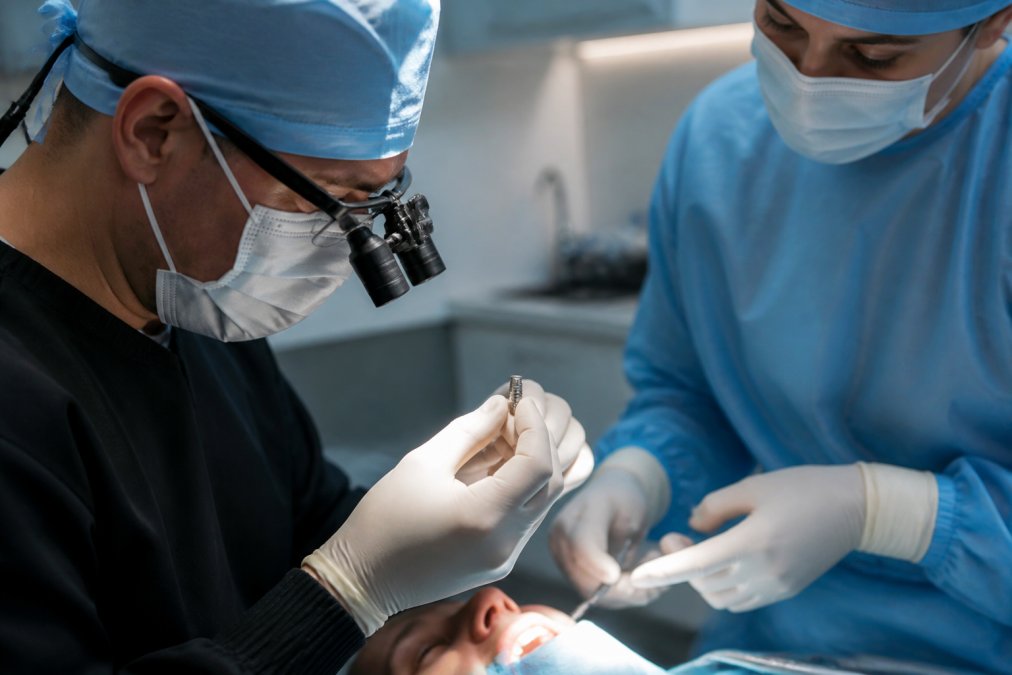
Here's the sequence most patients experience. The steps below describe a standard single-tooth implant; your plan may vary based on bone quality, location, and whether grafting is needed.
Incision, Site Preparation, and Implant Placement
- Anesthesia and set-up. The surgeon confirms the site with a pre-operative X-ray or CBCT scan, then administers local anesthesia. You'll feel pressure and vibration, not sharp pain.
- Flap elevation. A small gum incision is made and the tissue is gently lifted to expose the jawbone. Some surgeons use a flapless approach guided by a surgical stent when bone and tissue conditions allow.
- Osteotomy (site preparation). A series of progressively wider drills prepares the implant site to the correct width and depth. Each drill runs at a controlled speed with saline irrigation to keep the bone cool; overheating is one of the main causes of early implant failure, so this step is slower than patients expect.
- Implant placement. The titanium post, also called the implant body, is threaded into the bone at a specific torque. Surgeons aim for primary stability, measured as insertion torque or resonance frequency, because that number drives every decision that follows.
- Healing cap or abutment. A healing abutment or cover screw is attached, and the tissue is closed around it with sutures.
A single implant typically takes 30 to 60 minutes from incision to sutures. Multiple implants, grafting, or full-arch cases can run two to four hours.
Bone Grafting and Temporary Prosthesis
If jawbone density is insufficient, bone grafting is performed during the same visit or in a prior stage. Graft material, which may be your own bone, donor bone, or a synthetic substitute, supports new bone growth, and the implant may be left to heal for three to six months before the final restoration is attached.
In some cases, a temporary prosthesis is placed the same day so you leave with a tooth. Whether that's possible depends on implant stability at placement, which your surgeon assesses in the moment. High insertion torque in good bone often allows immediate loading; low stability usually means a delayed approach.
What You'll Actually Feel and Hear
Patients consistently describe three sensations: pressure as the implant is threaded in, vibration from the drill, and the taste or smell of saline. None of these are pain. If you feel anything sharp, raise your hand, the surgeon can top up anesthesia at any point. Knowing this in advance removes most of the surprise.
Dental Implant Recovery Timeline: What to Expect Week by Week
The dental implant recovery timeline varies, but most patients follow a predictable arc. The surgical site typically heals on the surface within one to two weeks, while osseointegration, the process where bone fuses to the implant, takes several months.
| Phase | Typical Timeframe | What's Happening |
|---|---|---|
| Days 1-3 | Immediate | Swelling, minor bleeding, soreness peak |
| Week 1-2 | Early healing | Soft tissue closes, sutures removed |
| Weeks 3-8 | Consolidation | Discomfort fades, diet normalizes |
| Months 3-6 | Osseointegration | Implant fuses with bone |
| After healing | Restoration | Final crown or prosthesis attached |
Your surgeon confirms progress at follow-up appointments before the final restoration is made.
Dental Implant Surgery Pain Management and Discomfort Relief
Dental implant surgery pain management is more manageable than most patients expect. Over-the-counter pain relievers handle the majority of cases. Ice packs for the first 24 to 48 hours reduce swelling and bruising.
A common mistake is waiting until pain peaks to take medication.
Dental Implant Post-Operative Care Instructions for Healing
Dental implant post-operative care instructions matter as much as the surgery itself. Follow them closely for the first two weeks.
- Avoid vigorous rinsing, spitting, or straws for the first 24 hours.
- Eat soft, cool foods; skip hot, spicy, or crunchy items.
- Take all prescribed medications exactly as directed.
- Keep your head elevated when resting for the first few nights.
Oral Hygiene and Follow-Up Appointments
Resume gentle oral hygiene as directed, usually with a soft brush and prescribed rinse. Don't scrub the implant site. Attend every follow-up appointment; these visits catch problems while they're still minor. Long-term, implants need the same care as natural teeth, plus regular professional cleanings.
Managing Anxiety and Planning Finances for Implant Surgery
Two things derail patients more than pain: fear and cost. Most clinical guides skip both. Here's the practical version.
Managing Dental Anxiety Before and During Surgery
Dental anxiety is common, and implant patients often carry years of avoided care. A few techniques that actually help:
- Schedule a dry run. Ask to sit in the operatory, see the instruments, and meet the surgical assistant before surgery day.
- Agree on a stop signal. Raise your left hand to pause. Knowing you can halt the procedure at any moment is a strong anti-anxiety tool.
- Bring noise-cancelling headphones and a playlist. The drill sound is a common trigger; masking it can change the experience.
- Ask about sedation depth. Nitrous oxide wears off within minutes and lets you drive yourself home. Oral sedatives (such as triazolam) require a driver and last several hours. IV sedation is the deepest option short of general anesthesia and is typically reserved for longer or more complex cases.
- Consider a morning appointment. Anxiety tends to build through the day; getting it done early shortens the anticipation window.
Navigating Insurance and Out-of-Pocket Costs
- The surgical phase, consultation, imaging, extractions, bone grafting, and implant placement.
- The restorative phase, the abutment and the final crown, bridge, or denture.
- Is the implant body itself a covered benefit, or only the crown?
- Is bone grafting covered, and does it count toward my annual maximum?
- What is my annual maximum, and how much of it will this treatment consume?
If coverage is thin, ask about:
- In-office payment plans with no interest for 6 to 24 months.
- Third-party financing (CareCredit and similar medical lenders are widely accepted).
- Health savings or flexible spending accounts, implant treatment is generally an eligible medical expense.
- Staging treatment across two calendar years to reset your annual maximum.
The EXTERNAL_LINK: American Dental Association on [dental financing | ada.org] offers general guidance on navigating costs and payment options.
Frequently Asked Questions
What is the most painful part of dental implant surgery?
Most patients report that the actual surgery is not painful because local anesthesia or sedation dentistry numbs the area completely. The most uncomfortable part tends to be the first 24 to 72 hours after the numbing wears off, when swelling, minor bleeding, and soreness peak. Over-the-counter pain relievers and cold compresses usually manage this well. If pain increases sharply after day three, call your oral surgeon, as it could signal a complication.
How many days should you rest after a dental implant?
Plan to take it easy for at least 24 to 48 hours after implant surgery. Most people can return to desk work within two to three days, but avoid strenuous exercise, heavy lifting, and bending over for at least a week to protect the implant site and reduce bleeding. Your dentist will give you specific guidance based on the complexity of your procedure and your overall dental health.
Is dental implant surgery performed under general anesthesia?
General anesthesia is rarely needed for routine implant placement. Most procedures use local anesthesia to numb the jaw, sometimes combined with sedation dentistry such as oral sedatives or IV sedation to keep you relaxed. Your oral surgeon will recommend the right option based on the number of implants, whether bone grafting is required, and your level of anxiety. Discuss your preferences and medical history during your consultation.
What should I eat during the dental implant recovery timeline?
Stick to soft, cool foods for the first few days: yogurt, smoothies, mashed potatoes, scrambled eggs, and soup. Avoid hot, spicy, crunchy, or sticky foods that can irritate the implant site. As swelling subsides, gradually add softer proteins like fish and well-cooked vegetables. Proper nutrition supports the healing process and helps maintain your energy. Your dentist can provide a more detailed dietary plan tailored to your recovery.