 blog
blog
Prestige Dentistry Alternative for Implants
Table of Contents
- Why Patients Seek Alternatives to Prestige Dentistry for Implants
- What Are Dental Implants and How Do They Compare to Other Solutions
- Board-Certified Implantologist Benefits and What to Look For
- Same-Day Dental Implants Procedure: Timeline and Expectations
- Dental Implant Consultation Checklist: Questions to Ask Before Committing
- In-House Dental Lab Advantages for Implant Quality and Speed
- Fixed Bridges, Dentures, and Implant-Supported Options Compared
- Bone Density, Long-Term Cost, and Psychological Factors in Your Decision
- Frequently Asked Questions
Last Updated: September 3, 2026
Why Patients Seek Alternatives to Prestige Dentistry for Implants
Many patients assume major dental chains are their only option for implants. The reality is more nuanced. Patients seek Prestige Dentistry alternative for implants because they want a board-certified implantologist who takes time during consultation, need same-day or expedited solutions, prefer in-house lab capabilities for quality control, or prioritize comfort and long-term outcomes over volume.
At Trinity Dental Arts, we understand why patients explore their options. Some come after feeling rushed at larger surgical centers. Others have had anxiety-inducing experiences and need a gentler approach. The key insight is this: choosing a Prestige Dentistry alternative for implants isn't about settling for less. It's about finding a practice whose values, capabilities, and approach match your specific needs.
What Are Dental Implants and How Do They Compare to Other Solutions
Dental implants are artificial tooth roots made of biocompatible titanium surgically placed into the jawbone to support replacement teeth. Unlike removable dentures or fixed bridges, implants integrate with your bone through osseointegration, creating a stable foundation that functions like a natural tooth root.
When you lose a tooth, your jawbone gradually resorbs because it no longer has a root stimulating it. Dentures and bridges don't prevent this; implants actively preserve bone by transmitting chewing forces directly into the jaw, maintaining its structure for decades.
Fixed Bridges anchor artificial teeth to adjacent natural teeth but require grinding down healthy teeth, which removes protective enamel and can eventually compromise those teeth. Bridges typically last 10-15 years.
Removable Dentures rest on gums and remaining bone. They're affordable upfront but shift during eating and speaking, require daily removal and cleaning, and accelerate bone resorption.
Implant-Supported Dentures are removable dentures that clip onto implants. They provide more stability than traditional dentures and some bone preservation, but still require daily removal and cleaning.
Implants offer the most natural function and appearance, preserve bone, don't require modification of adjacent teeth, and can last 25+ years with proper maintenance.
Board-Certified Implantologist Benefits and What to Look For
Not every dentist who places implants is an implantologist. A board-certified implantologist has completed extensive postgraduate education in implant dentistry, passed rigorous examinations, and maintained continuing education requirements. Common certifications include DICOI, DABOI/ID, and MAGD.
General dentists can place implants after minimal training, but they lack the depth to handle complex cases, insufficient bone, multiple implants, medical complications, or aesthetic precision.
When evaluating a Prestige Dentistry alternative for implants, look for:
- Board certification in implant dentistry (DICOI, DABOI/ID, or equivalent)
- Membership in professional organizations like the International Congress of Oral Implantologists
- Years of specialized implant experience
- Continuing education in advanced techniques
- Willingness to handle complex cases
Trinity Dental Arts is led by Dr. Xhoana Gjelaj, who holds multiple implant certifications including DICOI and DABOI/ID, representing thousands of hours of specialized training and demonstrated expertise.
Same-Day Dental Implants Procedure: Timeline and Expectations
Same-day dental implants sound ideal, but understanding the actual timeline matters. True same-day implants (placing the implant and attaching a temporary crown in one appointment) are possible only for patients with adequate bone volume and density. If bone has resorbed significantly, bone grafting is needed first, requiring 4-6 months of healing before implant placement.
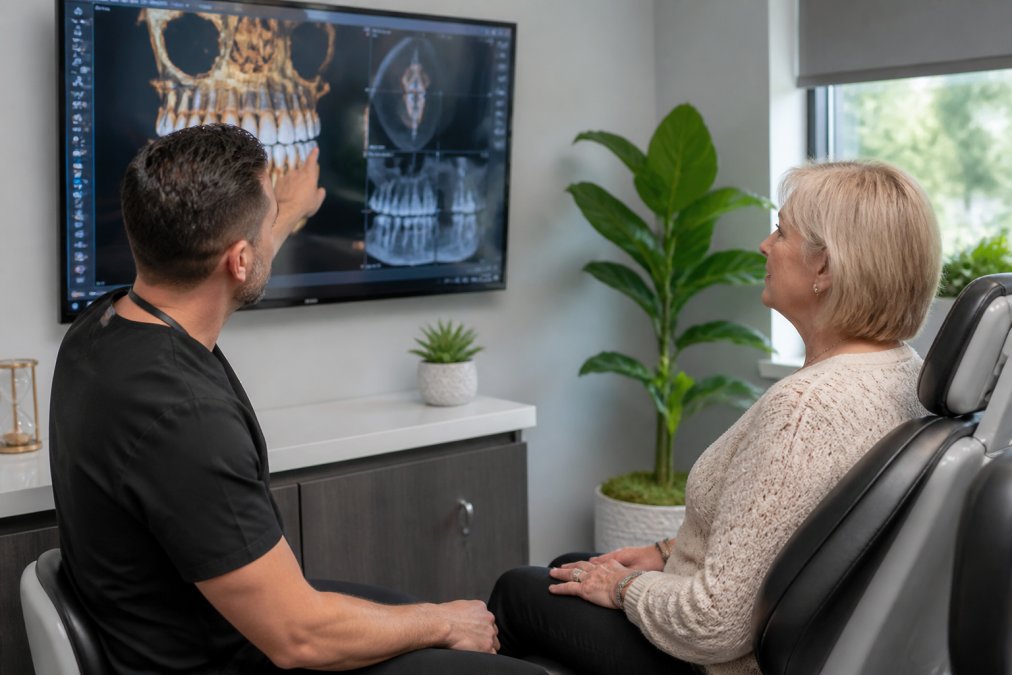
For candidates, here's the same-day process:
Initial Consultation (30-60 minutes): You meet with the implantologist to discuss goals, medical history, and tooth loss timeline. Advanced imaging (CBCT scan) assesses bone quality, density, and volume.
Treatment Planning (1-2 weeks): The implantologist uses specialized software to plan implant placement with precision. A surgical guide may be fabricated to ensure accuracy.
Implant Placement Surgery (60-90 minutes): You receive local anesthesia (and sedation if desired). The implantologist creates an opening in the bone, places the titanium implant, and ensures sufficient stability. A temporary crown is attached immediately or within the same day.
Osseointegration Period (3-6 months): The implant fuses with the bone. You wear the temporary crown and follow specific care instructions: soft foods, careful chewing, gentle oral hygiene.
Final Crown Placement (30 minutes): Once osseointegration is complete, the temporary crown is replaced with a permanent, custom-crafted crown.
The total timeline for a straightforward same-day implant case is typically 4-6 months from surgery to final restoration.
Dental Implant Consultation Checklist: Questions to Ask Before Committing
A thorough consultation reveals whether a practice is right for you. Ask these questions:
About Your Bone and Anatomy:
- What is my current bone volume and density? (Ask to see the CBCT scan)
- Do I need bone grafting?
- How many implants do I need, and where will they be placed?
- Are there anatomical factors (nerve location, sinus proximity) that affect my treatment plan?
About the Procedure and Timeline:
- Am I a candidate for same-day implants?
- What is the realistic timeline from surgery to final restoration?
- What are my restrictions during osseointegration?
- What happens if the implant doesn't integrate?
About the Implant and Crown:
- What implant system will you use? (Reputable brands: Nobel Biocare, Straumann, Zimmer Biomet)
- Who will design and fabricate my crown?
- What materials will the crown be made from?
- How long does the crown typically last?
About Complications and Guarantees:
- What are the risks of implant failure?
- If my implant fails, what happens?
- What is your success rate?
- How long have you been placing implants?
About Cost and Financing:
- What does treatment cost, and what's included?
- What does my insurance cover?
- Do you offer payment plans or financing?
About Your Comfort and Experience:
- How do you manage patient anxiety?
- Do you offer sedation options?
- Can I speak with other patients who've had implants placed by you?
A practice that answers these questions thoroughly, shows you imaging, discusses your specific anatomy, and doesn't rush you demonstrates the attention that correlates with better outcomes.
In-House Dental Lab Advantages for Implant Quality and Speed
The quality of your crown matters as much as the quality of your implant. Many practices send crown fabrication to external labs, creating inefficiencies and delays. If there's an issue with fit or color, the process repeats.
An in-house dental lab eliminates these intermediaries. The implantologist places the implant, takes a scan or impression, and hands it directly to the lab technician in the same building. The crown can be fabricated within hours. If adjustments are needed, they're made immediately.
This approach offers concrete advantages:
Speed: A crown can be ready in hours instead of weeks.
Quality Control: The implantologist and lab technician communicate directly with no lost information.
Precision: The lab technician understands the specific implant system, bone quality, and patient anatomy.
Customization: Your crown is crafted specifically for your implant and bite.
Accountability: The practice takes full responsibility for outcomes.
Trinity Dental Arts operates an in-house lab, meaning your implant restoration is designed and fabricated with direct oversight.
Fixed Bridges, Dentures, and Implant-Supported Options Compared
Fixed Bridges look natural and function reasonably well but require grinding down healthy teeth, which is irreversible. They typically last 10-15 years.
Removable Dentures are less expensive and don't require surgery but shift during eating and speaking, accelerate bone resorption, and require daily removal and cleaning. They need replacement every 5-8 years.
Implant-Supported Dentures provide more stability than traditional dentures and some bone preservation but still require daily removal and cleaning.
Implants offer the most natural function and appearance, preserve bone, don't affect adjacent teeth, and can last 25+ years.
| Solution | Lifespan | Bone Preservation | Adjacent Teeth Affected | Daily Maintenance | Cost Range |
|---|---|---|---|---|---|
| Fixed Bridge | 10-15 years | No | Yes (grinding required) | Brush normally | Moderate |
| Removable Dentures | 5-8 years | No (accelerates resorption) | No | Daily removal, cleaning, soaking | Low |
| Implant-Supported Dentures | 15-20 years | Yes (partial) | No | Daily removal, cleaning | Moderate-High |
| Dental Implants | 25+ years | Yes | No | Brush normally | High upfront |
For most patients with adequate bone, implants offer the best combination of longevity, function, and bone preservation.
Bone Density, Long-Term Cost, and Psychological Factors in Your Decision
Bone Density and the Implant Requirement
Implants require adequate bone volume and density. If you've been missing teeth for years, your jawbone has likely resorbed. A thorough implantologist will assess your bone using advanced imaging and discuss bone grafting needs upfront.
Dentures and bridges don't require bone density assessment but don't prevent bone loss either. As bone resorbs, dentures fit worse, requiring frequent adjustments and eventual replacement.
Long-Term Cost Analysis
Implants have higher upfront cost but last 25+ years with minimal maintenance. A traditional denture might cost less initially but requires replacement every 5-8 years. Over 25 years, you might replace it 3-5 times. The long-term cost approaches or exceeds implant cost.
A fixed bridge lasts 10-15 years, then requires replacement. If supporting teeth fail, you may need implants anyway. The long-term cost adds up.
Psychological Impact of Tooth Loss
Missing teeth affect your confidence, willingness to smile, social interactions, and career prospects. Studies consistently show that patients who restore missing teeth report improved quality of life, better self-esteem, and increased social engagement.
When evaluating your options, consider how each solution makes you feel. Do you feel confident eating in front of others? Do you feel comfortable smiling? These psychological factors are legitimate considerations.
When evaluating a Prestige Dentistry alternative for implants, you're assessing whether a practice understands your specific situation, bone quality, timeline, budget, and emotional needs. Trinity Dental Arts brings board-certified expertise, in-house lab capabilities, same-day implant options, and comprehensive care. If you're considering implants and want to explore whether our practice is the right fit, a consultation is the logical next step.
Frequently Asked Questions
Q: What are the primary alternatives to traditional dental implants?
A: The main alternatives to dental implants include fixed bridges, removable partial dentures, complete dentures, and implant-supported dentures. Fixed bridges anchor to adjacent teeth and offer good stability for single tooth replacement. Removable dentures are more affordable but require daily care and adjustment. Implant-supported dentures combine the stability of implants with removable convenience. Each option has different trade-offs in durability, comfort, and long-term cost. A board-certified implantologist can evaluate which solution fits your bone structure, budget, and lifestyle during a consultation.
Q: How do I evaluate the credentials of a dental implant provider?
A: Look for providers with board certification in implant dentistry, advanced training credentials (such as membership in the American Academy of Implant Dentistry), and specialized experience in full-mouth restoration or same-day solutions if that's your need. Ask how many implant cases they've completed and request before-and-after examples. Verify they use modern imaging and have an in-house lab for quality control. During your consultation, assess whether they explain your options thoroughly, address your anxiety concerns, and answer your questions without pressure to choose the most expensive treatment.
Q: What should I look for in a same-day dental implants consultation?
A: A thorough consultation should include a detailed assessment of your bone density and jaw structure, a discussion of your timeline and work schedule, an honest explanation of candidacy (not everyone qualifies for same-day solutions), and a clear treatment plan with realistic expectations. The provider should explain the same-day dental implants procedure step-by-step, discuss potential complications, and outline the restoration process. Ask about their in-house lab advantages and how that affects your timeline. They should also address your specific concerns, whether that's dental anxiety, cost, or previous bad experiences. A good consultation feels unhurried and educational, not sales-focused.
Q: Are there significant differences between local implant specialists and larger dental chains?
A: Local implant specialists often provide more personalized care, continuity with the same provider, and faster decision-making. Many maintain in-house labs, which can reduce turnaround time and improve precision. Larger chains may offer more convenient hours and multiple locations but often refer complex cases to outside specialists, adding cost and time. Local specialists typically spend more time on consultation and custom treatment planning. For full-mouth restoration or same-day solutions, working directly with a board-certified implantologist in a specialized practice often results in better outcomes and fewer complications than fragmented care across multiple providers.
This article was written using GrandRanker