 comparison
Invisalign vs Veneers for Smile Makeover: 2026 Guide
Table of Contents
- Invisalign vs Veneers: What Each Treatment Actually Does
- Key Differences: Invisalign vs Veneers Side by Side
- Is Invisalign Good for Complex Bite Issues?
- The Long-Term Biological Cost of Enamel Reduction
- Cost of Invisalign vs Veneers: What to Expect
- How Long Does a Smile Makeover Take?
- Retainer Compliance vs. Veneer Maintenance: The Ongoing Commitment
- Hybrid Treatment Planning: When You May Need Both
Last Updated: August 27, 2026
Invisalign vs Veneers: What Each Treatment Actually Does
Most patients arrive at a cosmetic dentistry consultation having already decided what they want, often based on social media transformations or assumptions about invasiveness. The reality is more nuanced: Invisalign vs veneers aren't competing solutions to the same problem. They address different problems entirely.
Invisalign is an orthodontic correction system. Porcelain veneers are a cosmetic dentistry restoration. One moves teeth; the other masks their appearance. Understanding that distinction is the foundation of every good treatment plan.
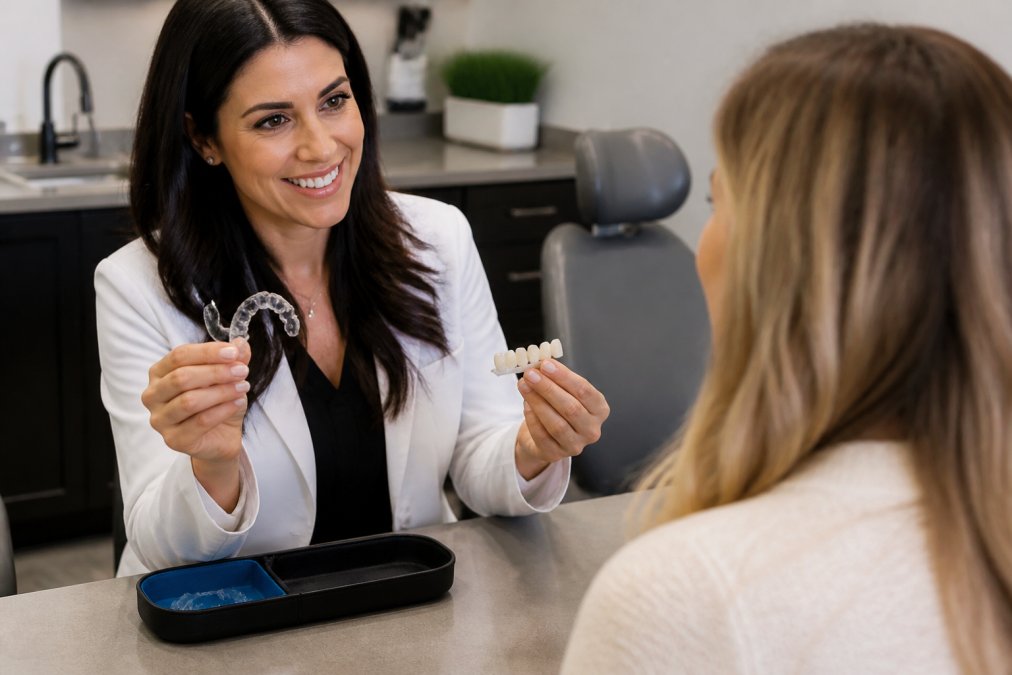
How Invisalign Works: Gradual Movement Through Orthodontic Correction
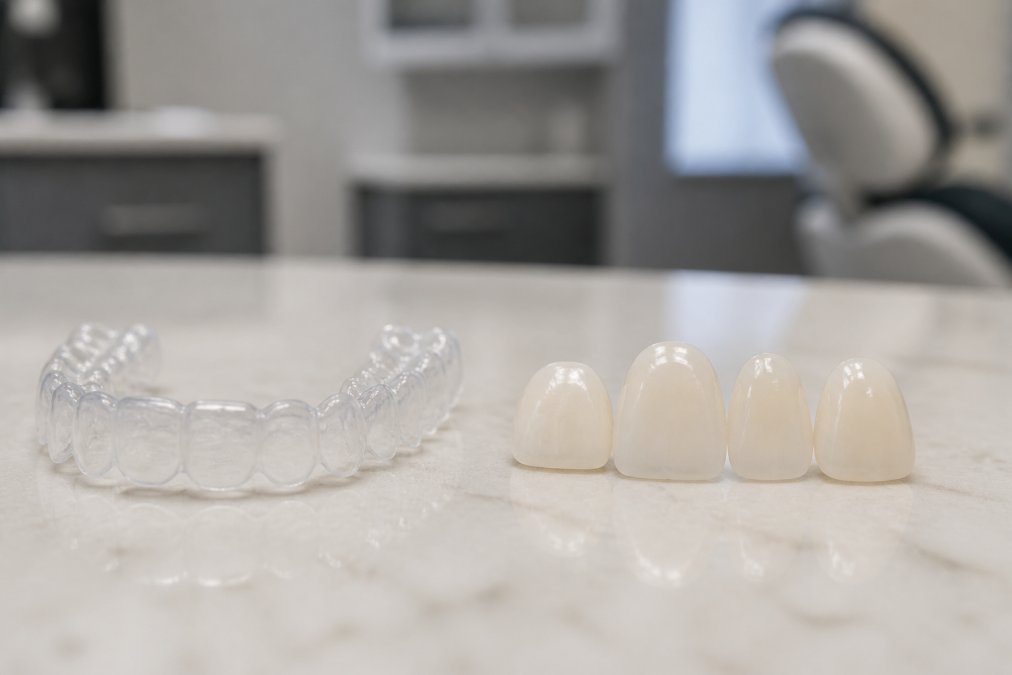
Invisalign uses custom-fitted, clear removable aligners made from SmartTrack material to apply controlled force to teeth over time. Each aligner shifts teeth incrementally, typically fractions of a millimeter per tray. Digital smile design technology maps the full orthodontic correction before manufacturing, allowing patients to preview projected outcomes.
Aligners must be worn 20 to 22 hours per day for optimal results. Treatment addresses malocclusion, bite alignment, crowding, spacing, and gaps. It does not change tooth color, shape, or surface texture. Teeth are repositioned through sustained, gentle pressure applied over months or years, with underlying tooth structure remaining entirely intact.
How Porcelain Veneers Work: Instant Transformation Through Cosmetic Dentistry
Porcelain veneers are thin, custom-made shells bonded to the front surface of teeth to correct aesthetic imperfections. They address discoloration, chips, irregular shapes, minor gaps, and surface wear. The visual change is dramatic and immediate compared to the gradual movement of aligner therapy.
The process requires removing a thin layer of enamel from the tooth surface before bonding. This makes veneers an irreversible procedure, once enamel is removed, the tooth requires permanent restoration. Composite resin veneers cost less but are less durable than porcelain veneers, which better mimic natural tooth enamel's light-reflecting properties.
Key Differences: Invisalign vs Veneers Side by Side
These two treatments overlap in one area only: both can improve smile appearance. Everything else diverges.
| Feature | Invisalign | Porcelain Veneers |
|---|---|---|
| Primary purpose | Orthodontic correction | Cosmetic dentistry restoration |
| Tooth structure | Fully preserved | Enamel reduction required |
| Reversibility | Fully reversible | Irreversible procedure |
| Treatment duration | 6-24 months (typical) | 2-4 dental visits |
| Addresses bite issues | Yes, including malocclusion | No |
| Addresses discoloration | No | Yes, highly stain resistant |
| Ongoing commitment | Retainer wear post-treatment | Replacement every 10-20 years |
| Best for | Misalignment, bite problems | Color, shape, surface aesthetics |
The most important distinction is reversibility. Choosing veneers commits a patient to that path permanently. Choosing Invisalign does not.
Is Invisalign Good for Complex Bite Issues?
Invisalign is effective for many bite alignment problems, including overbites, underbites, crossbites, and open bites. For mild to moderate malocclusion, Invisalign typically achieves excellent outcomes. For severe skeletal discrepancies, traditional fixed orthodontic appliances or surgical intervention may be more appropriate.
The key variable is whether the bite issue is dental or skeletal. Dental malocclusion, where teeth are mispositioned but the jaw relationship is sound, responds well to clear aligner therapy. Skeletal malocclusion, where the jaw bones themselves are misaligned, often requires more than orthodontic correction alone.
As documented in American Association of Orthodontists patient resources, clear aligner therapy now addresses many cases that previously required braces. However, a thorough clinical consultation remains essential before assuming Invisalign will handle a specific bite problem.
Veneers do nothing for bite alignment. A patient with a functional bite problem who chooses veneers to mask it may find the veneers chip or fracture over time because the underlying force distribution is wrong. This is one of the most common clinical mistakes: treating the appearance of a bite problem rather than the bite itself.
The Long-Term Biological Cost of Enamel Reduction
Enamel is the hardest substance in the human body and does not regenerate. When enamel is removed to prepare a tooth for a veneer, that enamel is gone permanently. The tooth now requires a restoration for life, because exposed dentin underneath is sensitive and structurally vulnerable without coverage.
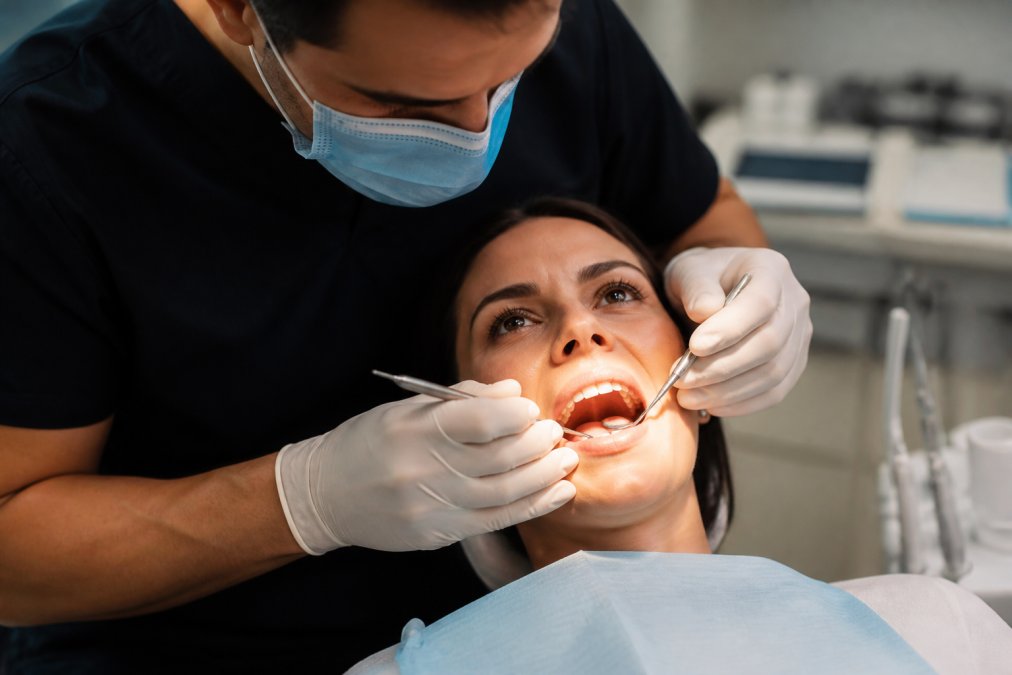
The amount of enamel removed for traditional porcelain veneers is typically described as "minimal," but minimal does not mean inconsequential. According to American Dental Association patient guidance on dental veneers, patients should understand that veneers are a permanent commitment before proceeding.
There is a compounding effect over time. Veneers last roughly 10 to 20 years with proper care. When they need replacement, the tooth is prepared again. Each replacement cycle carries some additional risk to remaining tooth structure and underlying periodontal health. A 35-year-old who gets veneers may need two or three replacement cycles over their lifetime.
Lumineers and minimal-prep veneers reduce this biological cost by requiring little to no enamel removal, making the procedure closer to reversible. The trade-off is that they may not suit more significant cosmetic corrections, and durability can be less predictable than traditional porcelain veneers.
Invisalign is minimally invasive in the truest sense. Tooth structure remains untouched throughout treatment. The only ongoing biological consideration is retainer wear, which preserves the orthodontic correction without altering any dental tissue.
Cost of Invisalign vs Veneers: What to Expect
The cost depends heavily on case complexity, the number of teeth involved, and the specific provider.
Invisalign treatment ranges based on case complexity. According to Invisalign official treatment information, treatment costs vary based on the length and complexity of the case. Shorter, limited treatments for minor corrections cost less than comprehensive full-arch orthodontic correction.
Porcelain veneers are priced per tooth. A full smile makeover typically involves six to ten veneers across the upper arch, which means the per-tooth cost multiplies quickly. Composite resin veneers cost less per tooth but typically require more frequent replacement.
Key cost considerations often overlooked:
- Invisalign includes retainers in many treatment plans, but replacement retainers after treatment are an ongoing cost.
- Veneer replacement is not optional when veneers reach the end of their lifespan. The tooth cannot be left unrestored.
- Insurance coverage for orthodontic treatment varies significantly by plan. Cosmetic veneers are rarely covered.
- Hybrid treatment plans that combine both treatments carry the combined cost of each.
For specific pricing at Trinity Dental Arts, a consultation is the right starting point.
How Long Does a Smile Makeover Take?
Treatment duration depends entirely on which treatment or combination of treatments is involved. Veneers can transform a smile in two to four dental visits over a few weeks. Invisalign requires months to years of active treatment followed by permanent retainer wear.
For veneers: the first visit typically involves tooth preparation, impressions, and temporary veneer placement. Permanent veneers are bonded at a second visit once the lab delivers custom restorations. With an in-house lab, this timeline compresses significantly.
For Invisalign: treatment duration depends on case complexity. Minor corrections may complete in six months. Comprehensive orthodontic correction for significant malocclusion commonly takes 18 to 24 months. Patients receive new aligner trays every one to two weeks and attend periodic progress appointments.
The practical implication: if the goal is purely aesthetic and teeth are structurally and positionally sound, veneers deliver results faster. If bite alignment or tooth position needs correction first, Invisalign sets the foundation, and cosmetic work follows. If both are needed, the orthodontic phase comes first.
Retainer Compliance vs. Veneer Maintenance: The Ongoing Commitment
Both treatments require a long-term commitment. Neither is truly "set it and forget it."
After Invisalign, retainer wear is permanent. Teeth have a natural tendency to shift back toward their original position, called relapse. Retainers, worn nightly or as directed, prevent this. Patients who stop wearing retainers often see gradual movement that undoes months or years of orthodontic correction.
Veneer maintenance is different in character but equally demanding. Porcelain veneers are stain resistant and durable, but not indestructible. Habits that damage natural teeth, such as grinding, nail biting, or using teeth as tools, will damage veneers faster. Patients with bruxism who choose veneers without addressing the grinding habit often see premature failure.
Oral hygiene with veneers requires the same diligence as with natural teeth. The veneer covers the front surface, but the margins where veneer meets tooth and the gumline remain vulnerable to decay and periodontal disease if oral hygiene is neglected.
The honest comparison: retainer compliance is a daily behavioral commitment with no biological downside if maintained. Veneer maintenance involves protecting a restoration that will eventually need replacement regardless of how well it is maintained.
Hybrid Treatment Planning: When You May Need Both
The most sophisticated smile makeover plans often combine orthodontic correction and cosmetic dentistry.
A patient with crowded teeth, a mild overbite, and significant surface discoloration is not a good candidate for veneers alone. Placing veneers on crowded teeth does not correct the crowding; it masks it, and bite forces on improperly positioned veneers accelerate wear and failure. The right plan: Invisalign first to correct alignment and bite, then veneers to address surface aesthetics that orthodontics cannot change.
Conversely, a patient with well-aligned teeth and a single discolored or chipped tooth does not need orthodontic treatment. A single veneer or composite resin restoration handles the aesthetic goal efficiently.
The hybrid planning process typically involves:
- A comprehensive clinical consultation assessing both functional bite alignment and cosmetic aesthetic goals.
- Digital smile design to model the projected outcome of each treatment phase.
- Orthodontic correction as the first phase if bite alignment or tooth position is involved.
- Cosmetic restoration as the second phase, with veneers, bonding, or other aesthetic treatments applied to teeth in their corrected positions.
As outlined in guidance from American Academy of Cosmetic Dentistry clinical resources, sequenced treatment planning that addresses functional concerns before cosmetic ones produces more durable and predictable outcomes.
Trinity Dental Arts approaches smile makeovers with this sequenced framework, combining Invisalign, cosmetic enhancements, and advanced restorative capabilities under one roof. The in-house lab allows for precise, custom-fitted restorations with faster turnaround than practices that outsource laboratory work, which matters when treatment involves multiple phases and coordination between orthodontic and cosmetic phases.
If a patient needs both treatments, the sequence matters as much as the choice of treatments. Getting the order wrong is expensive and sometimes irreversible.
Choosing between Invisalign and veneers is one of the most consequential decisions in cosmetic dentistry. The long-term biological cost of enamel reduction, the permanent nature of the veneer commitment, and the behavioral demands of retainer compliance all deserve honest discussion before treatment begins. Trinity Dental Arts provides comprehensive consultations that assess both functional and aesthetic goals before recommending any treatment path. With a board-certified implantologist, an in-house lab, and expertise across Invisalign and cosmetic dentistry, the practice is equipped to develop a sequenced treatment plan that addresses the full picture. Schedule a consultation with Trinity Dental Arts to get a clear clinical assessment of which path is right for your specific situation.
Frequently Asked Questions
Is it better to get veneers or Invisalign?
The better choice depends on your primary concern. Invisalign corrects the actual position of teeth through orthodontic correction, making it the right fit when bite alignment or malocclusion is the core issue. Veneers address aesthetic imperfections, discoloration, chips, gaps, and shape, without moving teeth. If your teeth are straight but cosmetically flawed, veneers deliver faster results. If misalignment is the problem, Invisalign treats the cause rather than masking it. A clinical consultation helps determine which path matches your dental health and aesthetic goals.
Are veneers considered a permanent dental procedure?
Yes. Porcelain veneers are considered an irreversible procedure because placing them requires removing a thin layer of enamel from the front surface of each tooth. Since enamel does not regenerate, the tooth will always require a veneer or crown for protection afterward. The veneers themselves typically last 10 to 20 years with proper care, but the underlying enamel reduction is permanent from the moment of preparation.
Can Invisalign fix gaps and alignment issues better than veneers?
For true gap closure caused by spacing between teeth, Invisalign produces a structurally sound result by physically moving teeth together. Veneers can close the appearance of small gaps by widening the veneer shape, but this is a cosmetic workaround, not orthodontic correction. For larger gaps or gaps linked to bite alignment problems, Invisalign is the clinically preferred approach. For very minor spacing where tooth movement is not needed, veneers or composite resin bonding may be sufficient.
Does insurance typically cover Invisalign or veneers for cosmetic purposes?
Dental insurance rarely covers veneers because they are classified as a cosmetic dentistry procedure. Invisalign coverage varies: some plans include a partial orthodontic benefit that applies to clear aligners, particularly when treatment addresses functional bite issues rather than purely aesthetic goals. The amount covered depends on your specific plan's orthodontic maximum and whether your provider is in-network. Contact your insurer directly and ask your dental office to submit a pre-authorization to clarify your benefits before starting treatment.
How long do porcelain veneers typically last compared to Invisalign results?
Porcelain veneers generally last 10 to 20 years before needing replacement, depending on oral hygiene habits, bite force, and whether you grind your teeth. Invisalign results, once treatment is complete, can last a lifetime, but only with consistent retainer wear. Without a retainer, teeth naturally drift back toward their original positions. The durability of both treatments depends heavily on long-term maintenance: veneer upkeep focuses on protecting the porcelain, while Invisalign results depend on retainer compliance.
This article was written using GrandRanker