 comparison
Is Full Mouth Restoration Worth It? A 2026 Guide
Table of Contents
- Is Full Mouth Restoration Worth It? The Bottom Line
- What Full Mouth Reconstruction Actually Involves
- Full Mouth Reconstruction vs. Smile Makeover: Know the Difference
- Understanding Full Mouth Reconstruction Cost and Financing
- Full Mouth Dental Implants Recovery Time: What to Expect
- Alternatives to Traditional Dentures: Weighing Your Options
- Long-Term Results: Lifespan, Maintenance, and the Psychological Payoff
- Conclusion: Deciding If Full Mouth Restoration Is Your Right Choice
- Frequently Asked Questions
Last Updated: September 7, 2026
Is Full Mouth Restoration Worth It? The Bottom Line
Full mouth restoration is a comprehensive dental rehabilitation that rebuilds or replaces all of the teeth in both arches to restore chewing function, speech clarity, and esthetics. Deciding whether full mouth restoration is worth it comes down to how severely tooth loss affects your daily quality of life. For patients living with dentures that slip, broken teeth that cause pain, or social withdrawal, the answer is almost always yes.
The real question is whether you understand what it demands of you. Below, we'll walk through what full mouth reconstruction involves, how much it costs, what recovery feels like, and why patients who commit rarely regret it.
What Full Mouth Reconstruction Actually Involves
Full mouth reconstruction is a branch of restorative dentistry that combines multiple procedures into one coordinated treatment plan, typically overseen by a prosthodontist or board-certified implantologist. Unlike a routine filling or single crown, it addresses the entire occlusal system: bite alignment, jaw position, gum health, and the structural integrity of every remaining tooth.
A complete reconstruction usually draws from several of these procedures:
- Dental implants to replace missing roots and prevent jawbone deterioration
- Crowns and bridges to rebuild damaged or decayed teeth
- Porcelain veneers for anterior teeth where appearance matters most
- Bone grafting where years of tooth loss have caused ridge resorption
- Periodontal therapy to establish healthy gum tissue before restoration begins
The process starts with a clinical assessment including dental imaging, bite analysis, and TMJ function review. Your dentist maps out the occlusal vertical dimension, then sequences the work so supporting structures are healthy before cosmetic layers go on top. This is why full mouth restoration takes months rather than weeks; each phase depends on the one before it.
Full Mouth Reconstruction vs. Smile Makeover: Know the Difference
A smile makeover and full mouth reconstruction serve different purposes. A smile makeover is elective cosmetic dentistry focused on aesthetics: whitening, veneers, and contouring. Full mouth reconstruction is functional restoration first, addressing the structural and biological problems that prevent normal chewing and speaking.
If your teeth are generally healthy but you dislike their appearance, a smile makeover is appropriate. If you have widespread decay, missing teeth, or advanced wear from bruxism, you need reconstruction before any cosmetic work can succeed.
| Factor | Smile Makeover | Full Mouth Reconstruction |
|---|---|---|
| Primary goal | Improve appearance | Restore function and health |
| Typical procedures | Veneers, whitening, bonding | Implants, crowns, grafting, orthodontics |
| Driven by | Cosmetic preference | Clinical necessity |
| Recovery | Minimal | Significant, phased |
| Insurance help | Rarely covered | Often partially covered |
Understanding Full Mouth Reconstruction Cost and Financing
Full mouth reconstruction cost is the single largest barrier for most patients and the hardest figure to quote because every case differs. A full-arch implant procedure using All-on-4 and individual implants for an entire mouth can be a significant investment. But the comparison that matters is cost over twenty years. Traditional dentures carry a lower initial price yet don't prevent bone resorption, which changes facial structure and requires repeated relines. Implant-supported restorations are designed for long-term durability and preserve bone in ways removable appliances cannot.
Dental insurance typically treats full mouth restoration as a mix of covered medical necessity and excluded cosmetic procedures. Most PPO plans cover diagnostic work, extractions, periodontal therapy, and bone grafting as medically necessary. However, implants, abutments, and final crowns are usually classified as major restorative work, and many plans have annual benefit caps.
A common pattern is staging treatment across calendar years to maximize annual benefits. Before committing, ask your dentist's coordinator to submit a pre-determination to your insurer, a formal request stating in writing what will be covered. It's not a guarantee of payment, but it gives you a concrete figure and prevents surprise denials.
If you lack dental insurance or have minimal coverage, third-party financing like CareCredit and LendingClub Patient Solutions offers revolving credit lines with promotional no-interest periods. After that, rates often revert to higher APRs, so paying off the balance within the window is critical. Some practices also offer in-house plans spreading cost over 24 to 60 months, though these may carry simple interest.
Many patients overlook Health Savings Accounts (HSA) or Flexible Spending Accounts (FSA). With a high-deductible health plan, you can contribute pre-tax dollars to an HSA for tax-free use on implants and crowns. An FSA also allows pre-tax contributions but is typically "use it or lose it" within the plan year. Pre-tax dollars reduce your cost by your marginal tax rate. Consult a tax professional about state deductions.
Don't underestimate the value of a second opinion. Treatment plans for full mouth restoration can vary between providers for the same clinical outcome, reflecting different philosophies on durability and maintenance. What matters is understanding the rationale behind each recommendation. A transparent practice walks you through the "why" behind each line item. At Trinity Dental Arts, we provide detailed treatment plans before any work begins.
Full Mouth Dental Implants Recovery Time: What to Expect
Full mouth dental implants recovery time follows a predictable pattern, but patients who expect to feel normal within a week are in for a surprise. Initial surgical recovery takes one to two weeks, with swelling, bruising, and dietary restrictions. You'll stick to soft foods, avoid strenuous activity, and manage discomfort with medication.
After implant placement, bone needs time to integrate with titanium posts through osseointegration, typically taking three to six months before permanent teeth attach. With same-day full-arch teeth, you'll leave with a fixed temporary set, load-bearing placeholders, not your final restoration.
- Week 1-2: Acute recovery, soft food diet, swelling management
- Week 2-8: Return to normal activity, continued soft food emphasis
- Month 3-6: Osseointegration phase, bone fuses to implants
- Month 6+: Final prosthetics placed, full chewing function restored
Alternatives to Traditional Dentures: Weighing Your Options
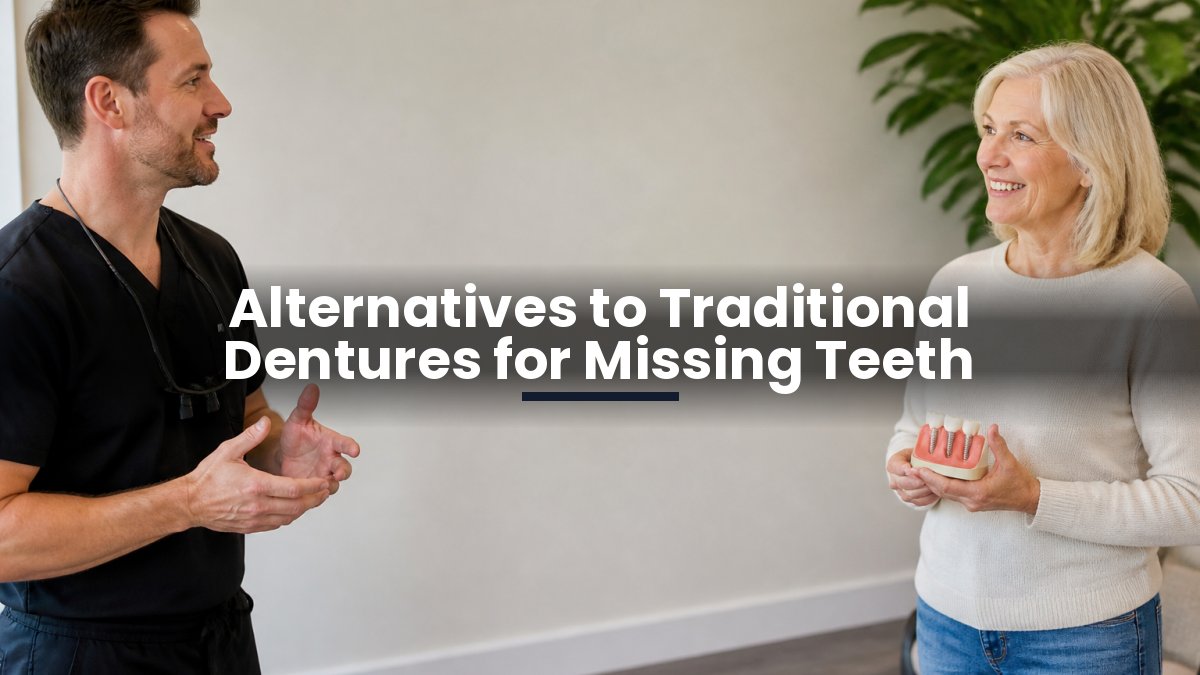
Alternatives to traditional dentures have improved dramatically, and the choice shapes both recovery and long-term satisfaction. Main options include implant-supported fixed bridges like All-on-4, individual implants for each missing tooth, and implant-supported removable overdentures.
All-on-4 uses four strategically placed implants per arch to support a fixed set of replacement teeth, often eliminating the need for bone grafting. Individual implants offer the most natural result but become cost-prohibitive when replacing an entire mouth, and require sufficient bone density at every site.
Traditional full dentures remain the lowest-cost entry point and require no surgery, but sacrifice stability, bone preservation, and confidence. Patients who switch to implants often describe it as life-changing, they can eat steak, laugh freely, and speak without worrying about shifting teeth.
| Option | Surgery Required | Bone Preservation | Stability | Relative Cost |
|---|---|---|---|---|
| Traditional dentures | No | Poor | Low | Lower |
| Implant-supported overdentures | Yes | Moderate | Moderate | Mid-range |
| All-on-4 fixed bridge | Yes | Good | High | Higher |
| Individual implants | Yes | Excellent | Highest | Highest |
Long-Term Results: Lifespan, Maintenance, and the Psychological Payoff
Long-term results depend more on daily habits than on the initial surgery. Implant-supported restorations are designed for decades of service but require disciplined oral hygiene, brushing twice daily, flossing or using interdental brushes around abutments, and regular professional cleanings to prevent peri-implantitis.
The clinical literature understates the psychological transformation. Patients who spent years hiding their smile report that restored function and speech clarity change how they show up professionally and socially. Eating comfortably at restaurants, speaking clearly in meetings, and smiling without self-consciousness carry a quality-of-life benefit that's difficult to quantify but impossible to ignore.

The maintenance routine is more specific than most patients realize. The interface between implant and crown creates a microscopic gap that breeds bacteria. Add two tools to your daily arsenal: interdental brushes (like Proxabrushes or TePe) to sweep along the gumline and abutment posts, and a water flosser (like Waterpik) to flush food particles and disrupt biofilm. For full-arch fixed bridges, a curved-tip attachment directs the stream under the bridge.
Your daily routine: brush with a soft-bristled or electric toothbrush using low-abrasive toothpaste for two minutes, clean around each abutment with an interdental brush, and finish with a water flosser on medium aimed at the gumline. This takes five to seven minutes and is non-negotiable. Skipping it leads to mucositis, a reversible inflammation; left untreated, it progresses to peri-implantitis with bone loss. Unlike natural teeth, implants are rigidly fused to bone, so the first sign of trouble is often silent bone loss detected only on X-ray.
Professional maintenance is more frequent than for natural teeth: cleanings every three to four months for the first year, then every four to six months. These are monitoring appointments, checking occlusion, probing gum pockets for inflammation, and taking X-rays to assess bone levels. Patients often skip them because everything feels fine, only to discover significant bone loss years later. A cleaning costs a fraction of treating peri-implantitis, which may require surgery or implant removal.
Managing parafunctional habits is critical. Clenching or grinding applies forces that can exceed implant component limits, porcelain or zirconia can chip, and abutment screws can loosen. A custom-fitted night guard is essential for patients with bruxism. Your dentist should fabricate a hard acrylic guard; wearing it nightly protects against micro-trauma that can cause catastrophic failure.
The lifespan of your restoration is not a single number. The implant fixture is designed to last a lifetime if healthy; prosthetic components have a finite lifespan. Porcelain-fused-to-metal crowns and all-zirconia or lithium disilicate prosthetics have varying lifespans. Acrylic teeth on overdentures may also need periodic replacement. These are normal wear-and-tear items; budgeting for replacements is part of long-term financial planning.
Conclusion: Deciding If Full Mouth Restoration Is Your Right Choice
Full mouth restoration is worth it for patients who understand they're investing in decades of function, confidence, and oral health. The decision requires honest self-assessment, realistic recovery planning, and a financial strategy accounting for the true long-term cost of doing nothing. Bone loss doesn't pause while you decide; it continues silently, making future treatment more complex and expensive.
At Trinity Dental Arts, our board-certified implantologist leads every full mouth restoration from the initial clinical assessment through final prosthetic placement, with our in-house lab ensuring precision at every step. We offer same-day full-arch teeth and same-day crowns, so you won't spend months waiting for a functional smile. If you're tired of dentures that slip, teeth that hurt, or the constant worry about your appearance, schedule a consultation and get a clear-eyed assessment of what restoration would require. Get started with Trinity Dental Arts and find out whether full mouth restoration is the right investment for your future.
Frequently Asked Questions
What is the downside of full mouth implants?
The main downsides are the significant upfront cost, the surgical nature of the procedure, and the recovery period. Full mouth reconstruction also requires a thorough clinical assessment to ensure you have adequate bone density and healthy gums. While the long-term benefits are substantial, the initial investment of time, money, and effort is considerable compared to non-surgical options.
How painful is full mouth reconstruction?
During the procedure itself, you will be anesthetized and should feel no pain. Post-operative discomfort is common and typically managed with prescribed medication. Most patients report that the pain peaks in the first 48 hours and subsides significantly within a week. Your dentist will provide detailed aftercare instructions to manage swelling and ensure a comfortable recovery.
What is the success rate of full mouth dental implants?
Full mouth dental implants have a high long-term success rate. Success depends heavily on your overall health, oral hygiene, and the skill of your implantologist. Choosing a board-certified implantologist, like those at Trinity Dental Arts, is critical to maximizing the longevity of your new teeth.
Can dental insurance cover any part of full mouth reconstruction?
Yes, but coverage varies widely. Most plans do not cover the cosmetic aspects of smile design or veneers. However, they may contribute to the restorative elements, such as the cost of extractions, diagnostic imaging, and some surgical procedures. It is essential to have a detailed treatment plan to submit to your insurer for a pre-determination of benefits to understand your exact out-of-pocket costs.