 how-to
Emergency Dental Care for Broken Teeth: What to Do
Table of Contents
- Is a Broken Tooth a Dental Emergency?
- Immediate Steps for Emergency Dental Care for Broken Teeth
- What to Do for a Chipped Tooth vs. a Severe Break
- Managing Pain and Swelling at Home
- How Long Can You Wait to Fix a Broken Tooth?
- Dental Emergency vs Urgent Care: Where to Go
- What to Expect During Your Same-Day Dental Visit
- Frequently Asked Questions
Last Updated: September 5, 2026
Is a Broken Tooth a Dental Emergency?
A broken tooth is a dental emergency when it involves severe pain, uncontrolled bleeding, or exposure of the inner pulp. Delaying care increases the risk of infection and permanent damage.
Not every chip warrants a middle-of-the-night call. Minor enamel fractures that cause no pain can often wait a day or two. However, any break that exposes the inner layers, causes significant bleeding, or results in sharp fragments that cut your tongue or cheek demands urgent attention.
Immediate Steps for Emergency Dental Care for Broken Teeth
Emergency dental care for broken teeth starts with staying calm and acting methodically.
Step 1: Rinse and Assess the Damage
Rinse your mouth gently with warm water to clear blood and debris. Do not scrub the area or use hot water. Examine the tooth in a mirror for visible cracks, missing pieces, or a reddish or pink spot inside the tooth, which indicates pulp exposure and requires urgent care.
Step 2: Control Bleeding and Reduce Swelling
If the break has caused bleeding, apply firm pressure with a clean gauze pad for ten minutes. For swelling, hold a cold compress against the outside of your cheek in fifteen-minute intervals. Avoid aspirin, since it thins the blood and can prolong bleeding.
Step 3: Preserve the Tooth Fragment
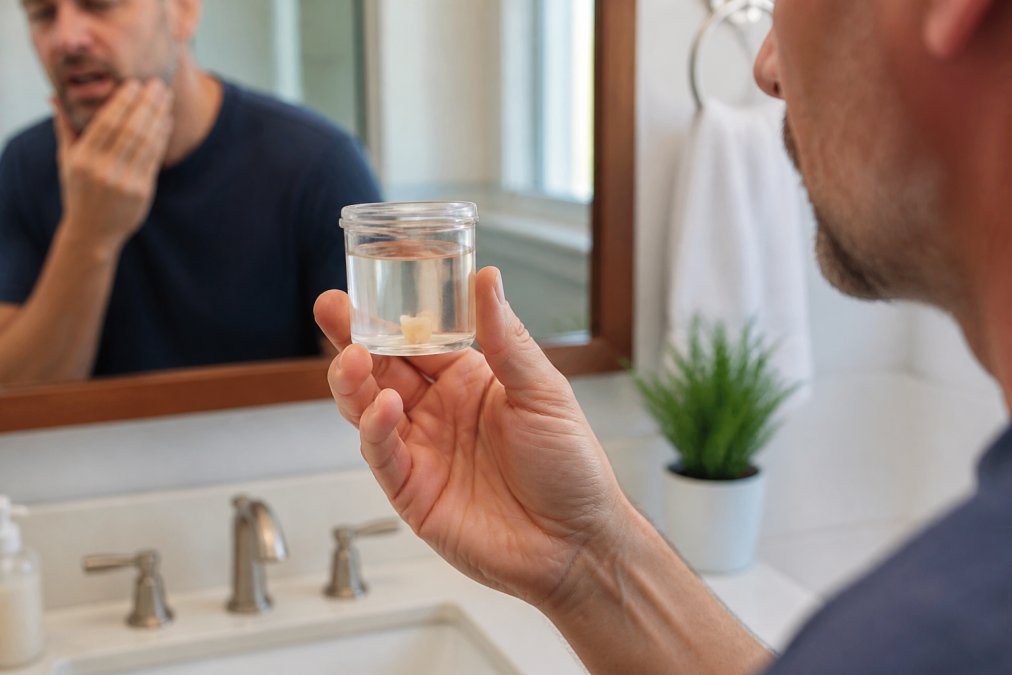
Locate any broken piece of tooth. Handle it only by the crown, never the root. Rinse the fragment briefly with water, then place it in a small container of milk or saline solution. If neither is available, tuck the fragment between your cheek and gum. Keeping the fragment moist improves the chances your dentist can reattach it.
What to Do for a Chipped Tooth vs. a Severe Break
A chipped tooth and a severe break require different responses, depending on whether the fracture involves only enamel or extends into the dentin and pulp.
A minor chip that removes a small piece of enamel typically causes little pain and no bleeding. Rinse the mouth, smooth any sharp edge with dental wax or sugar-free gum, and schedule a routine appointment. Your dentist will likely restore the tooth with bonding or a small filling.
A severe break, by contrast, exposes the dentin or pulp, causes throbbing pain, and may split the tooth down to the gum line. This is a true dental emergency. Cover the exposed area with sugar-free gum or dental cement, control bleeding, and contact a dentist for a same-day appointment. Teeth with pulp exposure typically require root canal therapy followed by a crown.
| Type of Break | Pain Level | Bleeding | Response Time | Likely Treatment |
|---|---|---|---|---|
| Minor chip (enamel only) | None to mild | No | 1-2 days | Bonding or filling |
| Moderate fracture (dentin exposed) | Moderate, sensitivity to air | Possible | Same day | Filling or crown |
| Severe break (pulp exposed) | Throbbing, intense | Yes | Immediate | Root canal and crown |
| Split tooth (below gum line) | Severe | Yes | Immediate | Possible extraction |
Managing Pain and Swelling at Home
Pain management after dental trauma follows a simple principle: reduce inflammation early. Ibuprofen is the most effective option because it addresses both pain and swelling, unlike acetaminophen. Take it according to the label directions unless your physician has advised otherwise.
A cold compress remains your best tool during the first 24 hours. Apply it for fifteen minutes on, fifteen minutes off, for up to two hours total. After the first day, switch to warm saltwater rinses several times daily. Avoid chewing on the affected side until your dentist completes the restoration.
How Long Can You Wait to Fix a Broken Tooth?
How long you can wait depends entirely on the break's severity. A minor enamel chip can wait up to a week without significant risk, provided the tooth remains pain-free. A fracture exposing dentin should be treated within 48 hours.
A break that exposes the pulp leaves you a window of only a few hours. Bacteria travel quickly through the open pulp chamber, and once infection sets in, the tooth's blood supply becomes compromised. Throbbing pain, sensitivity to hot or cold liquids, or a metallic taste in your mouth are signs of pulp involvement requiring same-day care.
Dental Emergency vs Urgent Care: Where to Go
Deciding between a dental office, an urgent care center, and a hospital emergency room is a logistical and financial decision as much as a medical one.
Go Directly to a Dentist for Isolated Tooth Trauma
If the injury is confined to the tooth itself, a break, a crack, a knocked-out tooth, a dentist is the only provider who can perform the definitive repair. Neither an urgent care center nor an ER can place a crown, perform a root canal, or reattach a fragment.
Call dental offices in your area and ask three questions before you hang up:
- "Do you have a dentist on site today?" Some practices list emergency slots but staff them with a hygienist who can only take X-rays.
- "Can you see me within the next two hours?" The window for saving a tooth with pulp exposure is narrow, and a practice that cannot fit you in today is not an emergency resource.
- "Do you accept my insurance for emergency exams?" Most PPO plans cover emergency exams at the same rate as routine exams, but HMO plans may require a referral that takes days to process.
Go to Urgent Care for Dental Pain Without Trauma
Urgent care centers are a reasonable middle ground when you have severe tooth pain but no visible break, swelling, or bleeding. They can prescribe antibiotics, provide stronger pain relief, and perform basic X-rays to identify an abscess.
The trade-off is that urgent care cannot treat the underlying cause. Antibiotics only buy time. Budget for the urgent care copay on top of the eventual dental treatment.
Go to the ER Only for Trauma Beyond the Tooth
The emergency room is for medical emergencies that involve the tooth as part of a larger injury. Go to an ER when you have any of the following:
- Facial swelling that is spreading to your eye, neck, or jawline, this can indicate a life-threatening airway compromise
- Uncontrolled bleeding that does not stop after 15 minutes of direct pressure
- Suspected jaw fracture, pain when biting down, misaligned bite, or numbness in the lower lip
- Loss of consciousness or a blow to the head accompanying the dental injury
An ER will stabilize you, control bleeding, rule out fractures with CT imaging, and discharge you with a referral. Expect a 4- to 6-hour wait and a facility fee that typically ranges from $500 to $1,500 depending on your insurance deductible. That is necessary when your airway or facial bones are at risk, but wasted money for a simple broken tooth.
The Cost Reality Check
Most patients do not realize that an emergency dental visit costs roughly the same as a routine exam. A typical emergency evaluation with X-rays runs between $150 and $300 without insurance, while an ER facility fee alone often exceeds that amount.
If cost is a barrier, ask the dental practice directly about payment options. Many offer third-party financing through CareCredit or in-house payment plans. Do not let a $200 copay talk you out of a $2,000 root canal that saves your tooth.
What to Say When You Call
When you call a dental office, use precise language to convey urgency: "I broke my tooth and I think the pulp is exposed. I need to be seen today." Practices triage phone calls the same way hospitals triage patients, and the words you use determine where you land in the queue.
What to Expect During Your Same-Day Dental Visit
The Clinical Assessment (First 15 Minutes)
The dentist begins with a clinical examination and digital X-rays to determine the fracture's depth and check for root damage. You will likely receive a local anesthetic before the examination touches the injured area.
A common pattern is to take two types of X-rays: a periapical view that shows the entire tooth from crown to root tip, and a bitewing view that reveals cracks between teeth. If the dentist suspects a vertical root fracture, a split that runs from the crown down the root, they may take a third angled view. Vertical root fractures have a poor prognosis and often require extraction.
The Treatment Decision (Minutes 15-30)
Once the imaging is complete, the dentist will present your options:
- Enamel-only chip: Bonding or a small filling in a single visit. You leave with a fully restored tooth.
- Dentin exposure without pulp involvement: A filling or crown, depending on how much tooth structure remains. The dentist may place a sedative dressing first and schedule the permanent restoration for a follow-up visit.
- Pulp exposure: Root canal therapy is required. The dentist will either perform it immediately or place a temporary sedative filling and schedule the root canal within days. Some practices, including ours at Trinity Dental Arts, fabricate same-day crowns using an in-house lab, which means you leave with a permanent restoration rather than a temporary one.
- Split tooth below the gum line: Extraction is often the only option. The dentist will discuss replacement options, an implant, bridge, or partial denture, before you leave so you can plan the next step.
What the Procedure Feels Like
For a root canal, the dentist will ensure you are fully numb before beginning. The procedure involves removing the infected pulp, cleaning the space with antimicrobial solutions, and sealing it with gutta-percha. You will feel pressure and vibration but not sharp pain. The entire root canal typically takes 60 to 90 minutes for a front tooth and up to two hours for a molar.
For bonding or a filling, the procedure is shorter, usually 30 to 45 minutes. The dentist etches the tooth surface, applies a bonding agent, and layers tooth-colored composite resin to rebuild the missing structure.
Post-Treatment Care: The First 48 Hours
What you do after the appointment determines how well the repair holds. The anesthesia will wear off two to four hours after you leave. For the first 48 hours:
- Pain management: Take ibuprofen before the anesthesia wears off, not after. A common protocol is 400-600 mg every six hours with food for the first 24 hours, then as needed. Avoid aspirin, which can increase bleeding.
- Eating: Stick to soft foods on the opposite side of your mouth for the first 24 hours. Avoid anything sticky, hard, or chewy for at least a week. If you received a temporary crown, bite down gently on a piece of bread to seat it if it feels loose.
- Oral hygiene: Do not brush or floss the treated area for the first 24 hours. After that, brush gently with a soft-bristled brush and rinse with warm salt water several times daily. Avoid mouthwash containing alcohol, which can irritate the healing tissue.
- Sensitivity: Mild sensitivity to cold or pressure is normal for the first week. If you received a root canal, the tooth may feel tender when you bite down for several days, this is the ligament healing and is not a sign of failure.
When to Call Back
Call your dentist immediately if you experience any of the following after the procedure:
- Swelling that worsens after the first 24 hours rather than subsiding
- Fever above 100.4°F
- Pain that is not controlled by over-the-counter medication
- A temporary crown that comes off, keep it and call; do not try to cement it back yourself
- Numbness that persists beyond 6 hours after the appointment
The Follow-Up Picture
Most broken tooth repairs require at least one follow-up visit. If you received a temporary crown, you will return in two to three weeks for the permanent one. If you had a root canal on a molar, the dentist may recommend a crown even if one was not placed the same day.
Plan for a two-week checkup to confirm the tooth is healing and the bite is comfortable. The dentist will adjust the restoration if you feel any high spots when chewing. A properly adjusted bite is essential, an uneven bite can cause jaw pain and premature failure.
Frequently Asked Questions
Will urgent care do anything for a broken tooth?
Urgent care clinics can treat facial swelling, bleeding, or suspected infections from dental trauma, but they are not equipped to repair the tooth itself. They may provide antibiotics or pain medication as a temporary measure. For the actual restoration of a broken tooth, you need a dentist who can provide emergency dental care for broken teeth, such as same-day crowns or bonding. If you have severe swelling that affects your breathing or vision, go to an emergency room first.
What will an emergency dentist do for a broken tooth?
The treatment depends on the severity of the break. For a minor chip, the dentist may smooth the edge or apply tooth-colored bonding. A deeper fracture that exposes the pulp might require a root canal followed by a dental crown. If the tooth is broken off at the gum line, an emergency extraction may be necessary. A same-day appointment allows the dentist to assess the damage, manage your pain, and provide a temporary or permanent restoration to protect the tooth.
Can I leave a broken tooth for a week?
Leaving a broken tooth for a week is risky. Even if you have no pain, the break creates an opening for bacteria to reach the inner pulp, which can lead to an infection or a dental abscess. The longer you wait, the more damage can occur, potentially turning a simple crown procedure into a root canal or extraction. You should seek emergency dental care for broken teeth within 24 to 48 hours to prevent complications and preserve the tooth.
How do I manage pain from a broken tooth at home?
While waiting for your dental appointment, take over-the-counter pain relievers like ibuprofen to reduce inflammation. Apply a cold compress to the outside of your cheek for 15-minute intervals to minimize swelling. Rinse your mouth gently with warm salt water to keep the area clean. Avoid chewing on that side of your mouth, and steer clear of very hot, cold, or sugary foods that can trigger sharp pain. These steps offer temporary relief, but they do not replace professional repair.
This article was written using GrandRanker