 how-to
Benefits of In-House Dental Labs for Your Practice
Table of Contents
- What an In-House Dental Lab Changes for Your Practice
- Same-Day Dental Restorations: What Becomes Possible
- How Dental Lab Turnaround Time Affects Treatment Planning
- Custom Dental Prosthetics Precision and Aesthetic Matching
- The Equipment and Space an In-House Lab Requires
- Staffing, Training, and Workflow Adjustments to Plan For
- Cost-Benefit Analysis: When an In-House Lab Pays Off
- Limitations of In-House Labs and How to Manage Them
- Frequently Asked Questions
Last Updated: September 22, 2026
What an In-House Dental Lab Changes for Your Practice
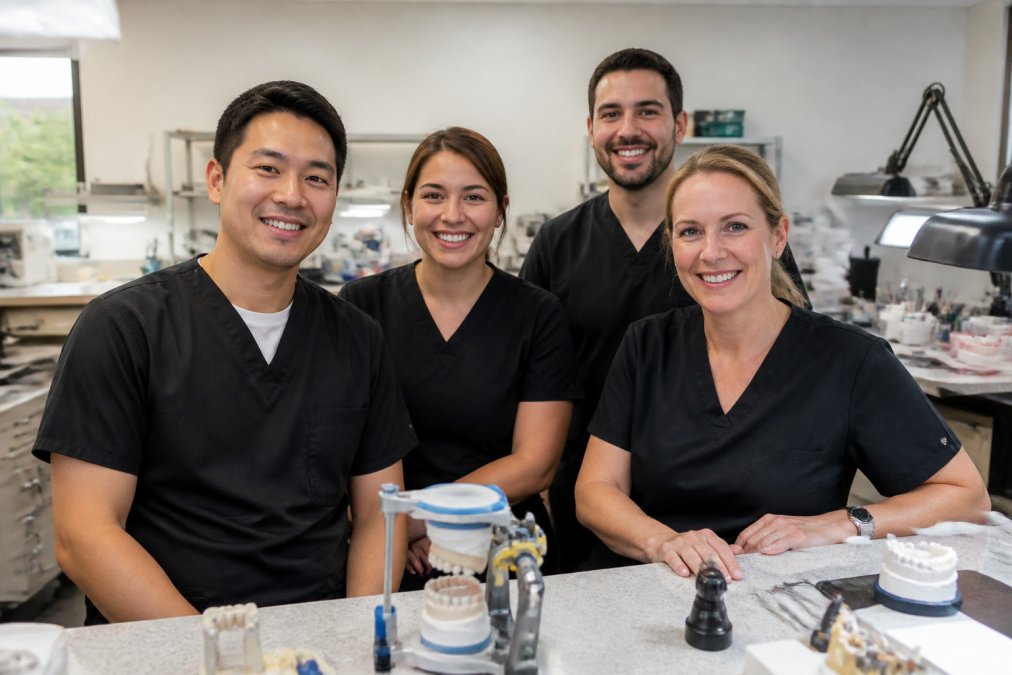
In-house dental labs move crown, bridge, and prosthetic fabrication into your own office, cutting the wait from weeks to a single visit. For practices like Trinity Dental Arts, that shift touches almost everything: scheduling, patient trust, and the way you plan treatment.
At Trinity Dental Arts, our lab supports same-day full-arch teeth and same-day crowns. But the benefits of in house dental labs go well beyond speed.
Here is the core idea. When you control fabrication, you control the outcome. You are not waiting on a courier or hoping a remote technician matched the shade. You adjust the restoration while the patient is still in the chair.
That matters for restorative dentistry, where small errors in fit or color mean a remake and another appointment. The American Dental Association's resources on dental materials and standards outline why material choice and fit drive long-term results.
Same-Day Dental Restorations: What Becomes Possible
Same-day dental restorations are crowns, bridges, and other prosthetics designed, milled, and placed in one appointment. A digital scan, CAD/CAM software, and an in-office milling unit replace the old impression-and-wait cycle.
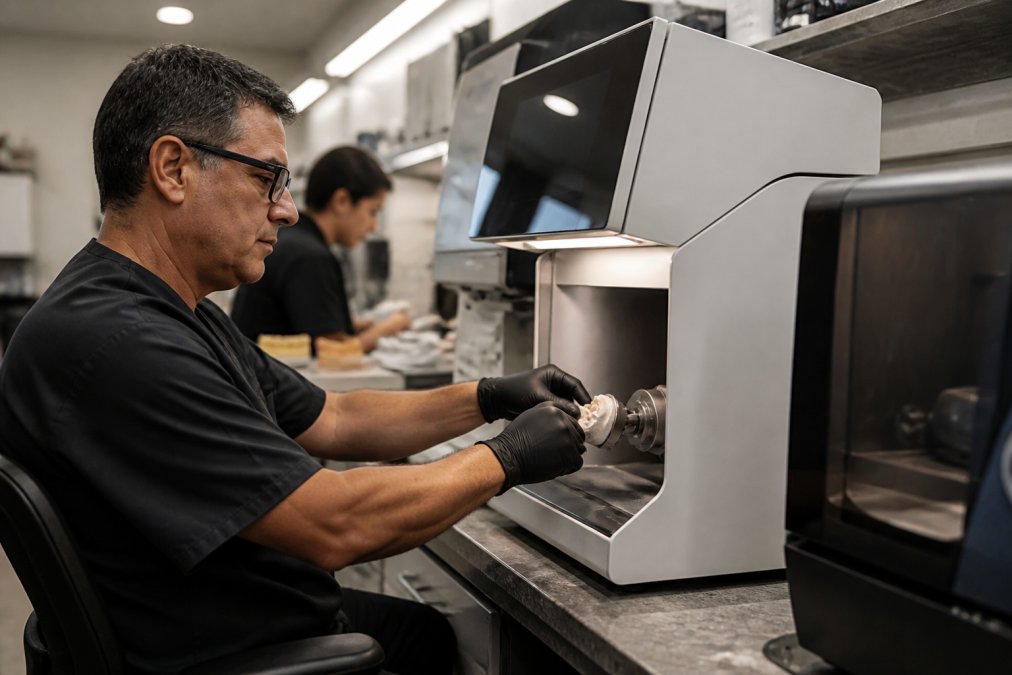
The workflow looks like this:
- Scan the prep with an intraoral scanner
- Design the restoration in CAD software
- Mill or 3D print the piece from a block of zirconia or porcelain
- Fit, adjust, and cement it the same day
For patients, this means fewer injections, fewer visits, and no temporary crown. For the practice, it means a chair that produces a finished result instead of a referral.
A common mistake is rushing the design step to save chair time. In practice, a few extra minutes at the design screen prevents a remake that costs far more.
How Dental Lab Turnaround Time Affects Treatment Planning
Dental lab turnaround time is the gap between taking an impression and getting the finished restoration back. With an outside lab, that gap often stretches across multiple visits. In-house, it can shrink to hours.
That single change rewrites how you plan treatment. You can sequence procedures around one visit instead of three. You can offer immediate loading for implants when the case allows.
It also changes what patients hear. Instead of "come back in two weeks," you say "we can finish this today." That reduces cancellations, because there is no second appointment to forget.
Shorter turnaround also helps urgent cases. A patient with a broken tooth or acute pain gets a same-day fix instead of a temporary patch and a return trip.
Custom Dental Prosthetics Precision and Aesthetic Matching
Custom dental prosthetics precision comes down to one thing: how closely the finished piece matches the prepared tooth and the neighboring teeth. An in-house lab lets you check that match before the patient leaves.
Shade matching is the clearest example. Under lab lighting, a crown can look perfect and still stand out in daylight. When the technician and the dentist work in the same building, they can compare the restoration against the patient's natural teeth in real time.
The same applies to fit.
The Equipment and Space an In-House Lab Requires
An in-house lab needs three things: space, equipment, and ventilation. A dedicated room of roughly 100 to 150 square feet is a common starting point for a single-chair milling setup, though full-arch and multi-unit workflows often push toward 200 square feet once you add a sintering furnace, a finishing bench, and material storage.
The core equipment stack breaks into four functional layers:
1. Capture and design
- An intraoral scanner (for example, a chairside scanner from a major dental imaging brand) to replace impression trays
- CAD software with a restoration library, the two dominant categories are open-architecture design suites and scanner-locked ecosystems, and the choice affects which mills and materials you can use later
2. Fabrication
- A chairside milling unit for zirconia, lithium disilicate, and hybrid ceramics, these range from compact wet-mill units for single crowns to dry-mill units for larger frameworks
- A 3D printer for models, surgical guides, night guards, and temporary or definitive resin restorations
3. Finishing
- A sintering furnace for zirconia (a multi-hour cycle, so plan for overnight runs)
- A crystallization oven for lithium disilicate
- A finishing station with a laboratory handpiece, polishing wheels, and a steam cleaner
4. Support
- Dust extraction and ventilation rated for ceramic and resin particulate
- A compressed-air line and dedicated electrical circuits for the mill and furnace
- Material storage with humidity control for resin and ceramic blanks
Staffing, Training, and Workflow Adjustments to Plan For
Someone has to run the lab, and that person is usually a trained dental technician or a staff member who learns the software and hardware. This is the part most practices underestimate.
Plan for these roles:
- A technician to design and mill restorations
- A trained team member to handle scanning and digital impressions
- A workflow owner who tracks cases and materials
Cost-Benefit Analysis: When an In-House Lab Pays Off
In-house dental labs pay off when your case volume is high enough to keep the equipment busy. If a mill sits idle, the math does not work, and that is the single most common reason practices regret the investment.
Here is how to frame the decision:
| Factor | Outside Lab | In-House Lab |
|---|---|---|
| Per-unit cost | Fixed fee per restoration | Higher upfront, lower per unit over time |
| Turnaround | Days to weeks | Hours to one day |
| Remakes | Shipped back and forth | Fixed on site |
| Chair time | Extra visits | Consolidated |
| Control | Limited | Full |
| Recurring costs | Bundled into per-unit fee | Burs, blanks, resin, service contracts |
| Staff time | None | Technician hours per case |
The cost side. Add up four buckets before you commit:
- Capital: scanner, mill, printer, furnace, software licenses, and the room build-out
- Recurring: milling burs, zirconia and lithium disilicate blanks, resin cartridges, and printer resin
- Service: annual maintenance contracts, calibration, and parts
- Labor: technician salary or the opportunity cost of reassigning an existing team member
The revenue side. The return does not come from cheaper crowns alone. It comes from three places:
- Margin per unit once the equipment is paid off, the per-unit cost of a milled zirconia crown is typically a fraction of an outside lab fee, but only after fixed costs are absorbed
- Additional same-day cases the practice can now schedule, which fill otherwise idle chair time
- Fewer remakes and fewer second visits, which recover chair time that was previously lost to rework
Limitations of In-House Labs and How to Manage Them
In-house labs are not right for every practice, and the limits are real. Being honest about them builds better decisions.
The main limitations:
- Upfront cost. Equipment and build-out require capital before any return.
- Learning curve. Design and material skills take months to sharpen.
- Scope. Complex cases still need a skilled technician, and not every restoration suits chairside milling.
- Volume dependency. The economics only work with enough cases.
- Maintenance. Machines need calibration, service, and downtime planning.
Frequently Asked Questions
Are in-house dental labs worth the investment for a small practice?
It depends on your case volume and mix. Practices that place a high number of crowns, bridges, or implant restorations often find that an in-house dental lab reduces remake costs and chair time enough to justify the equipment and staffing. Smaller practices with low prosthetic volume may find a commercial lab more economical. A cost-benefit analysis should weigh equipment, training, and materials against reduced turnaround time and fewer patient visits.
How does an in-house dental lab improve the accuracy of my crown?
An in-house lab allows the dentist and technician to communicate directly about margin placement, occlusion, and shade. Digital impressions from an intraoral scanner feed directly into CAD/CAM software, reducing errors from traditional impression materials. The technician can adjust the restoration while the patient is still in the chair, which improves custom dental prosthetics precision and minimizes remakes.
Can in-house dental labs provide same-day restorations?
Yes, many practices with in-house labs offer same-day dental restorations for crowns, veneers, and some bridges. The process uses digital impressions, CAD/CAM design, and milling or 3D printing to fabricate the restoration while the patient waits. Same-day service depends on the equipment available, the material chosen, and the complexity of the case. Not all restorations can be completed in a single visit.
What is the difference between an in-house lab and a commercial dental lab?
An in-house lab operates within the practice, staffed by technicians employed or contracted by the dentist. This allows real-time collaboration and faster dental lab turnaround time. A commercial lab is an external facility that receives digital or physical impressions and returns restorations by courier. Commercial labs often handle complex cases and offer a wider range of materials, but communication is less direct and turnaround is longer.
Choosing between an outside lab and building your own comes down to volume, control, and how much same-day care matters to your patients. Trinity Dental Arts runs an in-house lab led by a board-certified implantologist, which supports same-day full-arch teeth, same-day crowns, and full mouth restoration under one roof. If you want to see how chairside fabrication could fit your treatment, get started with Trinity Dental Arts and book a consultation to map out your options.