 How-to
7 Steps in Full Mouth Reconstruction, From Exam to Final Teeth
Last Updated: November 3, 2026
Quick Summary
Full mouth reconstruction is a planned, multi-step process that rebuilds the bite, teeth, and supporting gums in one coordinated plan. It starts with a diagnostic exam, imaging, and a bite assessment, followed by a written treatment plan, surgical placement of implants or foundation work, and a healing period before final teeth are placed.
- The first visit includes a full exam, panoramic X-ray, 3D cone beam scan, and bite assessment.
- Implants are small titanium posts that act as artificial tooth roots.
- Osseointegration, where bone grows around implants, usually takes several months.
- Swelling typically peaks at about 48 to 72 hours after surgery.
- Ask for the treatment plan in writing to compare options or get a second opinion.
Table of Contents
- Step 1: Diagnostic Exam, Imaging and Bite Assessment
- Step 2: Building the Treatment Plan and Digital Preview
- Step 3: Surgical Placement of Implants or Foundation Work
- Step 4: Healing, Osseointegration and Temporary Teeth
- Full Mouth Reconstruction Recovery Timeline and Pain Management
- Full Mouth Reconstruction Cost, Payment Options and Insurance
- Full Mouth Reconstruction vs Dentures: Which Path Fits Your Next Step
- Frequently Asked Questions
Full mouth reconstruction is a planned, multi-step process that rebuilds the bite, teeth, and supporting gums in one coordinated plan. Patients are walked through each stage so they know what comes next. Most people reach this point after years of missing or failing teeth, and the process is far more structured than the word "reconstruction" suggests.
Think of it as a sequence, not a single procedure. Each step builds on the last. Skipping one usually means the final result suffers.
Before anything starts, the team needs to answer three basic questions:
- Which teeth can be saved, and which must come out?
- How healthy are the gums and jawbone?
- What does the patient want the final result to look and feel like?
The answers shape every decision after this point. A clear picture of the starting point makes the rest of the plan easier to follow.
Step 1: Diagnostic Exam, Imaging and Bite Assessment
The first visit is about gathering facts. The dental team examines every tooth, checks the gums for disease, and reviews your medical history and medications. This matters because conditions like diabetes or osteoporosis can affect healing.
Next come the images. A panoramic X-ray shows the whole mouth, and a 3D cone beam scan shows bone density and nerve position. Digital impressions capture your bite without messy trays.
Bite assessment comes last. The team checks how your upper and lower teeth meet, and whether your jaw joint shows signs of strain. Clicking, soreness, or headaches often point to a bite problem that needs fixing.
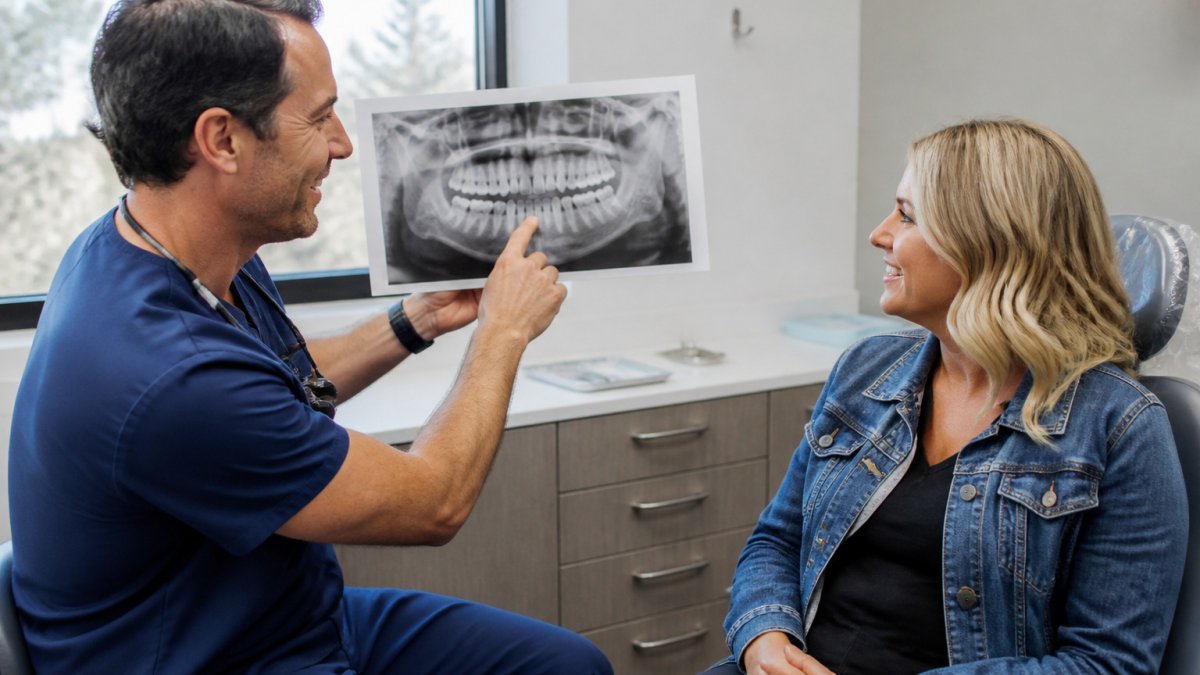
The American patient is seated beside the American dentist. Both are American.
Step 2: Building the Treatment Plan and Digital Preview
Once the scans are in, the team designs your plan. This is where the goals from the first visit become a concrete timeline with specific procedures.
A digital preview is one of the most useful parts of this step. Some practices use software to show a simulated version of a new smile before treatment begins.
Good plans also cover:
- The order of treatment phases
- Which procedures happen on the same day
- Estimated number of visits
- Temporary solutions to use during healing
Ask for the plan in writing. A clear document makes it easier to review your options and compare them if you choose to get a second opinion.
Step 3: Surgical Placement of Implants or Foundation Work
This is the step most patients picture when they hear "full mouth reconstruction." Surgery places dental implants, which are small titanium posts that act as artificial tooth roots. In some cases, bone grafting or gum work must come first to create enough support.
Anesthesia options generally range from local numbing to sedation, depending on the complexity of the work and the patient's comfort level; your provider can explain which options apply to you.
Watch out: skipping pre-surgery instructions about medications or eating is a common cause of complications. Follow your team's guidance exactly.
Step 4: Healing, Osseointegration and Temporary Teeth
After implants are placed, the bone must grow around them. This process, called osseointegration, usually takes several months. During this time, the implants form a firm bond with your jawbone.
Temporary teeth are often used during healing. These let you eat, speak, and smile while the permanent work is being finished. Temporary teeth are typically lighter and softer, so expect a short adjustment period.
Follow-up visits are generally used to check that healing is on track before final restorations are placed.
The healing stage has a few key timings and features worth comparing at a glance.
| Stage | What happens | Timing |
|---|---|---|
| Osseointegration | Bone grows around implants and forms a firm bond | Usually several months |
| Temporary teeth | Let you eat, speak and smile during healing | Used while permanent work is finished |
| Follow-up visits | Check that healing is on track | Before final restorations are placed |
Full Mouth Reconstruction Recovery Timeline and Pain Management
Recovery from full mouth reconstruction is not one event, it is a series of predictable stages, and knowing what each stage feels like removes most of the fear. The outline below reflects a common pattern; your provider can explain how the timeline may vary for your case.
The first 72 hours. Swelling typically peaks at about 48 to 72 hours after surgery, not on day one. Expect the most soreness, the most oozing, and the most fatigue during this window. Cold compresses applied in 20-minute cycles for the first 24 to 48 hours help limit swelling; after that, switch to gentle warmth if your surgeon approves it. Sleep with your head elevated on two pillows to reduce throbbing.
Days 4 through 10. Swelling begins to recede, and pain usually drops to a manageable ache. This is when most patients return to light work and normal routines. Bruising may appear on the jaw, neck, or chest and is normal. Gentle brushing around, not over, the surgical sites, saltwater rinses starting when your surgeon says so, and soft, cool foods remain the routine. Avoid straws, smoking, and vigorous rinsing, all of which can dislodge a healing clot or disturb grafted sites.
Weeks 2 through 6. Sutures are typically removed or dissolve in this window. Gums and soft tissues continue remodeling, and temporary teeth may need adjustment as swelling changes the fit. Patients often report that this is when they feel most like themselves again, though biting force should still be limited to protect the healing foundation.
Months 3 through 6. Osseointegration, the bone bonding to the implant surface, is underway. Discomfort at this stage is unusual; if pain appears months after surgery, it warrants a call to the office rather than a wait-and-see approach.
A practical pain-management protocol. Ask your provider in advance which medications you will be sent home with, whether any interact with what you already take, and what the maximum daily dose of each is. Be sure to tell your provider about any blood thinners, sleep apnea, or living situation before surgery day, as these can affect your plan.
Watch out: rising pain after day three, especially pain that worsens rather than fades, or is accompanied by fever, a bad taste, or swelling that returns, can signal infection or a problem with the surgical site, and should be reported to the office the same day rather than managed at home.
Reducing anxiety before it starts. Anxiety amplifies perceived pain, so plan ahead: stock soft foods you actually like, arrange help for the first two days, set phone reminders for medication so you do not miss a scheduled dose, and write down the office's after-hours number where you can find it without searching.
Full Mouth Reconstruction Cost, Payment Options and Insurance
Cost is the single most common reason patients delay full mouth reconstruction, and the most useful thing a guide can do is explain how the money actually works rather than quote a single number. Total cost depends on how many teeth are replaced, whether implants, bone grafting, or gum surgery are needed, the materials chosen for the final teeth, and the number of visits.
Start with your dental insurance, and read the fine print. Dental plans vary widely in how they cover restorative work, implants, and crowns. Check your plan's annual maximum, any waiting period for major services, and the percentage it pays after the deductible.
Use tax-advantaged accounts deliberately. If your employer offers a health savings account (HSA) or a flexible spending account (FSA), dental work generally qualifies as an eligible expense. The catch is timing: FSA funds usually must be spent within the plan year, while HSA funds roll over and can be invested.
Compare third-party financing structures, not just monthly payments. Some dental practices work with third-party lenders that offer financing; ask which options, if any, are available for your treatment. The monthly payment is the least important number on the offer, the annual percentage rate, the length of the promotional period, the retroactive interest that applies if you miss the payoff date, and any origination fee are what determine the real cost.
Ask about in-house payment plans and a cash discount. Ask whether an in-house payment plan or any payment discount is available, as the answer can help shape which option is best for you.
Sequence the spending. A workable order is: confirm insurance benefits and pre-treatment estimate, then apply tax-advantaged funds, then compare financing offers side by side, then negotiate an in-house plan for any remaining balance. Doing this before treatment starts, rather than after the first invoice, gives you leverage and avoids surprise balances.
Watch out: a financing offer with a low monthly payment and a long term can cost far more in total than a shorter, higher-payment plan, and promotional no-interest offers frequently apply retroactive interest to the entire original balance if you miss the payoff date by even one cycle.
For current pricing and a personalized quote, contact Trinity Dental Arts directly or visit its website.
IRS guidance on eligible medical and dental expenses for HSAs and FSAs
Full Mouth Reconstruction vs Dentures: Which Path Fits Your Next Step
Dentures are removable, lower in upfront cost, and can be a reasonable choice for some people. Patients comparing the two can see fixed implant teeth and denture alternatives offered at the practice. Full mouth reconstruction commonly uses implants anchored in the jawbone, which can keep teeth fixed in place. Implants are also generally associated with helping to preserve bone.
The right choice depends on your bone health, budget, lifestyle, and goals. Some patients prefer dentures for simplicity, while others want the stability of fixed teeth.
If you are weighing these options, a consultation is the best next step. You can also compare full mouth reconstruction with a smile makeover to see which fits your goals. A consultation with a qualified professional can help you review your options and decide which path fits your situation.
Frequently Asked Questions
What are the steps involved in full mouth reconstruction?
Full mouth reconstruction usually moves through a diagnostic exam with imaging, a written treatment plan often previewed digitally, surgical placement of implants or foundation work, a healing period while bone bonds with implants, and finally the placement of permanent restorations. The exact sequence depends on your jaw health, gum condition and the number of teeth involved. A consultation at Trinity Dental Arts is the place to get a plan built around your own mouth rather than a generic timeline.
How long does a full mouth restoration take?
Total time varies widely. Timelines vary, and some patients need several months of healing before permanent restorations are placed. Your recovery timeline depends on bone quality, how many implants are placed and whether any grafting is needed. Ask your provider for a timeline specific to your case during your exam.
Is full mouth reconstruction painful?
Soreness and swelling are common for several days after surgery. Your surgical team should review a pain management plan with you before treatment. Your surgical team should review a pain management plan with you before treatment, including what to do if pain increases rather than eases.
How do I know if I am a candidate for full mouth reconstruction?
Candidacy depends on overall oral health, bone volume in the jaw, gum health, medical history and how well your bite functions. A board-certified implantologist evaluates these factors through imaging and a clinical exam. A consultation with Trinity Dental Arts can clarify whether full mouth reconstruction suits your situation or whether other options should be considered first.