 listicle
Best Implants for Missing Front Teeth: 2026 Guide
Table of Contents
- Comparison of Front Tooth Replacement Options
- 1. Single-Tooth Dental Implant: The Standalone Solution
- 2. Maryland Bridge: A Non-Surgical Alternative
- 3. Traditional Dental Bridge: A Fixed Restoration
- 4. All-on-4 Dental Implants: Full-Arch Restoration
- 5. Removable Partial Dentures: A Budget-Friendly Option
- Dental Bridge vs Implant for Front Tooth: Key Differences
- How Long Does a Front Tooth Implant Take?
- Frequently Asked Questions
Last Updated: September 19, 2026
Comparison of Front Tooth Replacement Options
Losing a front tooth changes how you speak, eat, and smile in photos, which is why so many adults search for the best implants for missing front teeth. For adults weighing the best implants for missing front teeth, the choice usually comes down to five options: a single-tooth implant, a Maryland bridge, a traditional dental bridge, All-on-4 implants, or a removable partial denture. Each one balances cost, surgery, durability, and appearance differently. This guide from Trinity Dental Arts breaks down how each approach works, who it suits, and what to expect.
The American Dental Association's consumer resources on dental implants notes that implants remain the closest functional match to a natural tooth. That matters most in the front of the mouth, where appearance and speech are on display every day.
Below, we compare each option on cost, procedure type, and longevity. One warning before you start: your jawbone and gum health will narrow the list more than price will.
| Option | Surgery Required | Fixed or Removable | Best For |
|---|---|---|---|
| Single-tooth implant | Yes | Fixed | One missing tooth, healthy bone |
| Maryland bridge | No | Fixed | Non-surgical patients |
| Traditional bridge | No | Fixed | Healthy adjacent teeth |
| All-on-4 implants | Yes | Fixed | Most or all teeth missing |
| Partial denture | No | Removable | Budget-conscious patients |
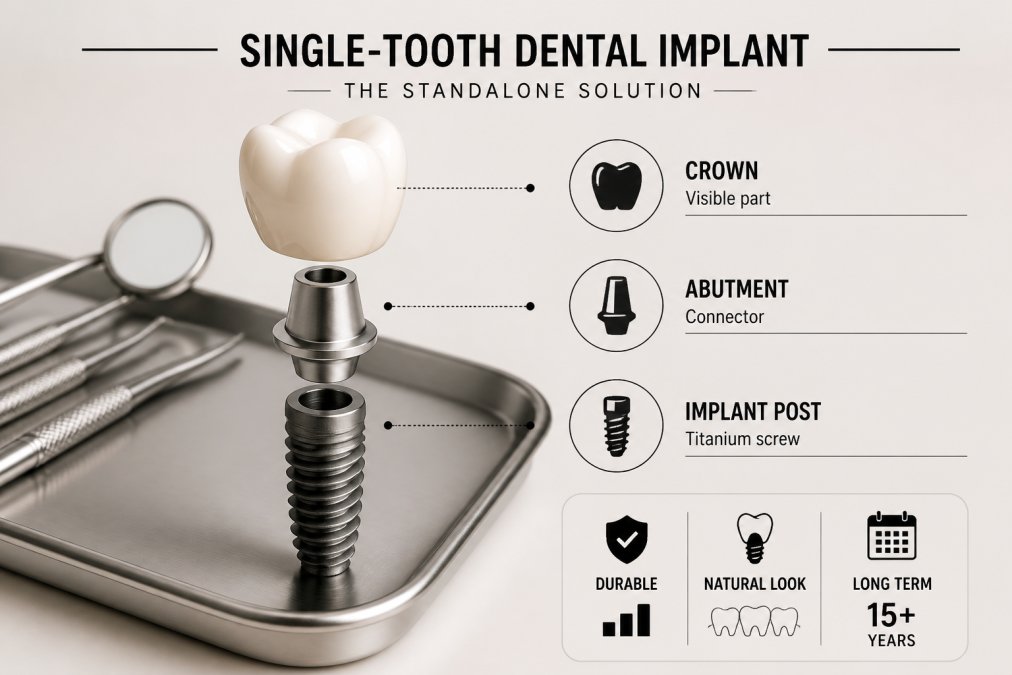
1. Single-Tooth Dental Implant: The Standalone Solution
A single-tooth dental implant is a titanium post surgically placed into the jawbone, topped with an abutment and a custom crown. It replaces one missing front tooth without touching the neighboring teeth. The post fuses with bone through osseointegration, which is why implants can last decades with good care.
The process takes several appointments. A surgeon places the implant, waits for healing, then attaches the abutment and crown. Candidates need adequate jawbone density and healthy gingival tissue. When bone is thin, a bone grafting step may come first. For a front tooth, the aesthetic outcome matters as much as function, so the crown is shade-matched to your natural teeth.
2. Maryland Bridge: A Non-Surgical Alternative
A Maryland bridge, also called a resin-bonded bridge, holds a replacement tooth with metal or porcelain wings bonded to the back of adjacent teeth. It requires no drilling of those teeth in most cases, making it the least invasive fixed option for a front tooth.
It suits patients who want to avoid oral surgery or who aren't implant candidates. The trade-off is durability. Maryland bridges can debond over time and often need rebonding or replacement sooner than an implant. For a temporary fix or a patient with medical reasons to skip surgery, it's a reasonable middle path.
3. Traditional Dental Bridge: A Fixed Restoration
A traditional dental bridge anchors a crown to the teeth on either side of the gap, with the replacement tooth (the pontic) suspended between them. It's fixed, non-removable, and typically faster to complete than an implant.
The catch: the adjacent teeth must be filed down to support the crowns, which is irreversible. Many patients prefer this route when those teeth already need crowns. If the anchoring teeth are healthy, though, removing enamel to support a bridge is a real cost that implants avoid.
4. All-on-4 Dental Implants: Full-Arch Restoration
All-on-4 dental implants support a full arch of replacement teeth on four strategically angled implants. This approach is for patients missing most or all teeth in an arch, and it can allow immediate function in suitable cases.
It's the most comprehensive restoration here and the largest investment. Candidacy depends on bone volume and overall health; some patients need grafting first. For someone facing full-arch tooth loss, it restores chewing function and a natural-looking smile in a way a denture cannot match.
5. Removable Partial Dentures: A Budget-Friendly Option
A removable partial denture clips onto remaining natural teeth to fill a gap. It's the most affordable option and requires no surgery, which makes it a common starting point for patients managing cost or health concerns.
The drawbacks are stability and comfort. Partial dentures can shift while eating or speaking, and they don't stimulate the jawbone the way an implant does. Over time, bone resorption under the gap can change the fit. Many patients use a partial denture as a temporary solution while planning a permanent restoration.
Dental Bridge vs Implant for Front Tooth: Key Differences
The clinical difference is straightforward: a bridge uses the neighboring teeth as support and leaves the jawbone unstimulated, while an implant replaces the tooth root itself, maintains bone, and leaves healthy teeth untouched. What most comparisons skip is the money, specifically how dental benefit plans treat these two options differently, and how patients close the gap.
| Factor | Dental Bridge | Single Implant |
|---|---|---|
| Adjacent teeth | Reshaped as anchors | Left untouched |
| Surgery | None | Required |
| Bone health | No stimulation | Maintains jawbone |
| Timeline | Faster | Longer healing |
| Longevity | May need replacement | Can last decades |
| Typical insurance treatment | Often covered as a restorative procedure | Frequently subject to a missing-tooth clause or annual maximum |
The missing-tooth clause. Many dental plans will not pay for an implant to replace a tooth that was already missing when coverage began. If the tooth is extracted while you are covered, the implant is more likely to qualify. This single rule explains why two patients with identical mouths get different coverage answers.
Annual maximums and the timing problem. A typical dental plan caps benefits at a fixed dollar amount per year, and a single implant plus crown can consume most or all of it. Splitting the surgical and restorative phases across two plan years is a common strategy, placement in one year, crown in the next, and it can meaningfully reduce out-of-pocket cost. Ask your dentist's billing office whether they will stage the treatment this way.
Medical versus dental billing. When a front tooth is lost to trauma, cancer treatment, or a congenital condition, some services may be billable to a medical plan rather than a dental plan. This is not automatic and requires documentation from the treating provider, but it is worth asking about before assuming the full cost is yours.
Financing options. Most implant practices offer third-party patient financing with monthly payment plans, and some offer in-house arrangements. Health savings and flexible spending accounts can often be used for implant treatment because it qualifies as a medical expense, check your plan documents, since rules vary.
The National Institute of Dental and Craniofacial Research overview of dental health notes that replacing a missing tooth helps protect the teeth and bone around it. That principle favors implants in the front of the mouth, where bone loss shows quickly, but the financial case depends on your plan, your timeline, and how the treatment is staged.
How Long Does a Front Tooth Implant Take?
Frequently Asked Questions
What is the best option for replacing a single missing front tooth?
A single-tooth dental implant is often the best option for a missing front tooth because it replaces the root and crown without affecting adjacent teeth. It preserves jawbone density and provides a natural look. However, a Maryland bridge or traditional bridge may be suitable if you want to avoid surgery. A consultation with a qualified dentist can help determine the best choice for your situation.
How long do dental implants for front teeth typically last?
With proper care, dental implants for front teeth can last 15 years or more, and many last a lifetime. Long-term durability depends on oral hygiene, regular dental visits, and avoiding habits like smoking. The titanium post fuses with the jawbone through osseointegration, providing a stable foundation. Your dentist can monitor the implant during checkups to ensure it remains healthy.
Can anyone get a dental implant for a missing front tooth?
Most adults with good general and oral health can get a dental implant, but sufficient jawbone density and healthy gums are required. Conditions like uncontrolled diabetes or smoking may affect healing. A clinical evaluation, including X-rays, will determine if you need bone grafting first. Your dentist will review your medical history to ensure implants are safe for you.
What is the recovery process for a front tooth dental implant?
Recovery after front tooth implant surgery typically involves mild swelling and discomfort for a few days, managed with over-the-counter pain relief. Most people return to work within 1-2 days. The initial healing phase lasts 1-2 weeks, but osseointegration takes 3-6 months before the final crown is placed. Follow your dentist's aftercare instructions for the best outcome.
Are dental implants the most natural-looking option for front teeth?
Yes, dental implants are often considered the most natural-looking option because the crown is custom-made to match your other teeth and the implant sits in the jaw like a natural root. Unlike bridges, no adjacent teeth are altered. The aesthetic outcome depends on the skill of the prosthodontist and the quality of the crown. Implants also help maintain facial structure by preventing bone resorption.